English
 Français
 Türkçe
 Español
 Русский
 العربية

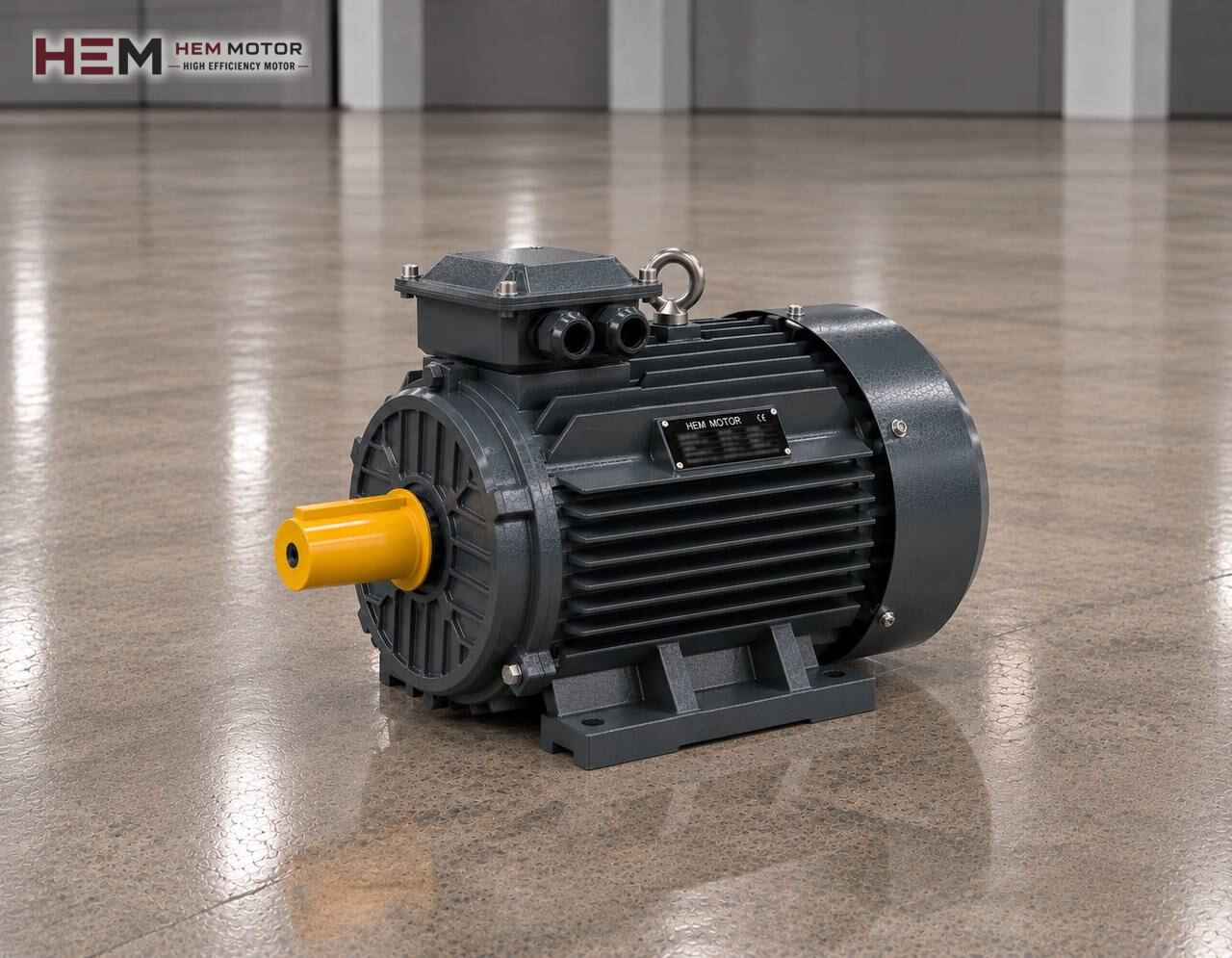
A booster set (hydrophore) delivers water to the tap at the required pressure in a building or plant where mains pressure is not enough: one or more pumps, a pressure vessel, a pressure switch or sensor and a control panel work together. This page deals with the electric motor that turns each pump in the set; for a summary of all pump types, go back to our Pump Electric Motors page.

What Does the Motor Go Through in a Booster Set During the Day?
Think of an apartment block in the morning: showers, washing machines and kitchens all draw water at the same time. Pressure drops and the panel starts the first pump; if consumption keeps rising, the second pump comes in. In the afternoon demand falls and the pumps stop one by one. At night only a few taps are opened and these small draws are covered by the water in the pressure vessel; as the vessel empties, a pump runs briefly and stops again.
The motor's load is therefore neither continuous nor entirely intermittent; it starts and stops dozens of times a day. This is the most important difference between a booster motor and an industrial pump motor that runs at the same point for hours on a single-stage pump: what matters is not just power but the number of starts per hour.
Pressure Vessel, Switch Setting and Number of Starts
The membrane vessel works as a buffer that leaves pressurised water in the line after the pump stops. If the vessel is too small or its pre-charge pressure is set wrongly, the pump starts with every small draw; the motor starts again and again at short intervals, and at each start the winding heats up with a current several times the rated value. If a new start comes before this heat has dissipated, the winding insulation wears over time.
In booster motors that trip often or burn out early, these are the first things to check:
- Is the vessel membrane intact, and is the pre-charge slightly below the pump's cut-in pressure?
- Has the gap between the switch's cut-in and cut-out pressures been set too narrow?
- Is there a cistern or valve in the installation that leaks continuously?
These problems are not solved by replacing the motor; if the set is not corrected, the new motor will face the same load. In sets with a high number of starts per hour, a PTC winding sensor can be added as an order option and reports the winding temperature to the panel.
Duty Rotation and Standby Pump in Multi-Pump Sets
In sets with two to six pumps, the panel changes the lead pump at each cycle. Operating hours and number of starts are thus shared between the motors; no single motor carries the whole load and wears out early. In most sets one pump waits as standby and comes in automatically in case of a fault.
An important detail in motor selection: the reference is not the installed power of the set but the nameplate of a single pump. In a four-pump set, a burnt motor is replaced by one motor with the same power, speed and flange as the other three. Having motors of the same frame and design in the set makes it easier to keep a spare and to replace them.
Inverter-Driven Booster Sets for Constant Pressure
In conventional sets the pump either runs at full speed or stops. In inverter sets the pressure sensor continuously informs the panel and the drive adjusts motor speed to demand; pressure at the taps is kept steady without fluctuation, starts become softer and the number of starts falls noticeably.
Our three-phase series can be operated with a frequency inverter. With a pump load, torque decreases as speed falls, so motor cooling is usually sufficient; however, if the drive is in a panel far from the motor or the set is left at very low frequency for long periods, let us discuss filters and an external fan at the quotation stage. For details, see the inverter-compatible motors page. To stop the pump completely at night when demand is low, the drive has a sleep function; this setting is the panel manufacturer's job.
The Motor on Top of a Vertical Pump and the Pump Room
In building booster sets the pumps are mostly vertical multistage types; the motor sits on top of the pump on a flange with the shaft pointing down, and its speed is in the 2-pole class. Small domestic boosters also use horizontal pumps and monobloc designs. In the vertical layout the motor runs in the V1 position; the flange type and shaft size are confirmed at the order stage by comparing them with the pump lantern. The flange-mounted electric motors page guides you through the flange options.
Booster rooms are usually in basements: damp, poorly ventilated and sometimes shared with the water tank. Our motors come with IP55 protection and Class F insulation; IP55 protects against splashing water but is not designed for flooding or for water dripping continuously onto the motor. In rooms where the walls sweat, an anti-condensation heater is an order option. Dry-running protection, that is stopping the pump when water runs out, is the job of the set and its panel; the motor does not detect it by itself.
For small domestic boosters without a three-phase supply, our single-phase electric motor series in the 0.18–5.5 kW range can be considered.
Example Motors by Set Type
| Booster set | Motor position | Key issue | Example HEM model |
|---|---|---|---|
| Small single-pump building set | On top of the pump, vertical | Vessel volume, number of starts | 0.75 kW 80M1-2 (2,880 rpm) |
| Two-pump set for an apartment block | On top of the pump, vertical | Duty rotation, spare motor | 2.2 kW 90L-2 (2,895 rpm) |
| Inverter set for a hotel or hospital | On top of the pump, vertical | Constant pressure, drive cable | 5.5 kW 132S1-2 (2,930 rpm) |
| Industrial plant water line set | On top of the pump or on a horizontal baseplate | Continuous demand, basement humidity | 11 kW 160M1-2 cast iron (2,945 rpm) |
The examples are for guidance only; the final choice is made according to the power on the pump nameplate, the required speed, the mounting arrangement and the conditions in the pump room.
Information for Ordering a Booster Motor
To find the right motor, it is enough to tell us the brand of the set and the pump type, the motor power and speed per pump, the supply voltage, the mounting (vertical flange or foot-mounted), whether it is inverter-driven, and how many motors are needed. Stating which machine the motor belongs to and adding a photo of the old motor's nameplate makes matching easier.
You can see prices on the model cards in our shop, and write to us by WhatsApp or phone to plan spare motors.
Frequently Asked Questions
Why does the booster motor keep switching on and off?
Usually the vessel membrane has burst, the pre-charge is wrong or there is a leak in the installation. Check the vessel and the switch setting before the motor.
Which power should I choose for a single burnt motor in a three-pump set?
Use the power, speed and flange on the nameplates of the other pumps. The total power of the set has no meaning for motor selection.
Do I need to replace the motor to convert an old booster set to inverter control?
If the existing three-phase motor is sound, usually not; a drive and a pressure sensor are added. If the motor is being replaced, state in the order that it will run on an inverter.
Is the motor protected if the booster room floods?
No. IP55 protects against splashing water and is not designed for operation under water. Drainage of the pump room and a level alarm should be part of the installation.