English
 Français
 Türkçe
 Español
 Русский
 العربية

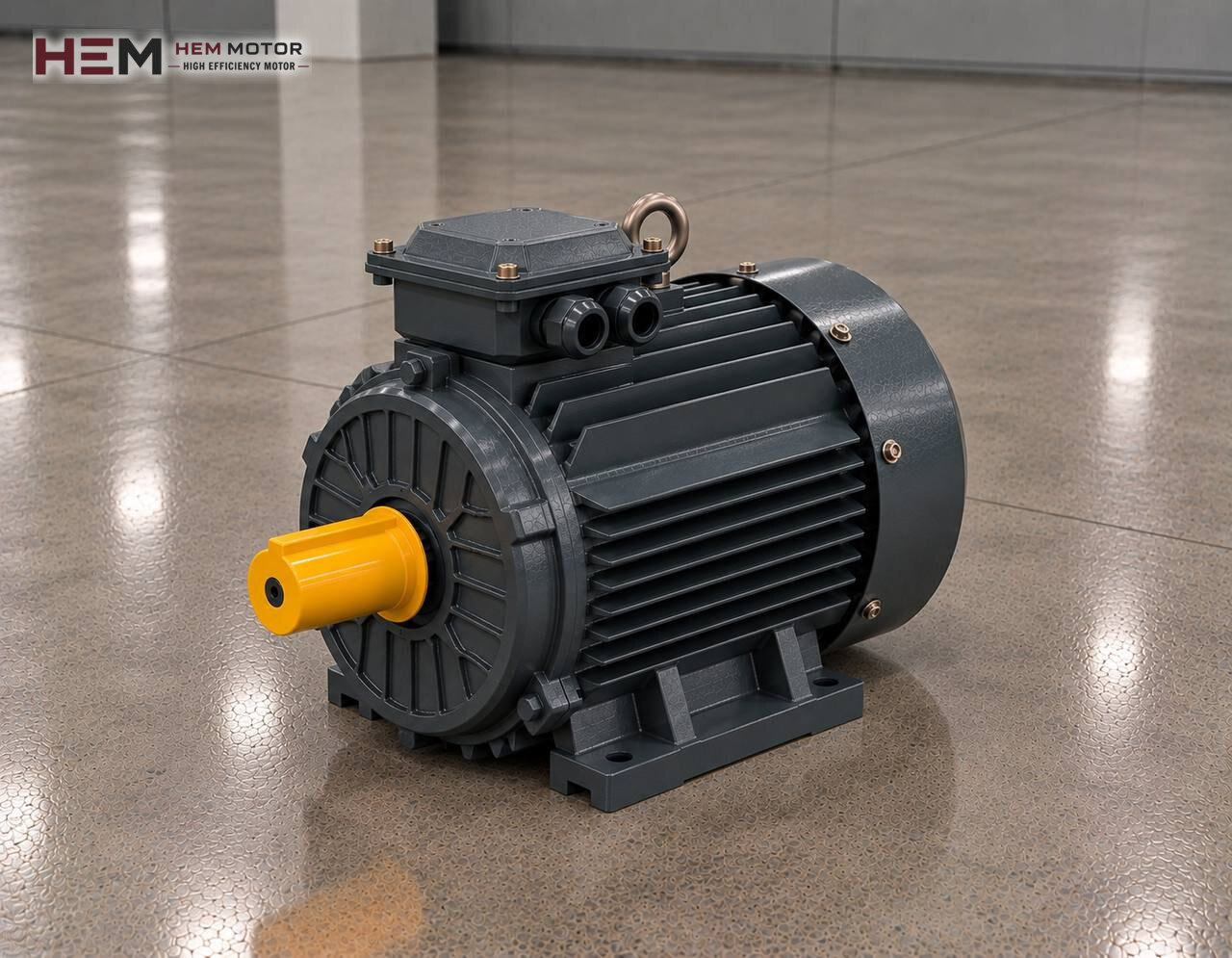
In field, orchard and greenhouse irrigation, the pump that lifts water from a canal, pond or tank and pushes it into the pipes is usually driven by a three-phase asynchronous motor. This page is about that motor: the different work that sprinkler and drip irrigation put on it, the idle months that come with seasonal use, weak rural supply lines and protection in open fields. For the general overview of other pump types, see our Pump Electric Motors page.

What Does an Irrigation Pump Expect from the Motor?
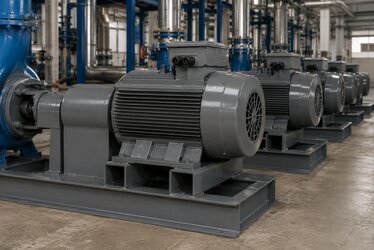
During the season an irrigation pump runs for many hours a day, often around the clock; then it stands still for months. For the motor this means a short, intense period of continuous duty followed by a long period of waiting. In the field the pump set is usually a simple arrangement on a base frame, where a horizontal centrifugal pump and the motor are joined by a coupling; smaller farms often use close-coupled sets where motor and pump share one shaft.
When water is taken from the surface, the pump works on suction: a foot valve sits at the end of the suction pipe and the pump is filled with water before the first start. If the pump turns with air inside, the motor draws a low current and the problem may go unnoticed; this damages the pump's packing and seals. Irrigation water drawn from a well needs a different layout; well pumps driven by a motor standing at the surface are covered on the deep well pump motor page.
Load Differences in Sprinkler, Drip and Flood Irrigation
In sprinkler irrigation the line needs high pressure so that the heads can throw water far. In most installations the pump turns with a two-pole motor, i.e. one running at roughly three thousand revolutions per minute, and the delivery head is large. If a travelling hose-reel machine or a rain-gun system is used in the field, the power drawn changes little during the season.
In drip irrigation the flow is split plot by plot. As valves open and close in sequence, the pump's operating point shifts: with few plots open the pressure rises and the flow falls. As the filter group clogs, resistance increases. In these systems, adjusting motor speed with a frequency inverter to keep pressure constant is a frequently chosen route.
In flood (surface) irrigation and in transferring water from a pond to a canal, pressure is low and flow is high. Large-diameter, slow-turning pumps can also work with a four-pole motor. The pump's own curve tells which speed is right; choose the motor according to the speed on the pump nameplate.
Rural Lines, Long Cables and Starting
Irrigation motors often run far from the transformer. A long, thin cable lowers the voltage at the moment of starting; since motor torque falls with the square of the voltage, the pump accelerates slowly, the current stays high for a long time and the protection may trip. Sizing the cable cross-section for the length of the line comes before choosing the motor.
A centrifugal pump needs little torque at low speed, so it starts easily; this allows low-current starting methods. In our catalogue the winding of models from 4 kW upwards is rated 400/690 V (Δ/Y); these motors run in delta on a 400 V supply and are therefore suitable for star-delta starting. At smaller outputs the rating is 230/400 V, so on a 400 V line the motor is already connected in star and this method cannot be used. Soft starters and inverters are also options; if an inverter is used, our three-phase series are suitable for it: if the motor will run for long hours at low speed under full load, a separate cooling fan is considered, and if the cable between drive and motor is long, a dv/dt or sine filter; please state these in your order. For details see inverter compatible electric motors.
For small pumps in vineyards, gardens and greenhouses without a three-phase line, our single-phase electric motor series (0.18–5.5 kW) can be considered.
Protecting the Motor in Open Fields
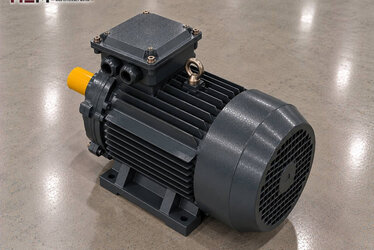
The enclosure protection class is IP55; this class protects against dust and splashing water. The motor is not designed to run in a flooded pit, submerged, or where a sprinkler head sprays it directly. A simple ventilated shelter over the pump set protects the frame from the sun in summer and from rain in winter. If the area in front of the fan cover gets blocked by grass or straw, the motor heats up; check this during the season.
Phase loss and voltage imbalance are common in farming areas. That is why setting the overcurrent protection device to the current on the motor nameplate matters; for selection see our article motor protection: thermal relay and fuse. PTC or PT100 winding sensors and an anti-condensation heater are order options.
End of Season: Preparing the Motor for Winter
The period when an irrigation motor wears most is often the months when it does not run. On cold nights, moisture condensing inside the frame weakens the winding insulation; in a bearing that never turns, the grease collects at one point. If possible, move the motor to a dry store, turn the shaft by hand from time to time and have the winding insulation measured before the first start of the new season. Practical steps on this are collected in the article keeping a spare motor on the shelf.
The pump must be drained too: if water left in the casing freezes, the pump casing cracks. Checking the coupling rubbers and base bolts at the same time reduces the chance of meeting an alignment fault in spring. On base-mounted sets a foot-mounted B3 motor is common; flange B5 and B14, foot-and-flange B34 and B35 and vertical V1/V3/V5/V6/V15 arrangements are also offered depending on the frame. We compare the flange and shaft dimensions with your pump when you order.
Example Motors by Irrigation Layout
| Irrigation layout | How the pump works | What to check when choosing the motor | Example HEM model |
|---|---|---|---|
| Drip irrigation in greenhouse and garden | Low flow, filter resistance, plot changes | Pressure control, supply type | 2.2 kW cast iron, 90L-2 |
| Field sprinkler line | High pressure, continuous over the season | Delivery head, cable length | 11 kW cast iron, 160M1-2 |
| Transfer from pond to canal | High flow, low pressure | Pump speed, suction lift | 22 kW cast iron, 180L-4 |
| Shared irrigation station | Variable demand, long running hours | Starting method, supply capacity | 30 kW cast iron, 200L1-2 |
The models in the table are examples; the final choice depends on the pump load, required speed, mounting and operating conditions. The power and speed written on your pump's nameplate are the most reliable starting point.
Information Needed for an Irrigation Motor Request
Write to us with the machine or pump type (horizontal centrifugal, close-coupled, multistage), motor power (kW), speed (rpm), supply voltage, mounting arrangement and how many units you need. The distance of the line from the transformer and the starting method also affect the choice. Sending a photo of the old motor's nameplate may be enough; how to do it is explained in the article send the motor nameplate.
Current prices of the models are shown on the buy electric motors page. To reach us by WhatsApp or phone, use our contact page. For drives other than pumps in agriculture, see our agricultural machinery electric motors page as well.
Frequently Asked Questions
Can my irrigation pump switch from a tractor PTO to an electric motor?
Often yes; but if the speed the pump receives from the PTO differs from the motor speed, the pulley ratio or the pump selection has to be reworked. Send us the speed and power the pump requires.
What speed of motor should I buy for a sprinkler pump?
Sprinkler pumps that need high pressure usually run with a two-pole motor at around 2,900 rpm. The final decision follows the speed on the pump nameplate; a motor with a different speed changes the pump's delivery head.
Why does the motor keep tripping the overload in mid-season?
The most common causes are voltage drop from a long cable, one weak phase, a blocked fan cover and an operating point shifted by a dirty filter. Measure these before moving to a bigger motor.
Can I leave the motor in the field over winter?
If it stays, it should stand under a covered, ventilated shelter and should not be started in the new season before the winding insulation is measured. During long idle periods the anti-condensation heater option reduces moisture.