English
 Français
 Türkçe
 Español
 Русский

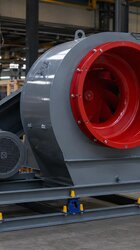
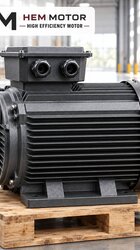

Picture two motors fed from the same switchroom at a wastewater treatment plant. One drives an aeration blower at around 3000 rpm; the other turns the bridge of a clarifier so slowly that a single revolution takes minutes. The first is all about energy and heat, the second about high torque at very low speed, out in the weather. What makes motor selection difficult in a treatment plant is not one heavy application but the sheer variety of duties running side by side, in the same damp, gassy atmosphere, around the clock.
It helps to read the plant not as a motor list but as the route the water and sludge follow. Below we walk from the inlet works to sludge dewatering, looking at what each stage needs from its motors, what tends to go wrong and what an order should specify.
Inlet works: screens and lift pumps
Sewage usually enters through a lift station, where coarse and fine screens remove solids and pumps lift the flow to the level that feeds the rest of the plant. Screen rakes are small geared drives that run intermittently. Their real problems are water, splashing and jamming: when a rake catches on a stone or a mass of rags, the motor stalls and protection must take it off line quickly.
Lift pumps follow the daily flow pattern. Morning and evening peaks can be several times the night flow, so either several pumps cut in and out in stages or an inverter varies their speed. Centrifugal pumps in a dry well can use standard three-phase induction motors; submersible pumps in a wet well have integral motors supplied by the pump maker.
A common failure at lift stations is a pump running dry or at very low flow because the suction is blocked. Motor current drops, and the thermal overload never notices. An undercurrent function catches it; our article on motor protection relay functions explains how it is set.
Aeration: where the energy goes
In biological treatment, the blowers that supply oxygen are usually the largest single energy consumer. Side channel blowers are typically driven by 2-pole motors, while rotary lobe blowers often run through belts from 2- or 4-pole motors. Selection by blower type is covered in our blower motor selection article; here we focus on points specific to treatment.
Oxygen demand in the basin changes through the day. An inverter controlled by a dissolved oxygen sensor slows the blower when less air is needed and cuts consumption. Unlike centrifugal fans, positive displacement blowers still need roughly constant torque at reduced speed. If the motor will spend long periods at low speed, its shaft-mounted fan may not cool it adequately and a separate fan may be required, which should be raised at the order stage.
Because aeration blowers run most of the year, efficiency class feeds straight into operating cost. At 37 kW, 4-pole, the minimum efficiencies are 93.9% for IE3, 95.2% for IE4 and 96.1% for IE5. Over the life of a blower running year-round, a few points can easily outweigh the difference in purchase price. Blower houses are usually enclosed and warm. HEM Motor ratings apply up to +40 °C ambient, a limit a poorly ventilated blower room can exceed in summer. Either improve ventilation or select the motor with derating or one size up.
Clarifiers and scrapers: slow but relentless
Rotating or travelling bridges in primary and final clarifiers gather settled sludge. The drive motor is small but the output speed is extremely low, so a high-ratio gearbox or multi-stage gearing is used. The bridge drive sits outdoors, where rain, snow, sun and frost are everyday conditions.
Two problems recur. A motor standing idle outdoors collects condensation and, after a winter, its insulation resistance may have fallen; an anti-condensation heater and a terminal box facing the right way make a real difference. And when ice forms on the basin surface, the bridge is forced; without a torque limiter or overload protection, that load goes straight into the gearbox and motor.
Sludge lines and the digester: meeting the gas zone
Sludge pumps are mostly positive displacement types, such as progressive cavity or lobe pumps, which need high starting torque and keep demanding torque at low speed, unlike a centrifugal pump. If an inverter controls their speed, the motor must deliver constant torque at low speed without overheating.
The anaerobic digester is where biogas is produced. Mixers and sludge recirculation pumps run continuously. Some in-tank mixers are submersible units with the mixer maker's own motor; top-entry mixers carry their motor and gearbox on the tank roof. The roof, gas dome, gas pipework, gas storage and the area around the CHP unit may be classified as explosive atmosphere zones because of methane.
Here clarity matters. Zoning is set by the plant's explosion protection document, and only certified Ex motors suitable for that zone may be used there. A standard motor cannot be used in an Ex zone, however high its IP rating. HEM Motor's 2026 catalogue does not include Ex certified motors, so those duties need a manufacturer of certified equipment. The general logic of zoning is set out in our article on when an explosion-proof motor is required. Everything outside the zones, from lift pumps and aeration to clarifiers and dewatering, uses standard industrial motors.