On a diamond wire saw, the main motor sets the cutting speed of the wire by turning the drive wheel. That is why three questions are answered together when choosing the motor: how is the wheel attached to the motor shaft, how will the machine start with a tensioned wire, and how will the wire speed be adjusted? This article covers the single-wire cutting machines used in marble quarries and for block cutting; the main drives of multi-wire block cutting lines are assessed separately.
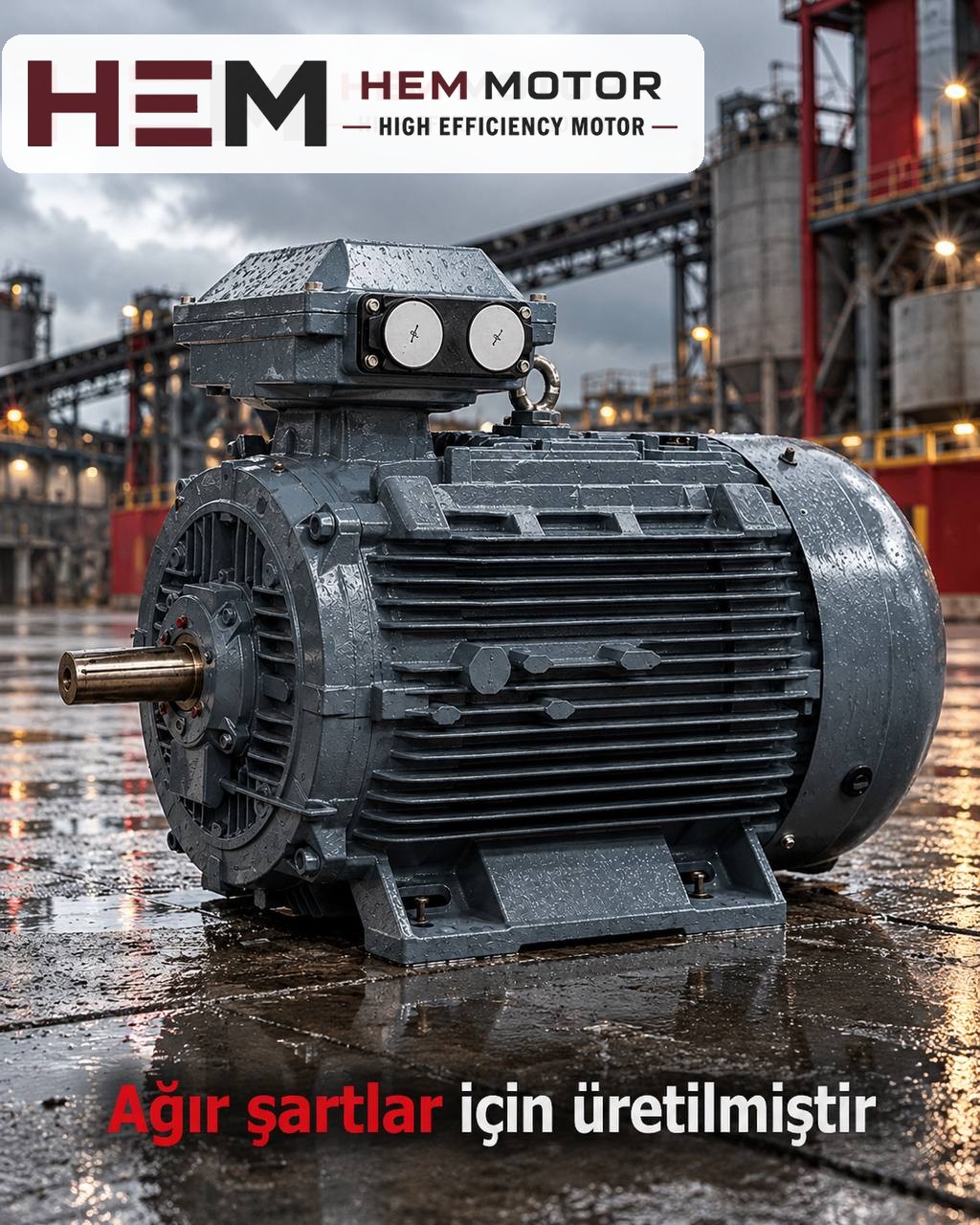
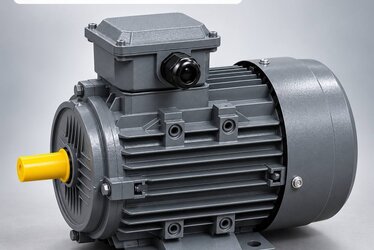
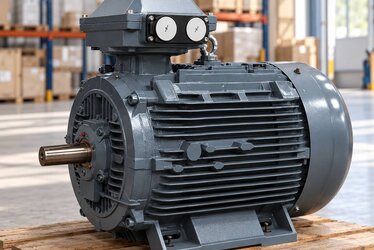
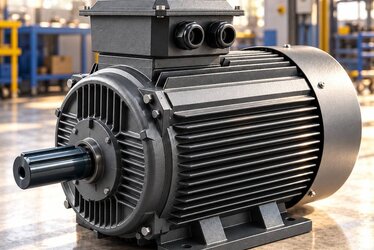
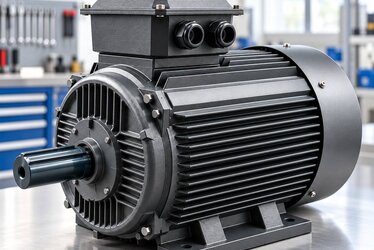
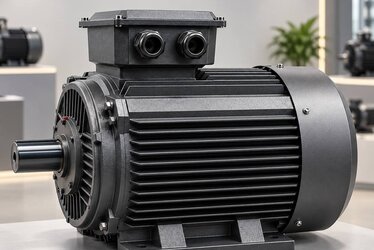
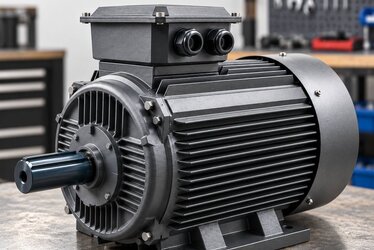
In quarries and block cutting yards the motor works alongside water, slurry and dust (representative image).
The drive train of a wire saw
A single-wire saw consists of the main drive motor, a large-diameter drive wheel (flywheel), the diamond-beaded wire, the guide pulleys the wire runs over and the travel system that pulls the machine back along a rail. The main motor turns the wheel and the wheel pulls the wire. As the cut progresses, the machine moves back along the rail to keep the wire tensioned.
The connection between the main motor and the wheel varies from machine to machine:
Wheel directly on the motor shaft: The wheel is fitted on the motor shaft. This is the simplest arrangement, but the weight of the wheel and the pull of the wire act directly on the motor bearings.
Separately supported wheel shaft: The wheel runs in its own bearings and the motor is connected to this shaft by a coupling or belt. Less radial load acts on the motor shaft.
Reduction by gearbox or belt: If the wheel speed is lower than the motor speed, there is a belt stage or gearbox in between.
Before replacement, it is necessary to identify which arrangement is used, because this makes the biggest difference in motor selection.
If the drive wheel sits on the motor shaft
In arrangements where the wheel is fitted directly on the motor shaft, the motor carries much more radial load than in an ordinary coupled drive. The weight of the wheel, the wire tension and how far out the wheel sits on the shaft end determine the load on the front bearing. The shaft and bearings of a standard motor are designed for ordinary belt and coupling loads in IEC dimensions.
For this reason, a standard motor is not recommended in this arrangement without the following checks:
Are the shaft diameter and length of the old motor the same as a standard IEC shaft end, or is it an extended or thicker shaft specific to the machine manufacturer?
Is there a roller bearing or an additional bearing at the front instead of a standard bearing?
Is the wheel hub attached to the shaft with a key, a clamping ring or a taper bush?
If the shaft or bearing is special, this duty requires a special motor; it may fall outside the scope of the standard series in HEM Motor's 2026 catalogue, so ask us with the nameplate and application details. If the wheel is on a separately supported shaft and the motor is connected by a coupling, standard cast iron motors can be considered; in that case the connection dimensions are compared with the technical drawing.
Wire speed: wheel diameter and motor speed
Wire speed is the circumference of the drive wheel multiplied by the wheel speed: wire speed (m/s) = π × wheel diameter (m) × wheel speed (rpm) ÷ 60. Wire speed directly affects the life of the diamond beads and cutting efficiency; the correct value is set by the wire manufacturer's recommendation and the type of stone being cut.
A hypothetical example
The values are only meant to show the method. Let the wheel diameter be 800 mm and the wheel speed 750 rpm: wire speed ≈ 3.14 × 0.8 × 750 ÷ 60 ≈ 31 m/s. If the same wheel turned directly at the roughly 1,485 rpm rated speed of a 4-pole motor, the wire speed would roughly double. This example shows how decisive motor speed is on machines where the wheel is directly on the motor shaft: if the number of poles changes, the wire speed changes radically too.
So the first rule is again to keep the number of poles of the old motor. If the machine runs on a drive, the wire speed is set from the drive; even then, the motor's rated speed is the base value from which the drive settings are calculated.
Starting: first movement with a tensioned wire
Starting on a wire saw differs from an ordinary fan or pump. The wire is in contact with the stone inside the cut and is under tension; the heavy wheel also has inertia. A sudden start strains the wire, can shift the beads and increases the risk of breakage. If the wire is jammed in the cut, the starting torque rises further.
Direct-on-line starting: The starting shock is the highest; it is usually not preferred for the wire and the wheel.
Star-delta: It reduces starting current but also torque; with a tensioned wire prone to jamming, the motor may not start with enough torque.
Soft starter: It ramps the start; current and shock are reduced, but low starting torque can still be limiting.
Frequency inverter: It adjusts wire speed steplessly and provides a controlled ramp. It is the most common solution on wire saws.
Which method is used depends on the machine manufacturer's panel design. The nameplate voltage of the new motor is chosen to suit the method used on the old machine; for star-delta on a 400 V supply, a motor rated 400/690 V (Δ/Y) is required.
Prices and technical data are on the product pages; choose a model and order online.
Our three-phase series are suitable for speed control with a frequency inverter; for long periods at low speed with full torque an external fan may be needed, and if the cable between drive and motor is long a dv/dt or sine filter is considered; these conditions are stated with the order. For details, see the question on inverter use.
Both conditions are common on wire saw sites. When wire speed is reduced for hard stone and the machine runs that way for a long time, the motor's own fan may not be enough for cooling. In a quarry the cable between the panel and the machine is also often long, and the cable distance changes as the machine moves along the rail. Stating this information in the order allows the right additional measure to be planned from the start.
The travel motion of the machine along the rail is provided by a separate small motor, usually a geared drive, or by a hydraulic system. This travel drive is assessed separately from the main motor.
You can browse suitable HEM Motor models and current prices in the buy electric motors section.
Quarry environment: water, slurry and sun
The diamond wire is cooled with water; during cutting, slurry — a mix of stone dust and water — splashes around. The machine often works outdoors, in the sun or in the rain. HEM Motor models have IP55 protection and class F insulation; this rating protects against dust and water splashes, but it is not suitable for the motor to be exposed to a continuous water jet or to sit in slurry.
Use a shield or cover that protects the motor from direct water and slurry splashes; the shield must not block the fan's air intake.
Regularly clean stone slurry from the fan cover grille; a clogged grille heats the motor.
State conditions such as ambient temperature and altitude in the order.
Keep the terminal box cover gasket and cable entry tight; moisture enters mostly here.
A cast iron frame stands out on these sites, where shocks and vibration occur, thanks to its rigid structure. General information on mining and quarry applications is on the mining sector electric motor page.
Example models for wire saws
On single-wire quarry machines the main motor power varies with the size of the machine and its cutting capacity; the exact value is taken from the machine nameplate. The 4-pole cast iron models below are examples. All are 400/690 V (Δ/Y), 50 Hz, IP55 with class F insulation:
225S and 225M have the same shaft height but different frame lengths and foot spacings; when moving from 37 kW to 45 kW, base compatibility must be checked. 250M is a larger frame. You can compare the dimensions in the 2D technical drawings. Current prices are on the product pages.
Conclusion and information before ordering
When replacing the motor of a wire saw, first clarify whether the wheel is attached to the motor shaft or to a separate shaft. Then the number of poles is kept and the starting and speed control method is matched to the old panel. For a quotation, send us:
A photo of the old motor's nameplate and the machine make/model
A photo of the wheel connection (shaft end, wheel hub, any additional bearing)
Starting method or drive details, and the panel-to-motor cable length
Operating environment: open quarry, enclosed plant, water and slurry conditions
You can see suitable models and current prices in our online sales section. Send the nameplate photo, speed and mounting details of your current motor through the nameplate submission page and request a quotation for the right model.
Frequently Asked Questions
Can I lower the wire speed by fitting a 6-pole motor to the wire saw?
The wire speed drops, but the motor's frame, shaft end and torque also change; wheel and base compatibility may be lost. If speed adjustment is needed, running on a drive or changing the pulley ratio is usually a better route.
Can a standard motor be used if the wheel is fitted directly on the motor shaft?
It can be considered if the shaft size and bearing arrangement are the same as a standard IEC shaft end and the wheel load suits that shaft. If the shaft is extended or has an additional bearing, a special motor is needed; contact us with the nameplate and photos.
Why does the motor struggle when starting with a tensioned wire?
The wire rubs against the stone inside the cut, and the inertia of the heavy wheel must be overcome. If the wire is jammed, the required torque rises further; that is why methods providing a controlled ramp are preferred.
Is an IP55 motor sufficient in a quarry?
IP55 protects against dust and water splashes. A continuous water jet or being buried in slurry is beyond this rating; the motor should be protected with a shield and the fan grille kept clean.
HEM Motor Models Related to This Article
The cards show example models related to the topic. A suitable motor is not chosen by power alone: compare speed, voltage, mounting, shaft and connection dimensions on the product page; if unsure, send a photo of the existing motor’s nameplate on WhatsApp.
On a textile winding machine, what determines the motor choice is how the load changes as the roll grows. If fabric is wound at constant speed and constant tension, when the roll d... More Details
When choosing the turntable motor of a pallet stretch wrapper, the real compatibility is between the motor and the gearbox: the motor speed and the gearbox ratio determine the tabl... More Details
When replacing the motor on a pillar drill, the easiest route is to choose a motor with the same power, the same number of poles and the same shaft diameter as the old one and to m... More Details
The main motor of a universal lathe is chosen to match the power and speed on the lathe's nameplate, preferably with the same number of poles and the same mounting arrangement. All... More Details
When you replace the motor on a metal band saw, the way to keep the blade speed unchanged is to choose the new motor with the same number of poles (usually 4 poles, the 1,500 rpm c... More Details
A single fixed speed is not enough on a wood lathe: a large-diameter bowl blank must turn slowly, while a thin pen or spindle job must turn fast. This wide speed range used to be o... More Details
We use necessary and optional cookies to improve your experience, enhance content and analyse traffic. Under the GDPR, optional (analytics/marketing) cookies are only used with your explicit consent. Please choose your preference below.
Cookie Policy
 English
 Français
 Türkçe
 Español
 Русский