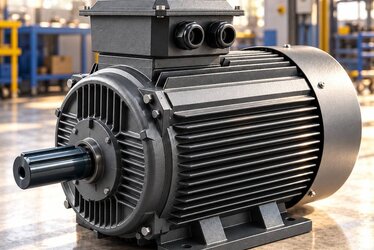
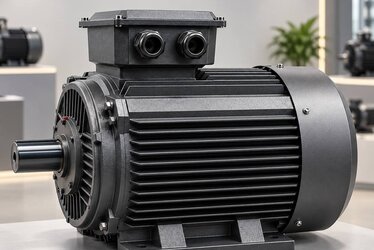
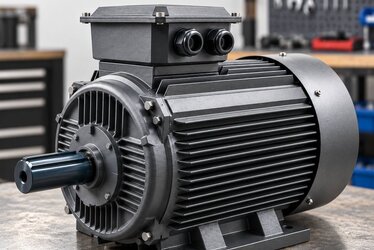
The main motor of a universal lathe is chosen to match the power and speed on the lathe's nameplate, preferably with the same number of poles and the same mounting arrangement. All spindle speed steps of the lathe are calculated in the gearbox on the basis of the motor's fixed speed; if the motor speed changes, the lathe's speed table becomes invalid. After power, the points that need most attention are frequent starts when reversing, the braking method and how the motor is attached to the machine body.
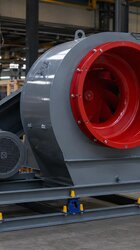
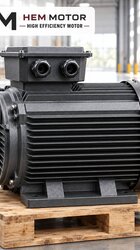
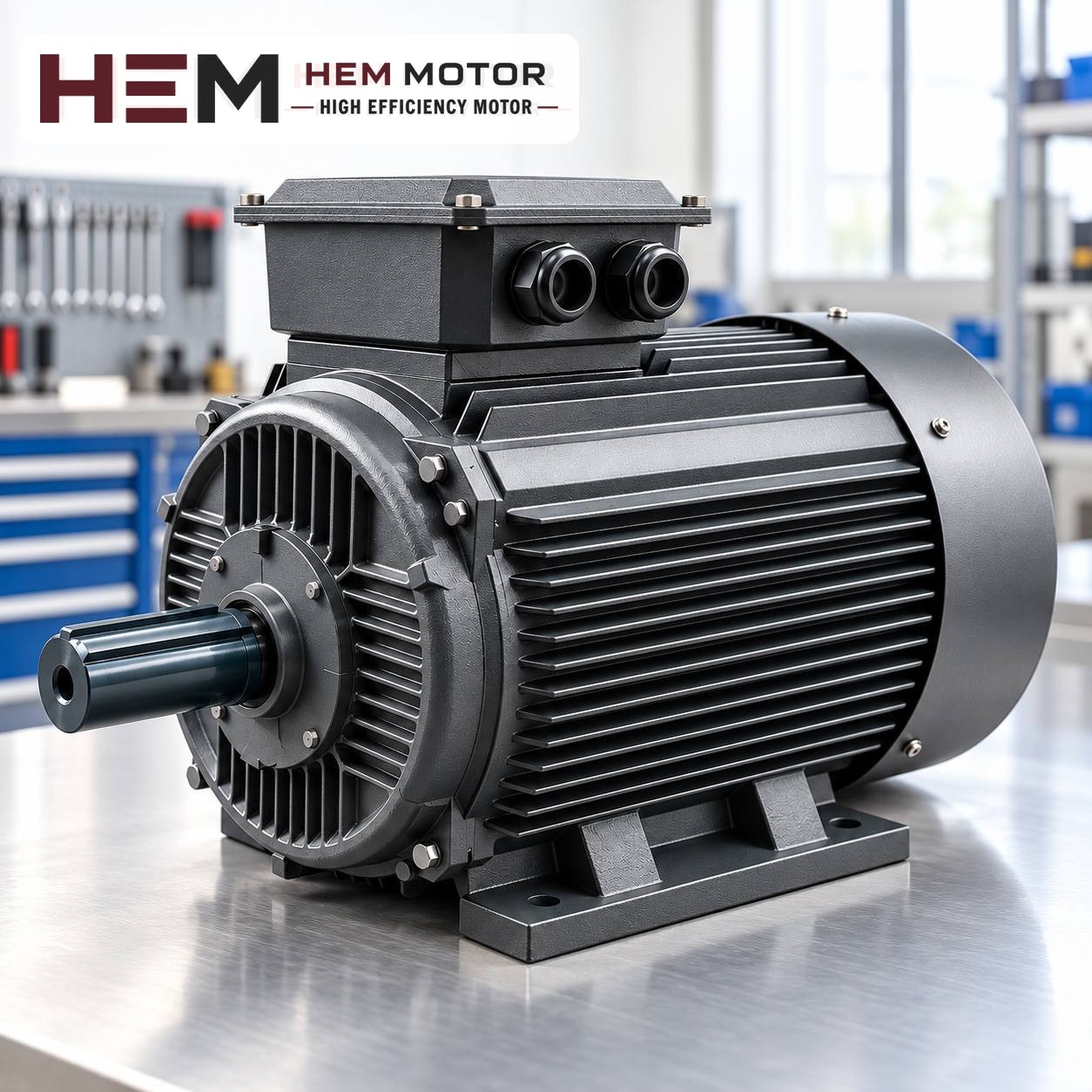
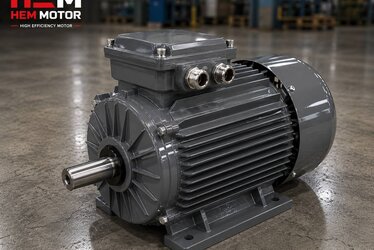
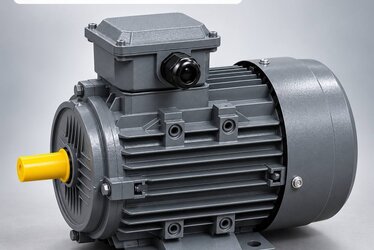
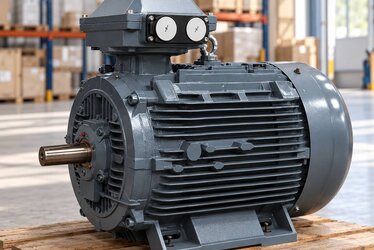
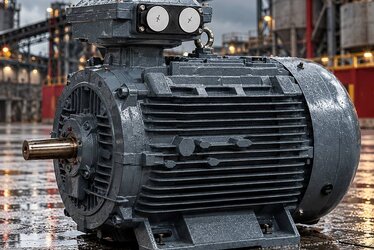
The main lathe motor usually sits in a compartment in the lathe stand and drives the headstock spindle by belt (representative image).
What does the main motor do on a lathe?
On a universal lathe the main motor usually runs at a fixed speed. The different spindle speeds are selected with gears and levers in the headstock. Power is mostly transmitted from the motor to the headstock by V-belt; the motor sits in a compartment in the stand or at the back of the lathe, on a plate that allows the belt tension to be adjusted.
The main motor does not only turn the spindle. On many lathes the feed motion and thread cutting are also taken from the same motor, through the headstock and the feed box. Rapid carriage traverse, the coolant pump and, on some lathes, the lubrication pump run on separate small motors. This article focuses on the main motor.
What determines the power, and should the main motor be upsized?
The power of a lathe's main motor is set by the manufacturer according to the largest chip cross-section the machine was designed for, the material being machined and the workpiece diameter. That is why the most reliable source is the lathe's own nameplate or operating manual. It is not right to state an exact power from the size of the lathe; two lathes of the same class may come with motors of different power.
Fitting a more powerful motor may seem attractive, but the lathe's belts, headstock gears, clutch and bearings are sized for the original power. A larger motor exposes these parts to higher torque; under heavy cuts the belt slips or the gears are overloaded. A larger frame may also not fit into the motor compartment. In short, increasing power only makes sense within the limit allowed by the lathe manufacturer.
What to check on the lathe
Why it matters
Motor nameplate (kW, rpm, voltage, frame code)
The basis for matching the new motor's power, speed and frame
Speed table on the headstock
The spindle speeds in the table are calculated from the motor speed
Belt type and motor pulley
The pulley hub must fit the new motor's shaft
Inside dimensions of the motor compartment
A longer or taller frame may not fit
Control diagram (forward/reverse, brake)
Shows how the motor operates and whether a special motor is needed
Speed and number of poles: keeping the speed table valid
The speed plate on the headstock is prepared for, say, the roughly 1,450 rpm rated speed of a 4-pole motor. If a 2-pole motor is fitted instead, all spindle speeds roughly double; the values on the plate become invalid and at the higher steps the headstock runs above its design speed. This is unacceptable for both safety and gear life.
So the first rule is to keep the number of poles of the old motor. The nameplate shows the rated speed (e.g. 1,440 rpm); this value corresponds to the 4-pole, 1,500 rpm synchronous class. Differences of a few rpm in rated speed do not change spindle speed noticeably.
A motor whose nameplate shows two speeds
On some lathes the motor has two speeds; a switch on the headstock doubles the number of speed steps. On the nameplate you will see two powers and two speeds (e.g. 4/2 poles). These motors have a different winding and connection and cannot be replaced one-to-one by a standard single-speed motor. This duty requires a special motor; it may fall outside the scope of the standard series in HEM Motor's 2026 catalogue, so ask us with the nameplate and application details.
Forward/reverse, frequent starts and braking
The lathe is one of the workshop machines where motor load changes the most. When cutting threads, boring or measuring a part, the operator stops, starts and reverses the spindle frequently. Depending on the lathe design, this is done in one of two ways:
Lathe with a mechanical clutch: The motor always runs in the same direction; the clutch and brake in the headstock control spindle direction and stopping. This is the easiest arrangement for the motor; there are few starts.
Lathe that reverses electrically: The motor direction is changed with forward and reverse contactors. Every reversal is a separate start and builds up heat in the winding. The thermal relay must be set to the nameplate current, and the protection setting should be chosen with the starting frequency in mind.
Braking matters too. On some lathes the spindle is stopped by plugging (briefly reversing the motor) or by DC injection; these are handled on the drive or control side and expose the motor to extra heat. On lathes with a mechanical brake at the back of the motor, a brake motor is required; this is not within the standard series either and is assessed separately with the nameplate.
The most common arrangement on lathes is B3, where the motor sits on its feet on a hinged or slotted plate that is used to adjust belt tension. On some lathes the motor can also be flange-mounted to the headstock. When replacing it, check the following:
Frame code: If the old and new motors have the same IEC frame code, the shaft height and foot holes usually match; mounting is possible without changing the plate.
Pulley: If the old pulley is to be fitted to the new motor, the shaft diameter and key size must be the same. Do not force the pulley onto a new shaft.
Belt alignment: The motor pulley and the headstock pulley must be in the same plane; otherwise the belt wears on its sides and vibration increases.
Cable entry and terminal box orientation: In a narrow motor compartment, the side on which the terminal box ends up makes wiring easier or harder.
Mounting arrangements are offered according to the frame; the flange size is confirmed with the order. For a dimensional comparison, see the 2D technical drawings by frame size.
Running the lathe with a drive
A common conversion on older lathes is to run the main motor with a frequency inverter to get speed adjustment between the gear steps. Our three-phase series are suitable for speed control with a frequency inverter; for long periods at low speed with full torque an external fan may be needed, and if the cable between drive and motor is long a dv/dt or sine filter is considered; these conditions are stated with the order.
For lathes specifically, remember this: taking heavy cuts on a large-diameter part at low speed means running the motor at high torque and low speed for a long time. In that case the fan on its own shaft may not cool it enough. The drive's braking resistor and stopping ramp must also be set separately so that the lathe stops safely. The question on inverter use gives the general framework.
You can browse suitable HEM Motor models and current prices in the buy electric motors section.
Example models for powers found on universal lathes
On workshop universal lathes the main motor power varies with the size of the machine; the exact value is taken from the lathe's nameplate. The 4-pole aluminium frame models below are given as examples. All have IP55 protection and class F insulation:
100L2-4: 3 kW, 4 poles, rated 1,450 rpm, IEC 100L, 230/400 V (Δ/Y), 6.02 A (400 V).
112M-4: 4 kW, 4 poles, rated 1,450 rpm, IEC 112M, 400/690 V (Δ/Y), 7.95 A (400 V).
132S-4: 5.5 kW, 4 poles, rated 1,460 rpm, IEC 132S, 400/690 V (Δ/Y), 10.7 A (400 V).
132M-4: 7.5 kW, 4 poles, rated 1,460 rpm, IEC 132M, 400/690 V (Δ/Y), 14.3 A (400 V).
Note that the 3 kW model is rated 230/400 V, while the models of 4 kW and above are rated 400/690 V. On a 400 V supply a 230/400 V motor is connected in star and a 400/690 V motor in delta. If the old lathe uses star-delta starting, the new motor's nameplate must read 400/690 V. Current prices are on the product pages.
Conclusion: what to send us for a lathe motor
The right choice for a lathe main motor is the same power, the same number of poles, the same frame that fits the motor compartment and a connection suited to the lathe's control method. Rather than upsizing the motor to make the lathe stronger, it is safer to assess the need using the manufacturer's data. For a quotation, prepare the following:
A photo of the old motor's nameplate and the lathe's make/model
How the motor is mounted (foot-mounted plate, flange) and pulley details
Control method: forward/reverse contactors or clutch, and whether there is a brake
Supply voltage and starting method
You can see suitable models and current prices in our online sales section. Send the nameplate photo, speed and mounting details of your current motor through the send motor nameplate page and request a quotation for the right model. For general industrial machines, you can also visit the general-purpose industrial motors page.
Frequently Asked Questions
Can I replace the lathe motor with a 2-pole motor?
Not recommended. If the lathe's speed table is prepared for a 4-pole motor, a 2-pole motor roughly doubles all spindle speeds and pushes the headstock above its design speed.
Will a more powerful motor let me take heavier cuts on the lathe?
Only to a limited extent. Since the belt, clutch and gears are designed for the original power, the real limit is usually the lathe itself; assess any power increase with the lathe manufacturer's data.
Why does the motor heat up on a lathe that reverses frequently?
Every reversal is a new start, and starting current generates heat in the winding. If the starting frequency is high, the thermal protection setting and the operating method should be assessed together.
Can a standard motor be fitted to a lathe with a brake at the back of the motor?
If the brake is part of the motor, a standard motor does not provide this function; a special brake motor is needed. Contact us with the nameplate and control details.
HEM Motor Models Related to This Article
The cards show example models related to the topic. A suitable motor is not chosen by power alone: compare speed, voltage, mounting, shaft and connection dimensions on the product page; if unsure, send a photo of the existing motor’s nameplate on WhatsApp.
On a textile winding machine, what determines the motor choice is how the load changes as the roll grows. If fabric is wound at constant speed and constant tension, when the roll d... More Details
When choosing the turntable motor of a pallet stretch wrapper, the real compatibility is between the motor and the gearbox: the motor speed and the gearbox ratio determine the tabl... More Details
On a diamond wire saw, the main motor sets the cutting speed of the wire by turning the drive wheel. That is why three questions are answered together when choosing the motor: how ... More Details
When replacing the motor on a pillar drill, the easiest route is to choose a motor with the same power, the same number of poles and the same shaft diameter as the old one and to m... More Details
When you replace the motor on a metal band saw, the way to keep the blade speed unchanged is to choose the new motor with the same number of poles (usually 4 poles, the 1,500 rpm c... More Details
A single fixed speed is not enough on a wood lathe: a large-diameter bowl blank must turn slowly, while a thin pen or spindle job must turn fast. This wide speed range used to be o... More Details
We use necessary and optional cookies to improve your experience, enhance content and analyse traffic. Under the GDPR, optional (analytics/marketing) cookies are only used with your explicit consent. Please choose your preference below.
Cookie Policy
 English
 Français
 Türkçe
 Español
 Русский