English
 Français
 Türkçe
 Español
 Русский

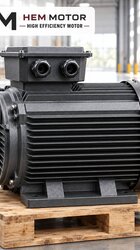
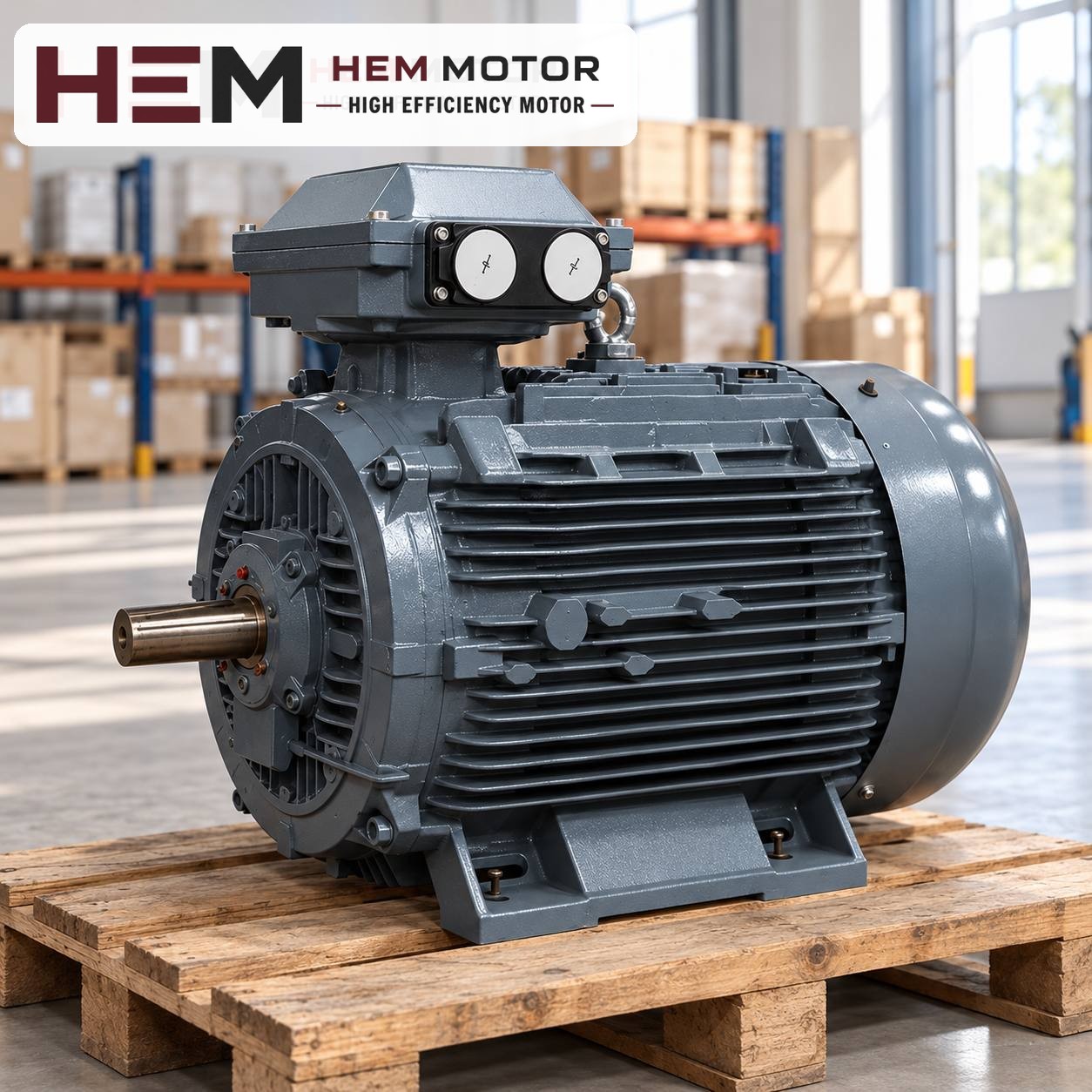

When choosing the turntable motor of a pallet stretch wrapper, the real compatibility is between the motor and the gearbox: the motor speed and the gearbox ratio determine the table speed, and the gearbox and chain carry the starting shock of the loaded pallet. That is why, when replacing, the number of poles, the gearbox input flange and the starting method must stay the same, as well as the power. A motor that is simply "more powerful" does not make the table turn without jolts.
This article deals with the table drive in semi-automatic and automatic turntable wrappers. The film carriage (up-down movement) and pre-stretch motors are separate drives; here we discuss only the motor that turns the table.
The turntable drive train
On a typical turntable, the motor is connected to a gearbox (worm or helical). The pinion on the gearbox output drives the ring gear or chain sprocket under the table; on some machines the table is turned by a friction wheel. The table sits on a large-diameter slewing bearing or on rollers.
- Motor: Usually a 4-pole, low-power three-phase motor, connected to the gearbox by a flange.
- Gearbox: Reduces the motor speed to the low speed required for the table and increases the torque.
- Final drive: Pinion and ring gear, or chain; there is a second reduction ratio here.
- Control: Usually a frequency inverter for soft start and stop; a position sensor so that the table stops at its home position.
Relationship between gearbox ratio and table speed
The table speed is found by dividing the motor's rated speed by the product of the gearbox ratio and the final drive ratio. A hypothetical example: if a 4-pole motor with a rated speed of 1,445 rpm, a 1:30 gearbox and a 1:4 chain drive are used, the table turns at about 1,445 / 120 ≈ 12 rpm.
Two practical conclusions follow:
- If you change the number of poles, the table speed changes in the same proportion. Fitting a 6-pole motor instead of a 4-pole motor slows the table by about one third; wrapping time and the number of film layers change.
- If you do not know the gearbox ratio, the old motor's nameplate speed and the measured table speed are enough to find it. If the new motor has the same number of poles, a difference of a few rpm in rated speed has practically no effect on table speed.
How is the inertia of the loaded pallet reflected to the motor?
A full pallet is a large rotating mass on the table. Getting the table moving from standstill requires much more torque than turning it at constant speed. However, this inertia does not reach the motor directly: passing through the gearbox and final drive, it is reflected divided by the square of the total ratio. In the example above, the total ratio is 120, so the table inertia reaches the motor shaft reduced to one 14,400th.
That is why, on a turntable, starting problems usually appear on the mechanical side rather than in the motor:
- If the motor starts direct-on-line, the gearbox output and the chain see a sudden shock; chain slack and gear wear accelerate.
- Products on the pallet may shift during sudden starts and stops.
- In worm gearboxes, a sudden stop creates a high back load on the gearing.
Increasing the motor power does not reduce this shock; it can even increase it. The solution is to soften starting and stopping; the gearbox's ability to withstand starting shocks is checked in the gearbox manufacturer's catalogue.
For the list of standard models suited to the table drive and current prices, take a look at the buy electric motors page.
Soft start: inverter and motor connection
On most turntable machines the table speed is adjustable and the acceleration ramp is provided by a frequency inverter. As stated in the inverter question on our site, our three-phase ranges are suitable for speed control with a frequency inverter. Because the table mostly turns close to the rated frequency, an external fan is rarely needed; still, the need may arise if the motor is to run at low speed with full torque for long periods. If the cable between the drive and the motor is long, a dv/dt or sine filter is considered, and this information is shared with the order.
Voltage and connection are the points most often overlooked during replacement:
| Drive output | Motor rated 230/400 V (0.25–3 kW) | Motor rated 400/690 V (4 kW and above) |
|---|---|---|
| 3-phase 400 V | Star (Y) | Delta (Δ) |
| 3-phase 230 V (small drives with single-phase input) | Delta (Δ) | Not suitable |
Some small machines use a drive with a single-phase 230 V input and a three-phase 230 V output. In this case, the new motor must be rated 230/400 V and connected in delta; a wrong connection clearly reduces the motor's torque, and the table struggles to start with a loaded pallet.
Stopping position and brake
Stopping the table at the point where the film is cut at the end of wrapping is usually achieved with the drive's deceleration ramp and a position sensor. If your machine stops with a mechanically braked motor, this is not the same product as a standard motor: a brake motor belongs to the special motor class; this type may not be included in the standard range of our 2026 catalogue. If the old motor's nameplate shows brake information or there is an additional brake connection, ask us with a photo of the nameplate. Safety stopping and guarding arrangements are the machine manufacturer's responsibility.