English
 Français
 Türkçe
 Español
 Русский

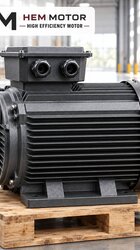
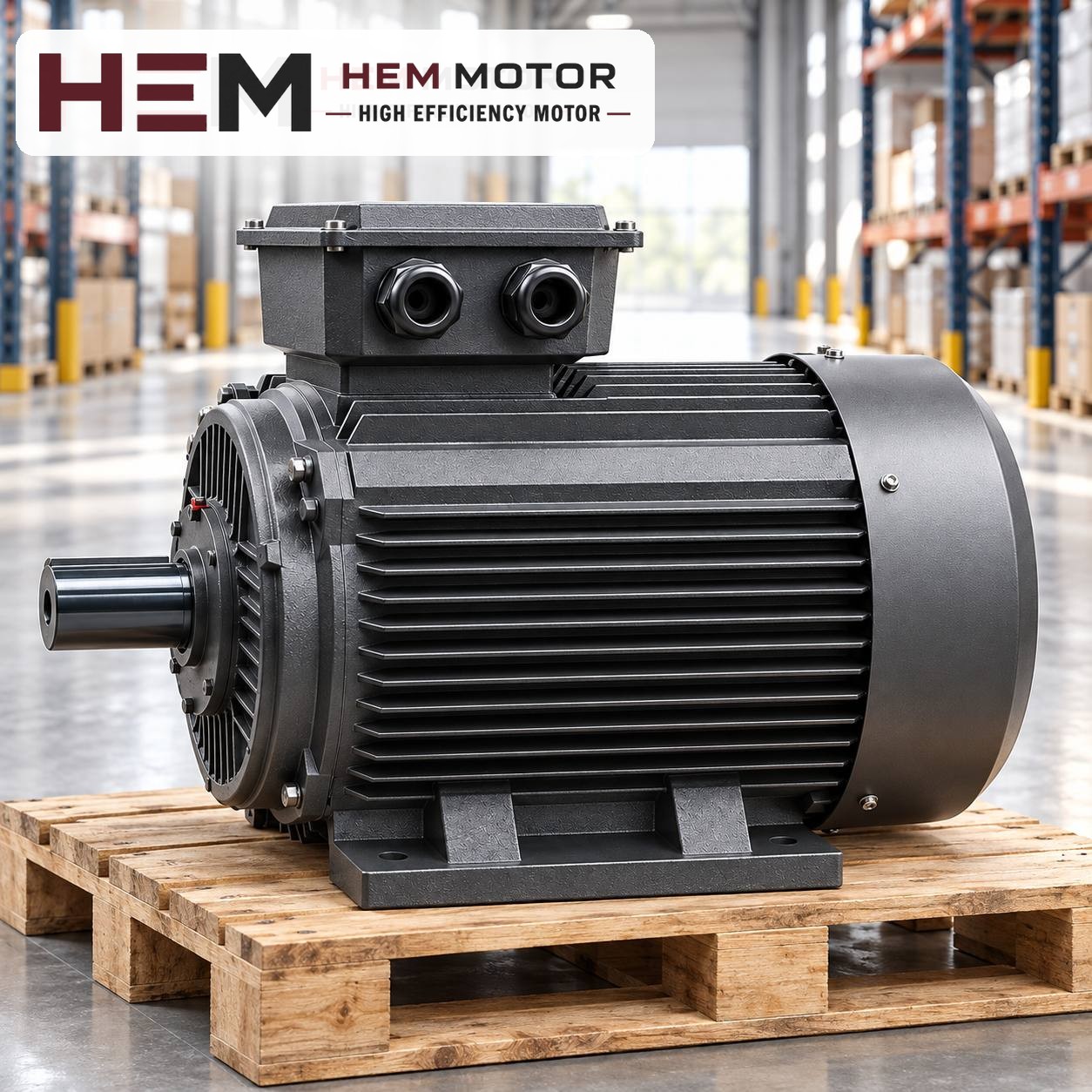

When ordering a 30 kW (40 HP) motor, the motor itself is often the item that causes the fewest problems. Problems appear after the motor arrives on site: the breaker and thermal relay in the panel were not selected for this current, the cable cross-section is insufficient, a single cable was run where a star-delta panel needs six ends, the coupling hub does not fit the shaft or the base does not suit the new frame. This article explains, in order, which checks to carry out on the electrical panel and the mechanical connection before ordering a 30 kW industrial motor, and who should prepare which information.
Basic values of the 30 kW models
At HEM Motor, 30 kW is offered with a cast iron frame at three speeds. Below are the rated current, which is the basis for the panel calculations, and the IEC frame, which is the basis for the mechanical side:
| Model code | Synchronous / rated speed | IEC frame | Rated current (400 V) | Rated torque | Product page |
|---|---|---|---|---|---|
| 225M-6 | 1,000 / 980 rpm | 225M | 56.2 A | 292.3 Nm | 225M-6 cast iron |
| 200L-4 | 1,500 / 1,475 rpm | 200L | 53.8 A | 194.2 Nm | 200L-4 cast iron |
| 200L1-2 | 3,000 / 2,960 rpm | 200L | 52.1 A | 96.8 Nm | 200L1-2 cast iron |
All three models have a 400/690 V (Δ/Y), 50 Hz supply, IP55 protection and class F insulation. The 1,500 and 3,000 rpm models share the same 200L frame; the 1,000 rpm model moves up one frame to 225M.
Panel side: questions for the electrician before ordering
Replacing a motor or adding one to a new line requires the panel components to match the new motor's values. The following checks should be carried out by the plant's electrical engineer; the aim here is to clarify which questions to ask.
Supply and connection
- Supply voltage: on a 400 V supply the motor is connected in delta (Δ). If the plant has 690 V distribution, a star (Y) connection applies. State the measured voltage in your order.
- Starting method: at 30 kW, many plants prefer star-delta, a soft starter or a frequency inverter instead of direct-on-line starting. Which one is used depends on transformer capacity, the condition of the line and the machine's starting load.
- Number of cables: with star-delta, the terminal links are removed and the six ends go separately to the panel. If the existing installation has a single three-core cable, a second cable must be planned.
Protective devices
- Thermal relay or motor protection breaker: the setting range must cover the new motor's rated current. In a star-delta arrangement, the thermal relay is often set to the phase current; your electrician will know this detail.
- Contactor and fuse: it must be confirmed that contactors and fuses suit the starting current and the utilisation category.
- Cable cross-section: rated current, cable length, installation method and voltage drop are calculated together. If the old motor was smaller, the existing cable may not be sufficient.
Details on how protective devices are selected are explained in the article on thermal relay and fuse selection.
If a drive will be used
According to the general information on our site, our three-phase series can be used with speed control by a drive. Two conditions must always be stated in the order: if the motor will run for long periods at low speed with full torque, an external fan may be needed; if the cable between the drive and the motor is long, a dv/dt or sine filter is considered. In a drive application, writing down the speed range and cable length at the ordering stage prevents later changes. For details, see the frequency inverter question.
Mechanical side: connection and layout check
The weight and torque of a 30 kW motor leave no tolerance for mechanical mistakes. Before ordering, clarify the following:
- Frame size: compare the IEC frame size on the old motor's nameplate with the new model's. Moving from 200L to 225M changes both the shaft height and the foot hole spacing.
- Mounting arrangement: whether it will be foot-mounted (B3), flange-mounted (B5) or foot-and-flange (B35). Mounting options are offered according to the frame and the flange size is confirmed with the order; a summary is in the mounting arrangements question.
- Connecting element: coupling, belt and pulley, or gearbox. The bore and keyway of the coupling or pulley hub must fit the new motor's shaft.
- Shaft end: in the 200L frame, the shaft end dimensions of the 2-pole and 4-pole models may differ. The same frame size does not mean the same shaft; read the row for your own model in the 2D technical drawings.
- Handling and lifting: check that the area where the motor will be lifted by its eyebolt and set in place is suitable, with access for a crane or forklift.
A connection outside standard IEC dimensions (special shaft, double-ended shaft, special flange, brake arrangement, etc.) cannot be met by a standard motor. In such a case a special motor is required; ask us by sending the old motor's nameplate and dimensions.