English
 Français
 Türkçe
 Español
 Русский

A rotary kiln is a long steel cylinder laid at a slight incline that processes materials such as cement clinker, lime, gypsum, expanded clay or mineral concentrate at high temperature. Material enters at one end, moves downwards as the cylinder turns and is heat-treated along the way. This page covers the drive motor that turns the cylinder; for the other motors in mining and mineral plants, see our mining sector electric motor page.

What Does Turning a Kiln Shell Involve?
The kiln shell rests on support rollers through steel tyres fitted around it. A large girth gear wrapped around the shell meshes with the pinion at the gearbox output. The motor turns the gearbox, the gearbox turns the pinion and the pinion turns the kiln. The kiln's speed per minute is very low and is varied according to process needs; this speed determines how long the material stays in the kiln.
The load facing the motor is the weight of the shell, the refractory brick lining its inner surface and the material inside. Roller friction resisting the rotation of this mass and the way material piles up inside the cylinder determine the torque. In continuous production the kiln turns for weeks or even months without stopping.
Starting: The Kiln's First Movement Is the Hardest Moment
Unbalanced load and breakaway torque
In a stopped kiln the material gathers in the lower part of the cylinder; in addition, a shell that stopped while hot sags slightly under its own weight. Setting the kiln in motion again means lifting this unbalanced load to one side and overcoming static friction at the rollers. The torque required at start-up is clearly above the running torque, and acceleration takes a long time.
Which starting method?
With this kind of load, direct-on-line starting strains both the mains and the gear system; star-delta reduces starting torque and may fail to move a loaded kiln. For this reason a frequency inverter is the most common solution for kiln drives built with a standard squirrel-cage motor: it delivers high torque in a controlled way at start-up and then adjusts kiln speed to the process. Some small kilns also use a soft starter. Data from the kiln manufacturer shows which is sufficient. Slip-ring and DC motors are not included in HEM Motor's 2026 catalogue; the recommendations on this page apply to squirrel-cage motors.
Variable Speed and Motor Cooling
Kiln speed is varied over a wide range according to the process; it turns very slowly during firing-up and heating, and faster in normal production. A motor driven by an inverter may therefore run for long periods well below its rated speed but with high torque. The motor's own fan cannot provide enough air under these conditions; a separately powered cooling fan is often needed in this application.
In large plants the cable between inverter and motor may be long; a dv/dt or sine filter is considered to protect the winding insulation. HEM's three-phase motors are suitable for this duty; simply state the fan and filter requirements in your order. For general information see the inverter compatible electric motors page.
Auxiliary Drive and Power Failure
Stopping a hot kiln is risky for the shell: a hot cylinder left motionless may bend under its own weight and the refractory lining may be damaged. That is why large kilns have, next to the main motor, a small auxiliary drive connected to the gearbox through a clutch. During a power cut or maintenance it turns the kiln very slowly, keeps the shell straight while cooling, and brings the kiln to the required position during bricklaying work. This motor is usually connected to a generator.
The auxiliary drive motor is much smaller than the main motor and works with its own gearbox; it still needs high torque at start-up. For matching with a gearbox see the electric motors for reducers page.
Conditions Around the Kiln and Motor Maintenance
The motor works beside the kiln shell, in an area with heat radiating from the hot surface and clinker or lime dust. The drive group is usually protected by a screen, and clean cooling air is supplied to the motor. If the ambient temperature is high, the selection must allow the motor to deliver its rated power continuously; please pass this information on with your order.
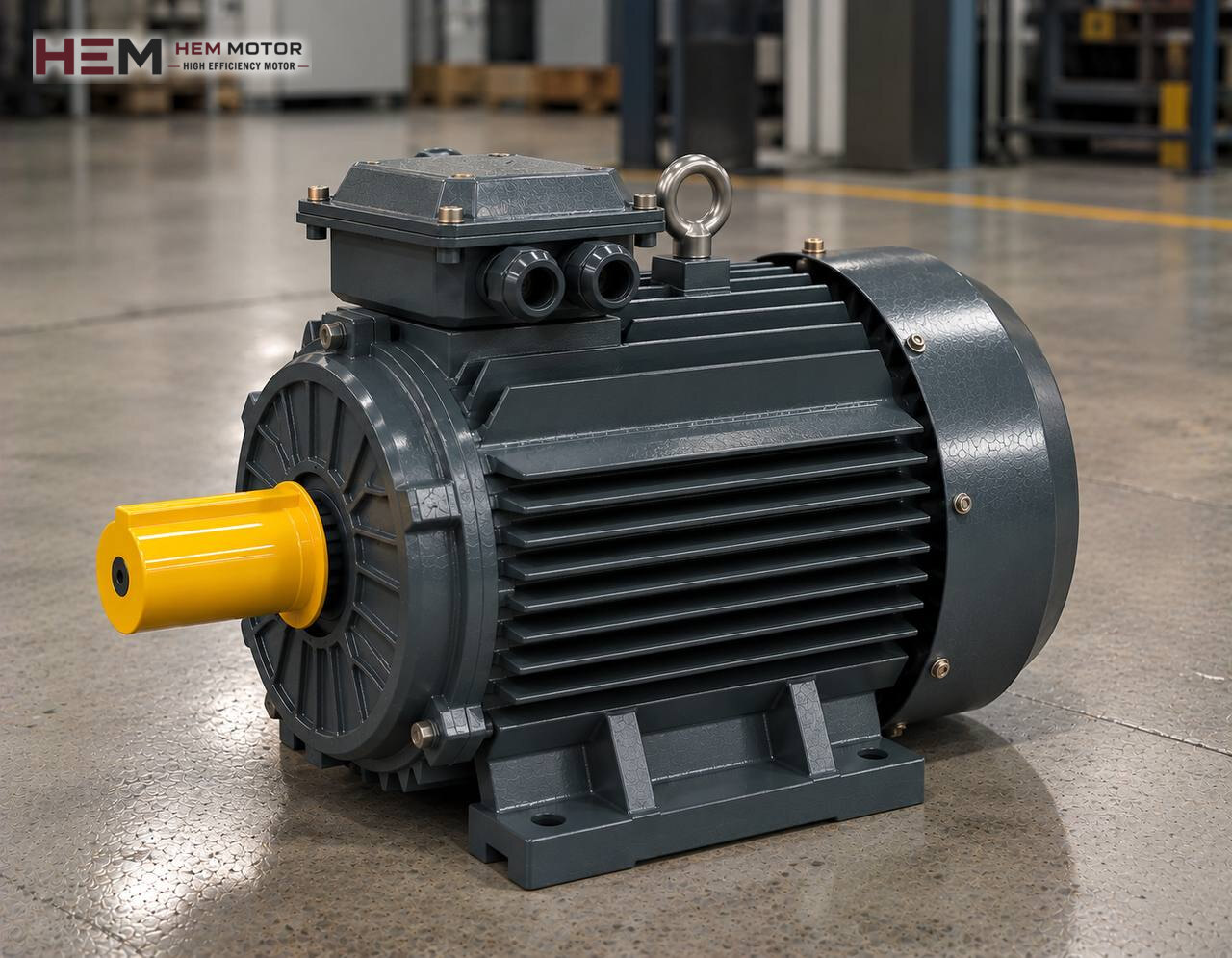
For motors running continuously for long periods, a PTC or PT100 sensor to monitor winding temperature and an anti-condensation heater for long maintenance stops are order options. Dust build-up on the cooling fins should be cleaned regularly, bearing lubrication intervals observed, and coupling alignment and gearbox connection checked periodically. Cast iron frame motors are used in this heavy duty; a foot-mounted B3 or, depending on the gearbox, a B35 frame is prepared to suit the frame size, and flange and shaft dimensions are finalised in the order.
Example HEM Motors for Rotary Kilns
| Kiln type | Motor's job | Point to watch | Example HEM model |
|---|---|---|---|
| Small calcining kiln | Main drive, on inverter | Starting torque, forced-cooling fan | 55 kW, 985 rpm, 280M-6 cast iron |
| Lime and expanded clay kiln | Main drive, variable speed | Ambient temperature, filter | 110 kW, 988 rpm, 315L1-6 cast iron |
| Large cement kiln | Main drive, uninterrupted operation | Winding temperature monitoring, gearbox input | 250 kW, 990 rpm, 355L-6 cast iron |
| Kilns of any size | Auxiliary (maintenance) drive | Generator supply, clutch | 15 kW, 978 rpm, 180L-6 cast iron |
The models in the table are examples; actual power and speed are determined by the kiln manufacturer according to kiln size, fill ratio, speed range and gear ratio. Models of 75 kW and above have a service factor of 1.15. For very large lines, the upper limit of our range is 355 kW.
For a Kiln Drive Motor Quotation
To help us determine the right motor, send: the machine (kiln type, main or auxiliary drive), required power, motor speed, plant voltage, mounting type (foot, flange, gearbox connection), whether an inverter will be used, and the quantity. A photo of the current motor's nameplate speeds up selection of an equivalent.
All models are on the buy electric motors page; current prices are shown on the product pages. WhatsApp and phone details are on the contact page.
Frequently Asked Questions
Why is a six-pole motor preferred for rotary kilns?
Because kiln speed is very low, the transmission ratio is large; a slower motor reduces the gearbox ratio and delivers higher shaft torque at the same power. Even so, the number of poles is chosen together with the gearbox; there are also drives that work with four-pole motors.
Why does the kiln keep turning when the power fails?
If a hot shell stays still, the lower and upper sides cool differently and the cylinder may bend; this damages the tyres, rollers and refractory lining. The auxiliary drive prevents this by turning the kiln slowly.
Is star-delta starting enough for a rotary kiln?
Usually not. In the star stage motor torque drops markedly and a loaded kiln may not move. For a controlled start, a frequency inverter or another method approved by the kiln manufacturer is preferred.
Is a separate fan essential on an inverter-driven kiln motor?
If the kiln runs at low speed for long periods, usually yes; the fan on the motor shaft does not produce enough cooling air when turning slowly. If you state the speed range in your order, the need for a fan is assessed together.