English
 Français
 Türkçe
 Español
 Русский

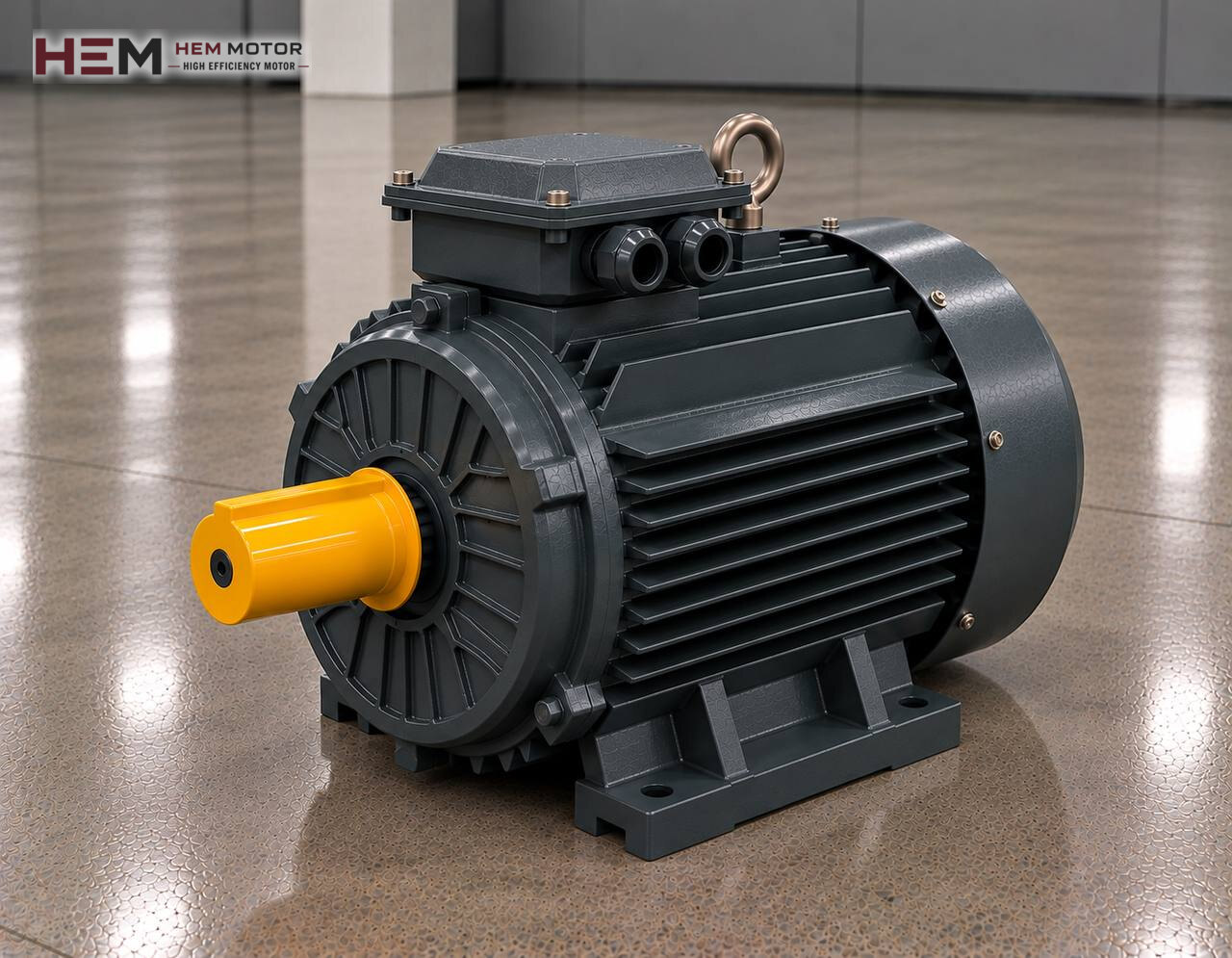
In a cement plant, limestone arrives from the quarry, is crushed and ground, turns into clinker in the kiln, is ground again and leaves in bags or in bulk. Every link in this chain runs an electric motor of a different character. For the general picture of the sector see the mining sector electric motors page; here we only describe the stations of the cement process and the job a standard three-phase motor does at each of them.

Stations from raw material preparation to packing
The process starts at the quarry. Limestone and clay pass through primary and secondary crushers and are carried by belts to the pre-blending yard. There a stacker piles the material in layers and a reclaimer cuts across the pile to take it back, so that the chemical composition is evened out.
Next comes the raw mill. The raw material is turned into fine powder in a vertical roller mill or a ball mill and dried at the same time with hot kiln gas. The raw meal is lifted by bucket elevators to the top of the cyclone preheater tower and descends into the rotary kiln. Clinker leaving the kiln is cooled with air in a grate cooler and transferred to the clinker silo.
In the last stage the clinker is ground in the cement mill together with gypsum and additives; the separator sets the fineness. Finished cement travels through air slides and pneumatic conveying to the silos, and from there to the rotary packer or to bulk loading bellows.
Motor power range and the part HEM covers
In terms of motor power a cement plant is extremely spread out. The main mill and large kiln drives reach the megawatt class in most plants; these ratings can exceed the upper limit of HEM Motor's 0.25–355 kW three-phase range. Slip ring motors and DC drives are not included in the 2026 catalogue either.
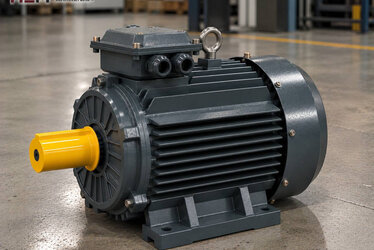
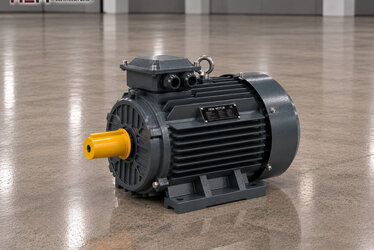
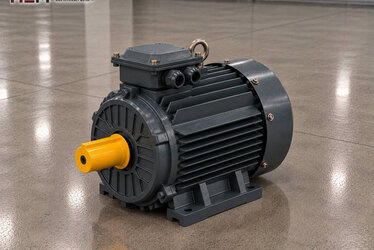
On the other hand, most of the motors in a plant, by number, stay below this upper limit: belts after the crusher, elevators, screw conveyors, air slide blowers, clinker cooler fans, dust filter fans, separators, pumps and compressors. Our squirrel cage, cast iron standard motor does its real work in this part. Which drive needs which rating is defined by the machine manufacturer's data and the nameplate of the motor on site.
Fans: the plant's most energy-hungry group
In a cement plant almost every process works together with a fan. The kiln induced draught fan (ID fan) pulls gas from the preheater; cooler fans blow air into the clinker from under the grate; the mill fan and bag filter fans collect dust. These fans run continuously, for long hours and mostly at steady load.
A large fan impeller has high inertia, so starting takes a long time. With direct-on-line starting the motor draws high current throughout this period and heats up; a soft starter or a frequency inverter eases this load. Setting fan flow by speed instead of throttling with a damper is also a common practice in plants. Fan power changes roughly with the cube of speed, but the real gain depends on the system. Details on fan motors are on the fan and extractor motors page.
Elevator, screw conveyor and separator drives
The bucket elevator lifts raw meal and cement tens of metres. The motor turns the head pulley through a gearbox; starting with full buckets after a stop is the heaviest moment, and the anti-runback device sits on the gearbox side. Screw conveyors and rotary feeders are smaller drives, but they work in dust and hot material. For gearbox matching on these drives the motors for gearboxes page is a guide.
In a dynamic separator the rotor speed directly determines cement fineness; for this reason the separator motor is almost always driven by a frequency inverter. With our three-phase motors running on an inverter, a separate cooling fan should be considered if full load is needed for long periods at low speed, and a dv/dt or sine filter should be planned if the cable between drive and motor is long; it is enough to state these in the order. Details are on the inverter compatible motors page.
Dust, heat and the kiln area
Cement dust is fine, abrasive and hardens with moisture. When it builds up on the fins of the motor frame and on the fan cover it spoils cooling; periodic cleaning is the most effective maintenance for motor life. IP55 protection is against dust and splashing water, but a motor buried in material or sprayed with pressurised water is outside the design purpose of this class.
Around the kiln and cooler the ambient temperature can rise. Catalogue values apply up to 40 °C ambient and 1,000 m altitude; a hotter motor room or a high-altitude plant should be stated in the order. An anti-condensation heater against moisture during long stops and a PTC or PT100 sensor monitoring winding temperature are order options.
The mounting of the motors is chosen, depending on frame size, from foot-mounted B3, flange B5 and B14, foot-and-flange B34 and B35, and vertical V1, V3, V5, V6, V15 options; flange and shaft dimensions are finalised with the order.
Example selection table by station
The models below are taken from our 4-pole cast iron range. For example, the 45 kW cast iron 225M-4 gives 289.4 Nm at 1,485 rpm, the 110 kW cast iron 315S-4 gives 706 Nm at 1,488 rpm and the 160 kW cast iron 315L1-4 gives 1,027 Nm at 1,488 rpm; models of 75 kW and above have a service factor of 1.15.
| Station | Load on the motor | Key point in selection | Example HEM model |
|---|---|---|---|
| Air slide blower, screw conveyor | Continuous, dusty environment | Belt or gearbox connection | 132M-4, 7.5 kW |
| Raw meal or cement elevator | Heavy start with full buckets | Gearbox input, starting method | 225M-4, 45 kW |
| Dynamic separator | Variable speed, continuous | Inverter, need for external fan | 315S-4, 110 kW |
| Clinker cooler or filter fan | High inertia, long start | Soft starting, ambient temperature | 315L1-4, 160 kW |
These rows only give direction; the actual motor is selected by looking at the station's load, the required speed, the connection type and the ambient conditions of the plant.
Requesting motors for a cement plant
For a quotation, tell us which station and machine the motor is for, the power (kW), speed (rpm), supply voltage, mounting type, starting method and quantity. If you are preparing for a maintenance shutdown, collecting several motors in one list speeds things up. A nameplate photo of the existing motor is the shortest way to find an equivalent. Models and current prices are on the shop page; WhatsApp and phone details are on the contact page.
Frequently Asked Questions
Can I buy the main motor of a cement mill from HEM?
If the main mill motor is below HEM's upper limit of 355 kW and a squirrel cage motor is suitable, we can evaluate it. Megawatt-class or slip ring main drives are not included in the 2026 catalogue.
Which starting method suits a kiln ID fan?
Because starting takes long on large impeller fans, a soft starter or a frequency inverter is preferred. The final decision is made with the fan manufacturer's inertia data and the current the supply can handle.
What should I do if the motor room is hot?
Catalogue values are for 40 °C ambient. If the environment is hotter, write this in the order; derating or choosing a larger frame is evaluated on that basis.
Is it mandatory to drive the separator motor with an inverter?
It is not mandatory, but changing speed is the practical way to adjust fineness, so most plants use an inverter. If there is long operation at low speed, the need for an external fan is discussed in the order.