English
 Français
 Türkçe
 Español
 Русский

An asphalt plant dries and heats aggregate, separates it by size, weighs it and mixes it with hot bitumen to produce a mix ready for road building. Although it does no crushing or grinding, this plant is one of the motor applications with the highest heat and dust. This page is a sub-topic of the mining sector electric motors page and covers the drives inside the plant station by station.

Plant flow: from cold aggregate to hot mix
The flow begins with the cold feed bins. A short metering belt under each bin drops its own aggregate grade at a set speed onto the collecting belt. The collecting belt and the inclined charging belt carry the blended aggregate to the dryer drum.
In the drum the burner flame drives off the moisture in the aggregate and raises the material to mix temperature. Hot aggregate climbs to the top of the tower on the hot elevator, is split into grades on the vibrating screen and drops into the hot bins. From there it is weighed and mixed with filler and bitumen in the mixer; the finished asphalt is discharged into a truck or a storage silo.
Alongside this chain run the fan supplying combustion air to the burner, the exhaust fan pulling drum gas through the bag filter, the filler screw conveyors and the bitumen pump. The motor list of stationary and mobile plants is similar; in mobile types the motors are fitted onto a more compact chassis and are often fed from a generator.
Dryer drum: a heavy cylinder sitting on four rollers
The drum is a long, slightly inclined cylinder with lifting flights inside, resting on support rollers through riding rings. The drive is usually by friction: the motors turn the rollers through gearboxes and the rollers turn the drum. On large drums each of the four rollers is driven by its own motor; in some designs a single motor drives through a girth gear or a chain.
In a multi-motor arrangement the motors must have the same power, speed and starting method; if one lags behind, slip and wear on the roller increase. The drum's inertia is large and a loaded drum needs high torque at start. Because of thermal expansion the roller contact differs between a cold and a hot drum; care is needed on the cold start at the beginning of a shift. For gearbox matching see the motors for gearboxes page.
When power fails the drum stops, but the hot material and flame zone inside keep heating the drum shell locally. For this reason many plants plan a standby drive or generator supply to turn the drum slowly after an outage; this safety arrangement is the plant manufacturer's design.
Burner fan and bag filter exhaust fan
The burner's combustion air fan works with an impeller mounted directly on the motor shaft; fan flow is considered together with the burner setting, and it is important that the motor speed stays in the same pole class as the old motor. Details are on the burner fan electric motor page.
The exhaust fan carries one of the largest motors in the plant. It pulls the hot gas and dust leaving the drum through the bag filter and sends it to the stack; it also creates the negative pressure in the drum. Large impeller inertia means a long start; a soft starter or a frequency inverter softens this load and lets flow be matched to burner capacity. On our three-phase motors driven by an inverter, an external cooling fan comes up if there is full load for long periods at low speed, and a dv/dt or sine filter if the motor cable is long; just add these two needs to the order. For more, see the inverter compatible motors page.
Hot elevator, screen and mixer
The hot elevator carries the material leaving the drum upwards at high temperature; its chain and bucket structure is turned by a geared motor. Starting with full buckets is heavy and the backstop is on the gearbox side. Because the elevator motor sits at the top of the tower, close to hot gas and dust, cooling air must reach the fins freely.
The vibrating screen works either with a standard motor turning an unbalanced shaft through belts or with vibration motors attached to the screen body. Unbalanced-mass vibration motors are not included in HEM Motor's 2026 catalogue; a standard motor can be used on belt-driven screens.
The mixer is a twin-shaft paddle mixer; the two shafts are usually driven by two motors or by one motor and a common gearbox. Because each batch is mixed and discharged in a short time, the load fluctuates often; the motor is assessed thermally against the average load and mechanically against the peak torque.
Heat, dust and motor care on site
In the tower section of the plant the motors are exposed both to the heating steel structure and to fine stone dust. Catalogue values are based on 40 °C ambient; around the drum and elevator this limit can be exceeded in summer, and this should be stated in the order. Dust sticking to the fan cover and fins reduces cooling; end-of-shift cleaning is a simple but effective measure.
IP55 protection is against dust and splashing water. The layer that bitumen vapour and oily dust form on the motor should be cleaned off over time. In plants working seasonally, a long winter stop can let moisture collect in the winding; an anti-condensation heater and a PTC or PT100 winding sensor are order options. Not starting the motors at the beginning of the season before measuring insulation resistance is a good habit.
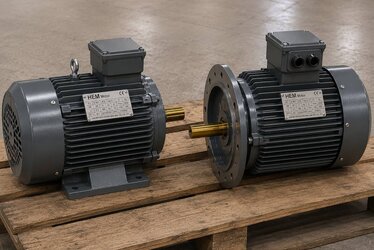
On the connection side the options vary by frame: foot-mounted B3, flanged B5 and B14, both foot and flange B34 and B35, and for vertical use V1, V3, V5, V6 and V15. Whether the gearbox flange and shaft end match is confirmed at the order stage.
Example models for plant drives
In plants, geared drives and fans are mostly built with 4-pole motors. At metering belt scale the 100L2-4 (3 kW) produces 19.8 Nm at its rated 1,450 rpm. At drum roller scale the 180L-4 (22 kW) offers 142.9 Nm, at mixer scale the 225S-4 (37 kW) 237.9 Nm, and at exhaust fan scale the 280S-4 (75 kW) 482 Nm rated torque; the last one is in the class with a 1.15 service factor.
| Plant drive | Nature of the load | To be clarified in the order | Example HEM model |
|---|---|---|---|
| Cold feed metering belt | Low power, adjustable speed | Gearbox input, inverter | 100L2-4, 3 kW |
| Dryer drum roller drive | High inertia, multiple motors | Equal start of motors, gearbox | 180L-4, 22 kW |
| Twin-shaft asphalt mixer | Batch cycle, torque peak | Matching of the two motors | 225S-4, 37 kW |
| Bag filter exhaust fan | Continuous, long start | Starting method, ambient temperature | 280S-4, 75 kW |
These pairings are for guidance; the motor to fit in your plant is determined by the real load of the drive, the required speed, the connection type and the operating conditions on site.
Quotation details for a plant motor
Write to us which machine the motor is for (drum, fan, elevator, mixer), the power (kW), speed (rpm), the plant's supply voltage (grid or generator), the mounting type and the quantity. Collecting the motors to be replaced in the pre-season maintenance into one list speeds up the quotation. Sending the nameplate photo of the motor to be removed answers most questions at once. You can reach the model list and current prices in the shop, and write to us by WhatsApp or phone via the contact page.
Frequently Asked Questions
If one motor fails on a four-roller drum, can I replace just that motor?
You can, but the new motor must be in the same power, speed and pole class as the other three. A motor with a different speed upsets load sharing between the rollers and increases wear.
What should be watched when a mobile plant runs on a generator?
The generator must be able to cover the starting current of the large fan and drum motors. A soft starter or inverter reduces starting current; switching the motors on in sequence also balances the generator load.
Why is the exhaust fan the largest motor?
The fan has to pass all the hot gas from the drum and the vapour from the moisture through the filter and expel it. Because the flow and pressure demand is high, the shaft power is also high; the exact value is given by the fan manufacturer.
How should I protect the motors between seasons?
Keep the motors dry, leave the anti-condensation heater on if possible and measure insulation resistance at the start of the season. Cleaning off dust and bitumen residue prevents overheating at the first run.