English
 Français
 Türkçe
 Español
 Русский

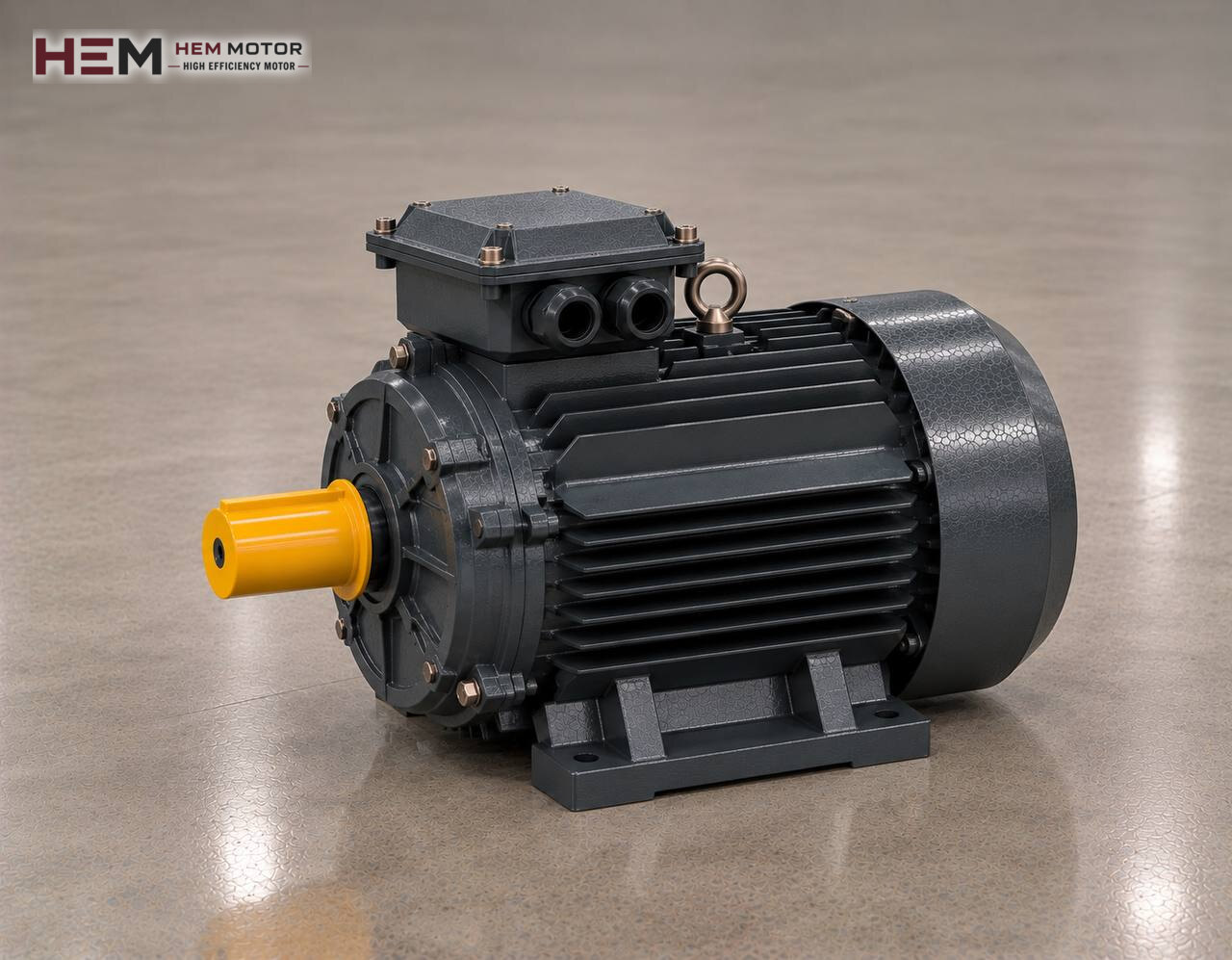
A hydraulic loading platform lifts a load over a short distance from ground level to a vehicle bed, a loading dock or an upper level. This page covers the electric motor that turns the pump in the platform's hydraulic unit; for other applications in the same family, see the handling systems electric motors page. Scissor lift platforms differ in arm geometry, lifting height and lifting time, so they are covered on a separate page.

The Motor's Job on the Platform: Only Turning the Pump
On a loading platform the electric motor turns a single part: the hydraulic pump. When the operator presses the lift button, the motor starts, the pump draws oil from the tank and pushes it into the cylinder, and the platform rises. When the button is released, the motor stops. In most of these units the pump is a unidirectional gear pump; the motor's direction of rotation must match the arrow on the pump body.
The motor usually does not run for lowering. When the lowering valve opens, oil in the cylinder returns to the tank under the weight of the load and the platform; a flow control valve sets the lowering speed. In short, the motor uses energy only while lifting and waits during lowering. On some vehicle tail lifts a double-acting cylinder and an additional valve open and close the flap; in that case the motor also runs briefly for the flap movement.
What the motor does not do is equally clear: it does not hold the load in the air, does not brake the descent and does not stop the platform from dropping on its own. These tasks belong to the hydraulic circuit and the mechanical parts of the platform.
Why Are Brakes, Load Holding and the Safety System Assessed Separately?
When the loaded platform stops, it is not the motor that holds the load in place but the check valve or load holding valve in the cylinder line. A pipe rupture (safety) valve against hose bursts, a relief valve against overpressure, limit switches cutting the upper and lower positions, and a mechanical prop or lock that secures the platform during maintenance: all of these make up the machine's safety system. This system is the platform manufacturer's design and responsibility and is assessed according to the relevant machinery legislation and standards.
Selecting the electric motor does not replace that assessment. It cannot be said that a standard three-phase induction motor is safe for lifting on its own or that it holds a load, and this page makes no such suitability claim. If your platform design requires a brake motor, state it clearly in the order; the assessment is made on the basis of the platform manufacturer's data.
What Information Is Needed to Select a Loading Platform Motor?
To find the right motor, the platform itself must be defined first. A fixed platform in front of a dock and a platform mounted at the rear of a truck body may use a similar pump, yet their supply, mounting and ambient conditions differ.
We need the following: platform type and installation location, pump flow and maximum working pressure, power and speed of the existing motor, whether the supply is single-phase or three-phase, how the pump is connected to the motor, and the number of lifts per shift. The last item is often forgotten, although on a loading platform it is the value that really determines how hot the motor gets.
Power and Speed: Pump Data and the Old Motor's Nameplate
Motor power is not estimated from the platform's load capacity. The required power is calculated from the pump flow, the highest pressure during lifting and the pump efficiency. These values come from the pump or platform manufacturer. The details of converting flow and pressure into power are on the hydraulic pump electric motors page; we do not repeat them here.
Speed is set by the range the pump allows. Gear pumps in these units frequently run with 4-pole motors, i.e. 1,500 rpm synchronous speed. A higher speed on the same pump increases the flow and therefore the lifting speed, but the pump manufacturer's limit must not be exceeded. A change in lifting speed may also affect the platform's own safety assessment.
On a working platform the soundest starting point is the existing motor's nameplate. If power, speed, voltage and current are readable, a motor with the same values is sought. If the pump and valves have not changed, a larger motor will not make the lift faster; flow depends on pump displacement and speed.
Pump Connection and Mounting Dimensions to Check
In loading platform units the pump is usually connected to the motor in one of two ways. In the first, a bell housing sits on the motor's front flange (B5 large flange or B14 small flange) and a flexible coupling joins the motor shaft and the pump shaft. In the second, the pump is attached directly to the motor flange with a pump adapter and the end of the motor shaft enters the pump hub. In both cases the bell housing or adapter dimensions must match the motor flange and shaft.
The comparison starts with the IEC frame number (e.g. 90L, 100L). Then the mounting type, shaft diameter and length, key size, flange outer diameter and bolt circle, foot hole spacing if any, and terminal box orientation are checked. On the electrical side, voltage, connection and rated current are compared. The same frame number does not mean that every dimension is identical; it cannot be said that the new motor will seat on the old bell housing without problems until the dimensions have been compared.
The frame size table guides you on dimensions, and the mounting arrangements page on the available layouts. If the unit stands upright with the motor shaft pointing down, vertical mounting (e.g. V1) must be stated in the order.
Dock Front, Under the Body and Cold Store: Effect of the Environment
Dock platforms often stand in front of a door opening to the outside, exposed to rain and dust. On vehicle platforms the unit sits under the body in a box reached by water and mud splashed from the road. The motors in our catalogue have IP55 protection and class F insulation; the catalogue is based on a lower limit of −15 °C, an upper limit of +40 degrees Celsius and an altitude up to 1000 m. If a cold store dock is colder or the site is at high altitude, this must be written in the order.
Condensation can form inside motors on platforms that stand idle for long periods. For docks that stand overnight and make their first lift in the cold morning, an anti-condensation heater is an order option. Pressure washing or submersion are not conditions IP55 is designed for; this is why the unit's closed box matters.
Short, Frequent Starts: Inverter and Supply Choice
On a loading platform the motor does not run for hours; it starts and stops for a lift lasting seconds. In a busy distribution warehouse a dock platform may operate many times in one shift. At each start the motor draws high current for a short time and the winding heats up; rest intervals are needed to dissipate this heat. We therefore ask you to state the number of starts per hour and the approximate duration of one lift in the order. A PTC or PT100 sensor can be added to monitor winding temperature.
Most of these platforms have no inverter; the motor starts directly through a contactor. If a soft start or adjustable lifting speed is wanted, a frequency converter can be considered. Our three-phase range can run on a drive; if there is long full-load operation at low speed a separate fan is discussed, and a dv/dt filter if the motor cable is long. Since a speed change affects lifting behaviour, the decision lies with the platform manufacturer. Details: inverter compatible electric motors.
The supply also shapes the selection. A small workplace without a three-phase line may want a single-phase motor; HEM Motor's single-phase range covers 0.18–5.5 kW (single-phase electric motor). DC 12/24 V unit motors powered from a vehicle battery are not included in HEM Motor's 2026 catalogue.
What to Send When Replacing an Existing Platform Motor
To find a replacement for a failed motor, simply send the information via WhatsApp. How to photograph the nameplate is explained in the send your motor nameplate article; WhatsApp and phone details are on the contact page. If the nameplate is unreadable, measuring and adding the shaft diameter and flange size speeds things up.
Pre-order checklist:
- A clear photo of the motor nameplate: power (kW), speed (rpm), voltage, current
- Platform type: fixed dock platform, floor-to-floor goods platform or vehicle body
- Supply: single-phase or three-phase
- Pump connection: B5/B14 flange and coupling or pump adapter; shaft and flange dimensions
- Pump flow and maximum pressure (manufacturer data)
- Number of lifts per hour and duration of one lift
- Whether a brake motor is required (per the platform manufacturer's design) and quantity
Motor Groups to Review for Loading Platforms
The table below shows motors in our store worth a first look, by platform use. All models are on the electric motor store page; for small units see aluminium frame motors, and for harsher environments cast iron frame motors.
| Platform use | Typical supply | How the motor operates | Store example |
|---|---|---|---|
| Platform in front of a loading dock | Three-phase building supply | A few short lifts per vehicle | 1.5 kW aluminium, 90L-4 |
| Fixed floor-to-floor goods platform | Three-phase | Longer stroke, infrequent but longer lifts | 2.2 kW aluminium, 100L1-4 |
| Small workshop lifting platform | Single-phase or three-phase | Occasional use during the day | 0.75 kW aluminium, 80M2-4 |
| Battery-powered vehicle tail lift | DC 12/24 V | Tied to the vehicle system | Not included in the 2026 catalogue |
The models in the table are examples, not a final selection; suitability for the machine is verified separately using pump data, speed and mounting dimensions.
Frequently Asked Questions
Why does the motor not run when the platform is lowering?
On most loading platforms lowering happens as the oil returns to the tank through the lowering valve under the weight of the load. The motor only turns the pump for lifting; it is normal for it not to run during lowering.
If I fit a more powerful motor, will the platform lift heavier loads?
No. Load capacity is determined by the cylinder, the relief valve setting and the platform structure; these are the manufacturer's design. Increasing power does not change these limits.
Does the motor hold the load in the air when stopped?
No. The check valve or load holding valve holds the load. When the motor stops the pump delivers no oil; safe holding of the load depends on the hydraulic circuit and the platform's safety parts.
Can I find a motor for a platform running on a vehicle battery?
DC 12/24 V unit motors are not included in HEM Motor's 2026 catalogue. For fixed platforms fed from the mains, our three-phase and single-phase models can be reviewed.
What happens if the new motor turns the wrong way?
A unidirectional gear pump delivers no oil in reverse and may be damaged. On a three-phase motor the direction is changed by the connection; this must be done by a qualified electrician, and the direction is checked with a brief test at first start.