English
 Français
 Türkçe
 Español
 Русский

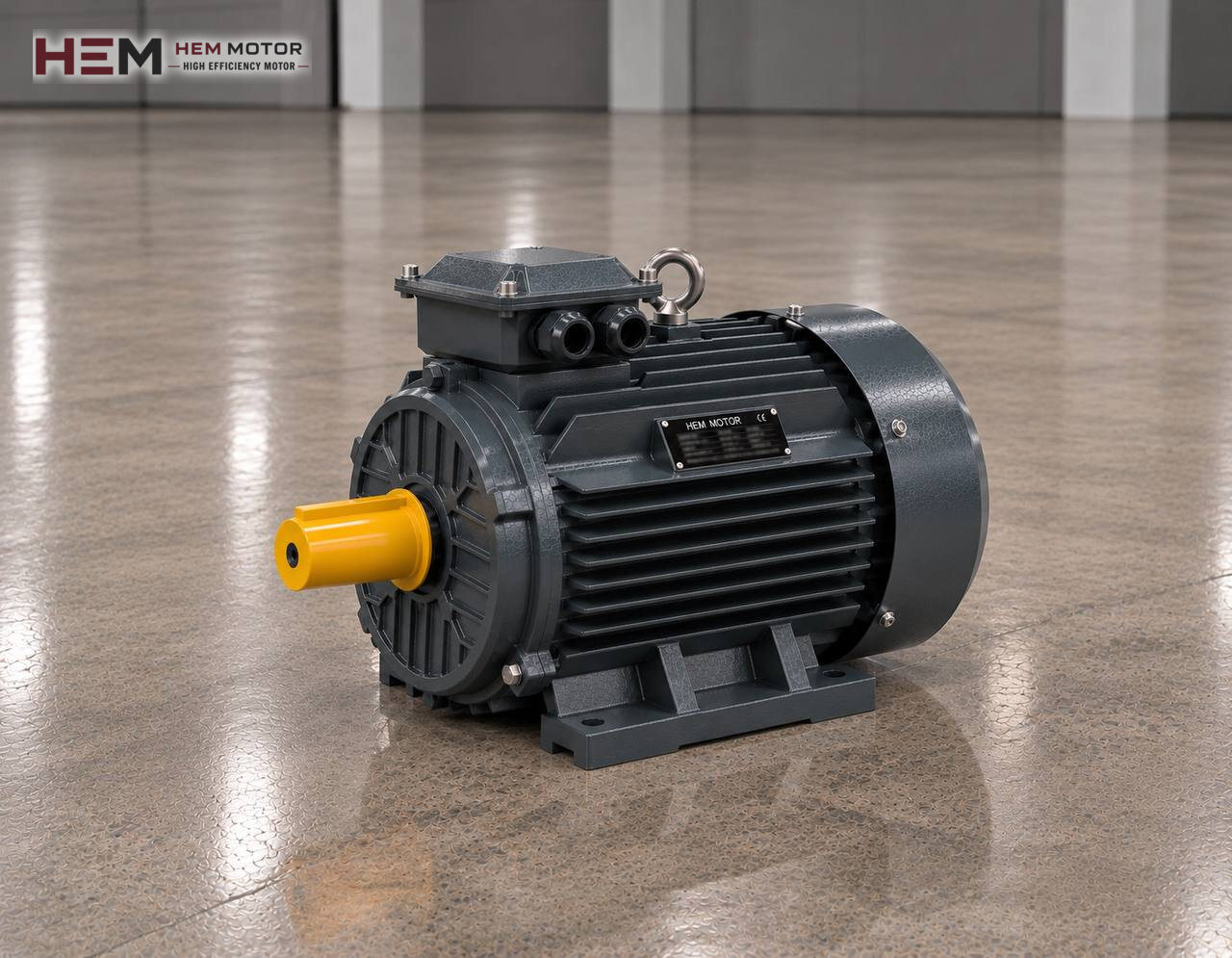
A turntable is a circular conveyor that changes the direction of the load on conveyor lines or turns the load to a given angle at a station. Transfer turntables making 90° turns on pallet lines, indexing tables moving parts from station to station in assembly cells and direction-changing tables at warehouse entrances all belong to this group. This page covers the drive motor that turns the table; the other machines in the same sector are gathered on the handling systems motors page.

Who Turns the Table: Motor, Gearbox and Rotation Mechanism
The turntable itself makes a quarter turn, half turn or full turn within seconds; a few revolutions per minute is often enough for this job. The electric motor, however, runs at 1,000, 1,500 or 3,000 rpm synchronous speed. The large gap is bridged by a gearbox: the motor turns the gearbox input shaft, and the gearbox output turns the table via a pinion and ring gear, a chain sprocket or directly through the table shaft.
An arrangement in which the motor is connected directly to the table practically does not exist. The motor's job is to deliver the required torque and speed to the gearbox input; the motor alone does not determine at which angle the table stops, how slowly it approaches or whether it stays still once stopped. Some turntables also carry a roller or chain conveyor on top; that conveyor's own motor is separate from the table drive and is covered on the roller and chain conveyor motor page.
Data Needed for a Turntable Motor Request
When looking for a motor for a turntable, the first thing to look at is how the table works. A continuously rotating display or feeding table and a pallet transfer table that turns 90° and stops in every cycle do not see the same load.
Information required: table diameter and the heaviest load on the table, the position of the load relative to the table centre, the angle and duration of one rotation, the number of rotations per hour, the type and output speed of the gearbox used, the connection between motor and gearbox and the existing motor's nameplate values. If the table performs positioning, the sensor and control arrangement used should also be stated.
Inertia, Torque and Motor Power
On a turntable the main load straining the motor is often not friction but inertia itself. When a heavy pallet sits near the edge of the table, the inertia of the rotating mass grows; with every movement the table has to accelerate and then decelerate this mass. Quick 90° turns require greater acceleration and therefore greater torque than slow, long turns.
The required power is determined by the table or gearbox manufacturer according to the table's inertia, bearing friction, desired acceleration time and gearbox efficiency. It would not be correct to say that a single kW value fits every turntable. If the motor is to be changed on a working line, the old motor's nameplate is the most reliable starting point; if heavier loads have started to be placed on the table, this change should be reported separately.
The speed reaching the table after the gearbox is found by dividing the motor speed by the gearbox ratio. Motor speed (gearbox input speed) and table speed (gearbox output speed) must therefore be written separately. For tables needing a very low output speed, 6-pole motors, i.e. 1,000 rpm synchronous speed, can help reduce the gearbox ratio; the choice is made together with the input speed the gearbox accepts.
Connection to the Gearbox Input and Mounting Check
Because of limited space, on turntables the motor is often placed horizontally under the table with a 90° output gearbox. In this arrangement bevel helical gearboxes or, for low speeds, worm gearboxes are common. The gearbox type and ratio are the table designer's choice; this page deals only with the motor side of the connection. For details see the electric motors for gearboxes page.
The motor is usually connected to the gearbox with a B5 or B14 flange, and the shaft enters the gearbox input hub with a key. The comparison starts with the IEC frame number; then the flange type and diameter, spigot diameter, bolt circle, shaft diameter and length, key size and the direction the terminal box faces under the table are checked. Voltage and rated current are also compared with the old motor. Until these dimensions are verified, it cannot be said that the new motor can be fitted to the gearbox. Frame dimensions: frame size table.
Ambient Conditions for a Motor Running Under the Table
The space under a table is usually narrow, with poor air flow. If there is no clearance in front of the fan cover, the motor cannot dissipate its own heat; this becomes more noticeable on tables with frequent stop-start operation. Debris falling from pallets, pieces of stretch film and dust can collect between the fins of the motor and need to be cleaned during maintenance.
The motors in our catalogue have IP55 protection and class F insulation and are specified for ambient temperatures of minus 15 to plus 40 degrees Celsius and altitudes up to 1000 m. If a turntable at a cold store entrance or a plant at higher altitude is outside these limits, this must be stated in the order. On lines that stand idle for long periods, an anti-condensation heater, and a PTC or PT100 sensor for monitoring winding temperature, are order options.
Positioning, Drive and Stopping Accuracy
A pallet transfer table must stop at a defined angle in every cycle; if the rail alignment is off by a few millimetres, the pallet cannot pass to the next conveyor. This accuracy comes from the control arrangement, not from the motor selection. On simple tables a proximity sensor gives a slow-down signal and a second sensor stops the table. In more precise applications a frequency converter accelerates the table on a ramp, creeps at low speed as it approaches the target and stops it in position.
If the table must not move once stopped, this is achieved by a measure on the machine side such as a brake, a mechanical locking pin or the gearbox's own holding behaviour. The table manufacturer determines these solutions; if the design calls for a brake motor, state it in the order. High-precision indexing tables using servo motors are not directly replaced by a standard induction motor doing the same job; such tables must be assessed separately.
For use with a drive, our three-phase range is suitable for frequency converters. If there is prolonged creeping at low speed with full torque, an external fan, and for long cables a dv/dt or sine filter, are considered; this information is written in the order. See inverter compatible motors.
What to Send When Renewing the Table Motor
As the table motor and gearbox are often removed together, sending the nameplates of both in the same WhatsApp message is the most practical way. Tips for taking the photo are in the finding an equivalent from the nameplate guide; our numbers are on the contact page.
- Motor nameplate photo: power, speed, voltage, current
- Gearbox nameplate: type, ratio and input flange
- Table type: pallet transfer, indexing, continuously rotating table
- Heaviest load on the table and its position
- Angle and duration of one rotation, and rotations per hour
- Whether a drive, brake or locking pin is used
- Mounting (B5/B14 flange, horizontal or vertical) and quantity
Motor Options in the Store for Turntables
All models are on the electric motor store page. For light tables see aluminium frame motors, and for heavy pallet tables cast iron frame motors.
| Table application | Motion character | What to check on the gearbox | Store example |
|---|---|---|---|
| Assembly cell indexing table | Short steps, frequent stop-start | Output speed and holding method | 0.37 kW aluminium, 71M2-4 |
| Pallet line 90° transfer table | Heavy load, high-inertia quarter turn | 90° output, input flange | 1.1 kW cast iron, 90L-6 |
| Continuously rotating feeding table | Constant low speed | High ratio, heating | 0.55 kW aluminium, 80M2-6 |
The models in the table are examples; they are not a final selection, and suitability for the machine is verified separately with gearbox data, table load and mounting dimensions.
Frequently Asked Questions
Why does the turntable drift back slightly where it stops?
After the motor stops, the table's inertia keeps it moving for a moment; if the table is not secured by a brake, a locking pin or a gearbox with holding behaviour, the position may drift. The solution lies in the stopping and holding arrangement on the machine side.
Can I fit a 3,000 rpm motor to speed up the table?
When motor speed changes, table speed changes in the same proportion and acceleration increases; the gearbox's input speed limit, the table's stopping accuracy and the risk of the load slipping must be assessed together. Discuss this change with the table manufacturer.
Can a standard motor replace a servo on an indexing table?
No. Precise angular positioning done with a servo system cannot be achieved in the same way with a standard induction motor and simple sensor control. For these tables the machine manufacturer's solution is the basis.
Can I buy the motor separately from the gearbox?
Yes; the motors on this page are ordered independently of the gearbox. Add the flange and hub dimensions on the input side of the existing gearbox to the order so they can be compared with the motor.