English
 Français
 Türkçe
 Español
 Русский

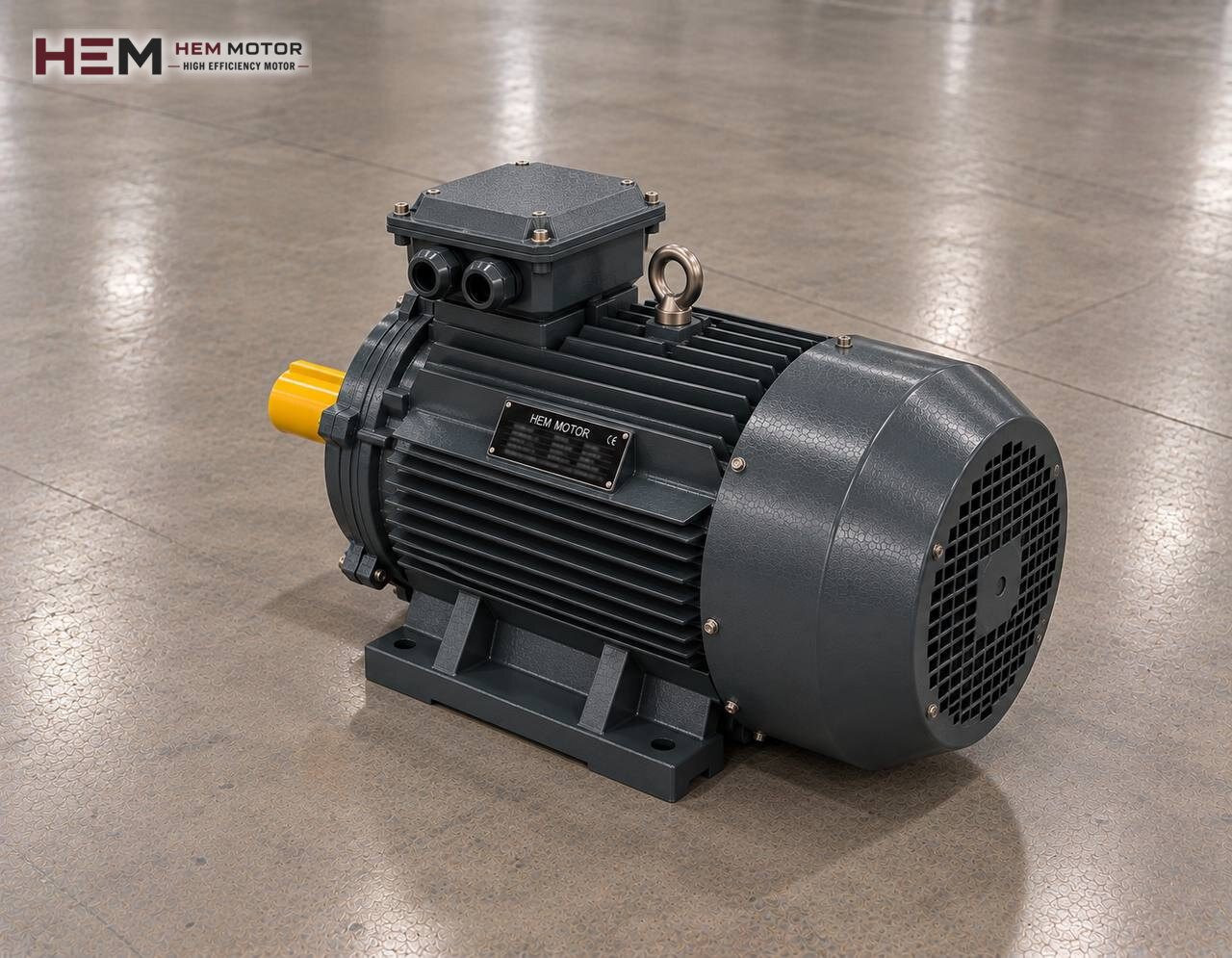
Lifting and handling machines raise the load from the ground, hold it in the air, travel it horizontally and set it down at the required point. Overhead travelling cranes, monorail hoists, gantry cranes, tower cranes, goods lifts and transfer carts are members of this family. The general framework of in-plant handling is on the handling systems electric motors page; this page honestly separates which motion the motor produces on crane-type machines and where a standard three-phase motor fits.

The three motions of a crane
An overhead travelling crane has three separate drives. The hoist drive turns the rope drum and moves the hook up and down. Trolley travel moves the hoist left and right along the bridge girder. Bridge travel moves the whole crane back and forth on rails along the building. On tower and gantry cranes a slewing motion is added to these.
The load character of these motions differs. Hoisting carries the load against gravity; during lowering the load tries to turn the motor and the motor brakes like a generator. Travel drives carry the load horizontally; here the main stress comes from inertia during acceleration and deceleration, and wind load increases it in open yards.
Brake and duty class on the hoist drive
Holding the load safely is the most critical issue in the hoisting motion. This is ensured by an electromagnetic brake combined with the motor, a separate brake fitted to the gearbox input or the rope drum, and the safety chain of the crane control. Brake motors are not included in HEM Motor's 2026 catalogue; therefore replacing a braked hoist motor with a motor without a brake arrangement is definitely not correct.
The second issue is duty class. Crane motors work with a cycle of frequent starts, short running and stops; this intermittent duty (such as S3, S4) requires a different thermal calculation from a motor designed for continuous duty. The motors in our catalogue are in the S1 continuous duty class. On hoist and travel drives, motor selection must follow the crane manufacturer's calculation and the relevant standards; a standard motor only comes into question if the crane manufacturer has specified it for that drive and the brake arrangement is installed independently of the motor.
Lifting and handling drives where a standard motor fits
In the lifting family there are many drives that need no brake or where another system holds the load. On hydraulic lifting platforms, scissor lifts, hydraulic goods lifts and truck ramps the electric motor only turns the hydraulic pump; the cylinder and check valve hold the load. In this arrangement motor selection is based on pump flow and pressure; details are on the hydraulic pump motors page.
Transfer carts running on rails on level floors inside workshops and warehouses, turntables, and coil and die transfer cars are also common applications. On these drives the motor turns a gearbox; where holding is needed, the brake is installed on the gearbox or wheel side. A frequency inverter is common for smooth starting at low speed.
The crane itself may also have auxiliary units using a standard motor: the fan of the cabin air conditioning or panel cooling, the pump unit of hydraulic grabs, a conveyor or feeder working with the crane. The crane manufacturer's wiring diagram shows which unit needs which motor.
Inertia and the inverter on travel drives
When a rail cart or bridge starts, the motor has to overcome not only friction but also accelerate the mass of the cart and the load. Direct-on-line starting makes this acceleration harsh; the load swings, wheels slip and the gearbox takes shocks. A ramped start with a frequency inverter largely eliminates these problems and makes positioning easier.
In inverter use, if the motor has to run at full torque for long periods at low speed, the shaft-mounted fan may be insufficient and an independent cooling fan is considered; if the drive is in the panel, the motor is on the crane and the cable is long, a dv/dt or sine filter is evaluated. Writing these two points in the order is enough; details are on the inverter compatible motors page. For gearbox matching you can also see the motors for gearboxes page.
Mounting, environment and maintenance
On travel and turntable drives the motor is mostly connected to the gearbox by a flange. Depending on frame, B3 foot, B5 and B14 flange, B34 and B35 foot-and-flange, and V1, V3, V5, V6, V15 vertical positions are offered; the gearbox flange and shaft dimensions are confirmed together in the order.
On gantry and port cranes in open yards, motors are exposed to rain, wind-blown dust and salty air. IP55 protects against splashing water and dust; a protective cover or a suitable mounting position should be considered in the crane design so that rainwater does not collect directly on the motor. An anti-condensation heater for long stops and a PTC or PT100 sensor monitoring winding temperature on frequently starting drives are order options. On motors fitted to a moving structure, fixing bolts and cable glands can loosen with vibration; periodic checking is simple but important maintenance.
Example selection for lifting and handling drives
4-pole motors are common on geared drives. For a small turntable the aluminium frame 100L1-4 (2.2 kW) produces 14.5 Nm at 1,450 rpm, for a transfer cart the cast iron 132M-4 (7.5 kW) 49.1 Nm at 1,460 rpm, for a hydraulic platform pump the 160M-4 (11 kW) 71.7 Nm at 1,465 rpm and for a heavy coil car the 160L-4 (15 kW) 97.8 Nm.
| Drive | What holds the load? | To be discussed in the order | Example HEM model |
|---|---|---|---|
| Turntable, light load | Gearbox and table brake | Flange size, inverter | 100L1-4, 2.2 kW |
| Rail transfer cart | Wheel or gearbox brake | Ramped start, cable length | 132M-4, 7.5 kW |
| Hydraulic lifting platform | Cylinder and check valve | Pump flow and pressure | 160M-4, 11 kW |
| Heavy coil or die car | Separate brake arrangement | Starting frequency, thermal load | 160L-4, 15 kW |
The table is a starting point; on the hoist drive the brake and duty class are decided by the crane manufacturer, and on the other drives by the selection set by the real load, speed, mounting and operating conditions.
Information list for a handling machine motor
For a quotation, send us the machine type and the task of the drive (travel, slewing, hydraulic unit), the motor power (kW), speed (rpm), voltage, mounting type, starting frequency and quantity. If the existing motor has a brake, be sure to state it. The nameplate image of the old motor is the most reliable source, since it also shows brake and duty class information. You can find our models and current prices on the shop page, and use the contact page for WhatsApp and phone.
Frequently Asked Questions
Can I replace my hoist's brake motor with a standard motor?
No. On a hoist drive the brake is there for the safety of the load. Since brake motors are not included in our 2026 catalogue, use the motor specified by the hoist manufacturer for this replacement.
Which motor is used on a hydraulic scissor lift?
The motor only turns the hydraulic pump; the cylinder and valves hold the load. Power is determined by pump flow and working pressure; a standard three-phase motor is suitable for this job.
Are the motors in your catalogue suitable for frequent-start crane duty?
Our motors are in the S1 continuous duty class. On crane drives with frequent starts and short operating cycles the thermal calculation is different; on these drives a motor matching the duty class specified by the crane manufacturer should be selected.
Is an inverter a must on a transfer cart?
It is not a must, but it reduces load swing, wheel slip and gearbox shock. On lines needing precise positioning an inverter is a practical solution.