English
 Français
 Türkçe
 Español
 Русский

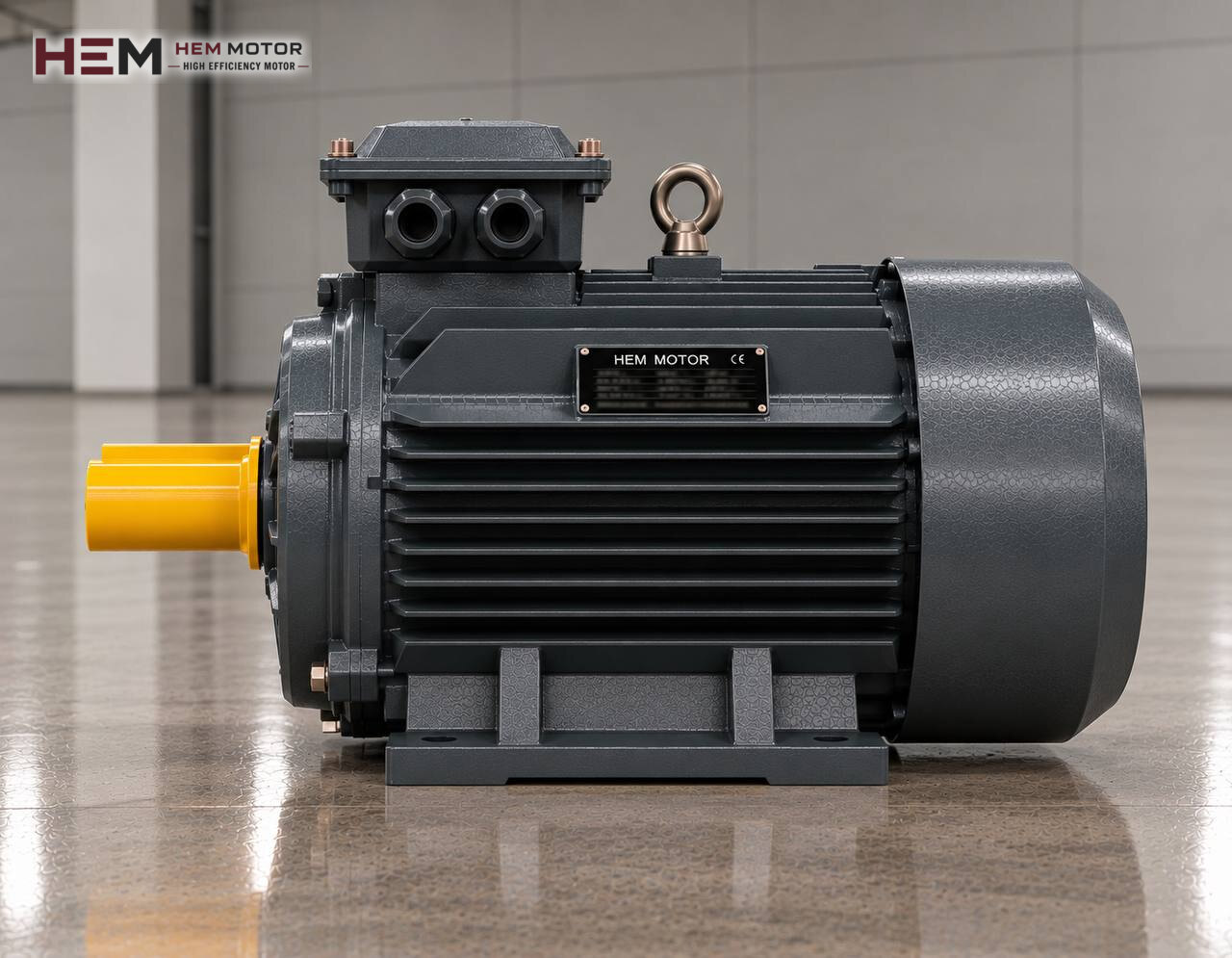
A scissor lift platform is a lift table that raises its deck vertically as pairs of cross-linked arms are opened by one or more hydraulic cylinders. It is used to bring workpieces to working height on a production line, to keep pallets at a steady feeding level or to provide an elevated work area for maintenance. This page covers the electric motor in the hydraulic unit that drives the scissor platform; the general page for its sector is under electric motors in handling systems.

The Cylinder That Opens the Scissor Arms and the Motor's Share
On a scissor platform the lifting force is produced by the hydraulic cylinder; the cylinder pushes the lower end of the scissor arms or presses on a pin in the middle of the arms, and the deck rises as the arms open. The electric motor's task here is to turn the pump in the hydraulic unit and send pressurised oil to the cylinder. The motor is not mechanically connected to the scissor arms, the deck or the cylinder.
Scissor geometry has an important consequence: when the arms are almost horizontal, i.e. when the platform is at its lowest, the force the cylinder needs to lift the same load is at its highest. As the deck rises, the arm angle grows and the required force falls. Hydraulic pressure therefore peaks at the very start of the lift, and that is also when the motor is under the greatest strain.
Keeping the deck in the air, controlling the descent and preventing the platform from collapsing in a hose failure are not the motor's job. These topics are dealt with separately in the safety section below.
Load Holding, Brakes and Safety: What Lies Outside Motor Selection
On a scissor platform, what keeps the deck at the desired height is the check valve or load holding valve fitted close to the cylinder. The pipe rupture valve that prevents a sudden drop if a hose breaks, the pressure relief valve, the lower and upper limit switches, protection against reaching between the scissor arms and the mechanical prop that locks the arms during maintenance form the machine's safety system. The design, selection and approval of this system are the responsibility of the platform manufacturer and follow the applicable machinery legislation.
Motor selection is independent of this safety assessment and does not replace it. There is no document showing that a standard three-phase motor is automatically suitable for lifting or able to hold the load, and we make no such claim. If the machine design calls for a brake motor, state this in the order.
Fixed or Mobile? Data to Collect for the Selection
Scissor platforms fall into two main groups. Fixed lift tables are installed on the floor or in a pit; their unit sits beside them in a separate cabinet or under the table and is usually fed three-phase from the building supply. Mobile (wheeled) scissor platforms generally run on batteries and carry their own DC pump unit; such DC unit motors are not included in HEM Motor's 2026 catalogue. The recommendations on this page apply to fixed platforms connected to the mains.
A motor request needs the following: the platform's lifting capacity and deck size, lifting height, the position of the load on the deck (load centre), the desired lifting time, the unit's pump flow and working pressure, the existing motor's nameplate values and the platform's daily operating pattern.
When the load centre moves away from the middle of the deck, the load on the arms and cylinder increases, and so does the peak pressure. The calculation is the platform manufacturer's job, but having this information in the motor request makes it easier to understand why the power has the value it has.
How Does Lifting Time Affect Power?
Two quantities determine motor power on a scissor platform: the highest pressure the cylinder needs and the volume of oil required to bring the deck to the top in the desired time. The shorter the lifting time, the more flow is needed to fill the same cylinder; when flow and pressure rise together, so does the power needed to turn the pump. The numerical calculation of this relationship relies on the pump manufacturer's data; the general method is described on the hydraulic pump motors page.
On the speed side the pump is decisive. When the unit designer chooses the pump displacement, the motor's synchronous speed is taken into account; four-pole motors are common in these units. If the motor is being changed on an existing platform, the same speed as the old motor should be kept; at a different speed the lifting time and the pump's operating point change.
If you have the old motor's nameplate, power and speed can be read directly from it. If it is worn off, the type plate on the pump and the unit's documentation are the second source.
Motor Connection on the Hydraulic Unit
In scissor platform units the motor usually sits on top of or beside the tank. The pump connection is made in one of two ways: a bell housing seated on the motor's B5 or B14 flange with a coupling inside, or a pump adapter through which the pump is attached directly to the motor flange. In compact units the motor may stand vertically, in which case the shaft direction must be written in the order. The general structure of the unit is described separately on the hydraulic power unit motor page.
The dimensional comparison starts with the IEC frame number. Then the flange type and diameter, bolt circle, shaft diameter and length, key width, foot hole spacing if any and terminal box position are compared one by one with the old motor. On the electrical side, voltage, star/delta connection and rated current must also be compared. Until these dimensions match, it cannot be said that the new motor can be fitted to the existing bell housing. For the available layouts see the mounting arrangements page.
In a Cabinet, in a Pit or in a Maintenance Area: Ambient Conditions
On a lift table recessed into a pit, the unit sometimes stays inside the pit, in a damp and poorly ventilated place. This makes cooling the motor harder; space must be left in front of the fan cover and the unit cabinet must be ventilated. On platforms near a paint shop or washing area, reducing the motor's contact with moisture and dirt is achieved through unit placement.
Our catalogue values apply to ambient temperatures from −15 to +40 degrees Celsius and altitudes up to 1000 m; the motors are IP55 with class F insulation. Installations outside these limits, for example a lift table inside a freezer store, must be written in the order. An anti-condensation heater for platforms that stand idle for long periods, and a PTC or PT100 sensor for those who want to monitor winding temperature, are order options. A standard motor is not suitable for areas requiring explosion protection (Ex).
Daily Start Pattern and Use with a Drive
The operating pattern of a scissor platform varies greatly with its place of use. On an assembly line the operator may raise and lower the deck a little for each part; that means short, frequent starts. On a pallet feeding table the deck rises step by step as each pallet layer is removed. On a maintenance platform there are only a few long lifts a day. Since motor heating depends on this pattern, we ask you to tell us the number of starts per hour and the duration of one lift.
On platforms that rise step by step, a frequency converter can be used for smooth movement. Our three-phase range can run on a drive; if there is long full-load operation at low speed an external fan is considered, and a dv/dt or sine filter for a long motor cable. Speed adjustment with a drive changes the platform's start and stop behaviour; this decision and its setting belong to the machine manufacturer. See inverter compatible motors.
Send Us This to Replace an Old Unit Motor
Sending the information via WhatsApp is enough; the angle from which to photograph the nameplate is explained in the nameplate guide. WhatsApp and phone details are on the contact page.
- A legible photo of the motor nameplate (power, speed, voltage, current)
- Platform type: fixed lift table, pit type, pallet feeding table
- Lifting capacity, lifting height and desired lifting time
- Pump type plate or flow and pressure values
- Mounting: B5/B14 flange, bell housing and coupling or pump adapter; motor horizontal or vertical
- Number of starts per hour and whether a drive is used
- Whether a brake motor is required, and quantity
Motors in the Store for a Scissor Platform Unit
All models are listed on the electric motor store page. For small lift tables see aluminium frame motors, and for heavy loads and pit installations cast iron frame motors.
| Scissor platform type | Decisive for power | Store example |
|---|---|---|
| Ergonomic lift table on an assembly line | Short stroke, frequent starts | 1.1 kW aluminium, 90S-4 |
| Pallet feeding table | Heavy load, stepwise rise | 3 kW cast iron, 100L2-4 |
| Heavy-duty pit lift table | High capacity, short lifting time | 4 kW cast iron, 112M-4 |
| Battery-powered mobile scissor platform | On-board DC unit | Not included in the 2026 catalogue |
These models are examples and not a final selection; suitability for the machine is verified separately with pump data, speed and flange dimensions.
Frequently Asked Questions
Why does the motor draw more current when the deck is at the bottom?
At the lowest position the scissor arms are almost horizontal; this is when the cylinder produces the greatest force to lift the same load. Pressure rises, and so does the load on the motor turning the pump.
The platform deck lowers by itself; could it be a motor fault?
Usually not. Whether the deck stays in place depends on the check valve, the load holding valve and the cylinder seals. This symptom calls for the hydraulic circuit to be checked by the platform manufacturer or its service.
Is fitting a larger motor alone enough to speed up the lift?
No. Lifting speed depends on pump flow; flow is set by pump displacement and speed. Changing the speed also affects pump, valve and safety settings; the platform manufacturer should make the decision.
Can I find the battery pump motor of a mobile scissor platform?
Battery-powered DC pump motors are not included in HEM Motor's 2026 catalogue. For fixed lift tables connected to the mains, our three-phase models can be reviewed.
Is an extra precaution needed for a unit inside a pit?
In a damp, poorly ventilated pit, motor cooling becomes harder and the risk of condensation increases. Ventilating the cabinet and, if necessary, specifying the anti-condensation heater option in the order is recommended.