English
 Français
 Türkçe
 Español
 Русский

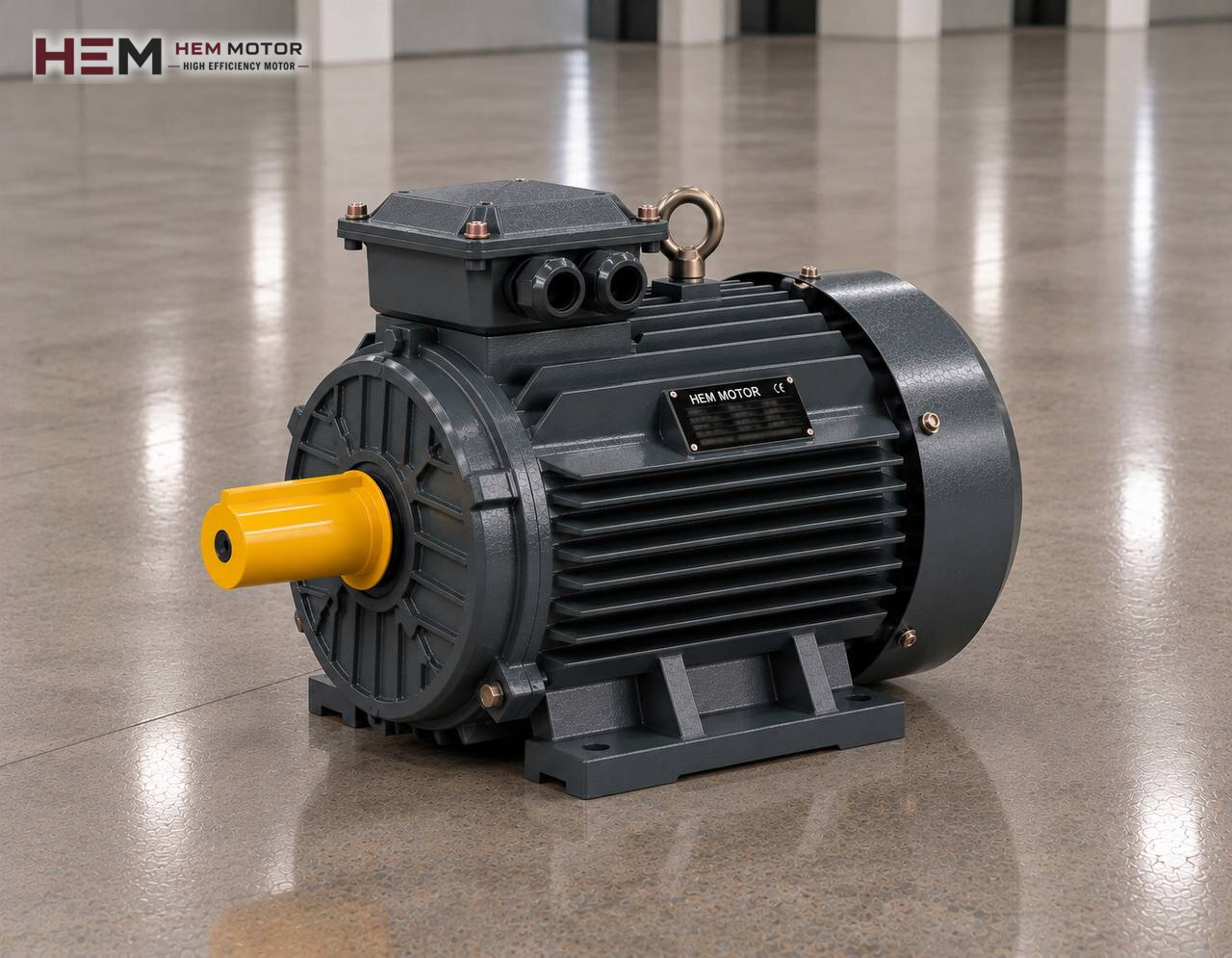
Ice cream production begins with preparing and ageing the mix, takes shape when it is aerated and partly frozen in the freezer, and ends in the hardening tunnel. A different electric motor works at each stop on this route: tank agitators turn slowly, the scraper-blade shaft of the continuous freezer delivers torque against a mass that cools and thickens, and tunnel fans blow air at sub-zero temperatures. This page sits under the section where we cover motors for food processing machines and describes the motor loads specific to an ice cream line.

Ageing tank: hours of slow mixing
The pasteurised and homogenised mix waits in chilled-jacket ageing tanks for anything from a few hours to overnight before going to the freezer. During this time the mix must move gently so that the fat crystallises and the stabiliser binds water. The agitator on top of the tank turns via a geared motor with a vertical shaft; the load is light but continuous, and the motor is usually flanged to the gearbox in a vertical arrangement such as V1.
Agitator speed is kept low; mixing too fast whips air into the mix and causes foaming. Speed is set by the gearbox ratio chosen by the machine builder; when replacing the motor, keep the ratio and the number of poles. Our geared drive page is a guide for motors coupled to gearboxes. The heat-treatment step of the mix is a separate topic, covered on the sister page we wrote for pasteurisation units.
Continuous freezer: the scraped-surface cylinder
The heart of industrial ice cream is the continuous freezer. It has a jacketed cylinder through which refrigerant flows and, inside it, a rotating dasher carrying scraper blades. As the mix is pumped into the cylinder, a controlled amount of air is injected; the blades constantly scrape off the thin layer freezing on the cylinder wall, disperse the air bubbles into the mix and push the product to the outlet at soft-serve consistency.
The dasher motor's load is directly linked to the stiffness of the ice cream. As the outlet temperature falls the mass thickens and the torque needed at the shaft rises; operators therefore watch dasher motor current as an indicator of consistency. Unlike an ordinary fan or pump load, this is a variable load fed by the product. Stopping the freezer is also a critical moment: if product left in the cylinder freezes, the motor needs very high torque at restart. Most freezers cut refrigeration or defrost the cylinder with hot gas when they stop; this control logic belongs to the machine builder.
Besides the dasher, the freezer has a mix feed pump (usually a gear or lobe positive-displacement pump) and a product pump at the outlet. Because these pumps set the flow and the air content of the product, they are mostly driven by a frequency converter. HEM's three-phase motors are suitable for converter use; if the pump or dasher will stay at low speed and high torque for long periods, whether an independent cooling fan is needed, and with a long cable between motor and drive whether a filter is needed, is discussed at the order stage. The topic is also on the inverter-driven motors page.
Batch ice cream machines
Batch machines used by ice cream parlours and small workshops apply the same principle one batch at a time: the mix is placed in a horizontal or vertical cylinder, the cylinder is cooled while the blades turn, and the ice cream is discharged once the consistency is reached. The load rises noticeably towards the end of the batch. Some of these machines run at two speeds or change speed by converter. For small businesses without a three-phase supply we have a single-phase motor series covering 0.18–5.5 kW; the existing motor's nameplate shows the correct power.
Other motors in the cold chain
- Hardening tunnel and cold room fans: Packed ice cream is hardened in tunnels where air at sub-zero temperatures is blown. Evaporator fans run continuously; since fan load varies roughly with the cube of speed, staying at the fan's design speed is important. General fan information is on the industrial fan motors page.
- Fruit and inclusion feeder: The screw feeder that adds nuts, chocolate pieces or fruit at the freezer outlet turns via a small geared motor.
- Refrigeration compressor: The refrigeration system feeding the freezer and tunnel relies on high-power compressors; these drives are described on the compressor motors page.
The motor in a cold and humid environment
In an ice cream plant motors work between two extremes: the production hall is cool and humid, while the hardening area is far below freezing. Motors moving from cold to warm areas or stopping overnight have a high risk of condensation in the winding; an anti-condensation heater is therefore a frequently requested order option. A PTC or PT100 sensor for monitoring winding temperature can also be added at order. If the ambient temperature where the motor will run falls below the limit in the catalogue, state it in your order; bearing grease and seal material are assessed according to this information.
The freezer and tanks are cleaned by CIP and washed on the outside after every production run. The IP55 protection of HEM motors is aimed at dust and water splashes; direct hosing, foaming chemicals, product contact or hygienic design expectations are not conditions this standard motor meets. In such a case a protective measure by the machine builder or a special motor is needed; state it in your order.
Example HEM models for an ice cream line
| Line section | Nature of the load | Point to watch | Example HEM model |
|---|---|---|---|
| Ageing tank agitator | Light, continuous for hours | Vertical mounting, gearbox ratio | 0.37 kW 71M2-4 (1,340 rpm) |
| Mix feed pump | Positive displacement, constant torque | Flow adjustment by converter | 1.5 kW 90L-4 (1,445 rpm) |
| Batch ice cream machine | Rising towards end of batch | Single- or three-phase supply | 2.2 kW 100L1-4 (1,450 rpm) |
| Continuous freezer dasher shaft | Varies with consistency, frozen-start risk | Starting torque, anti-condensation heater | 7.5 kW 132M-4 (1,460 rpm) |
The table is only for orientation; the right motor is chosen by examining the machine's load, required speed, connection type and operating environment together.
What to tell us when requesting a motor
Photographing and sending the nameplate of the motor to be replaced is usually enough; you can find the steps in our article on finding an equivalent motor from the nameplate. If there is no nameplate, please share: the machine (ageing tank, continuous freezer, batch machine, feeder, tunnel fan), the motor's power (kW), speed (rpm), supply voltage, mounting type (vertical, flange, foot), the ambient temperature where the motor will run and the quantity required.
You can browse all models and prices in our shop. For a quote contact us via WhatsApp or phone; the numbers are on our contact page.
Frequently Asked Questions
Why does the freezer's dasher motor sometimes fail to start?
If the ice cream left in the cylinder froze when the machine stopped, the blade shaft locks and the motor cannot overcome the starting torque. Wait for the cylinder to thaw; forcing the motor again and again damages the winding and the gearbox.
Why does dasher motor current change during production?
As the outlet temperature falls the ice cream thickens and more torque is needed at the shaft. This change in current is normal and is monitored in many plants for consistency control.
Can I turn the ageing tank agitator faster?
It is not recommended. Fast mixing whips air into the mix and causes foaming; the tank's design speed was chosen for product quality.
What should I state for a motor that will run in the hardening tunnel?
Give the lowest ambient temperature where the motor will be located and whether the motor has standstill periods. With this information the anti-condensation heater and bearing lubrication are assessed.