English
 Français
 Türkçe
 Español
 Русский

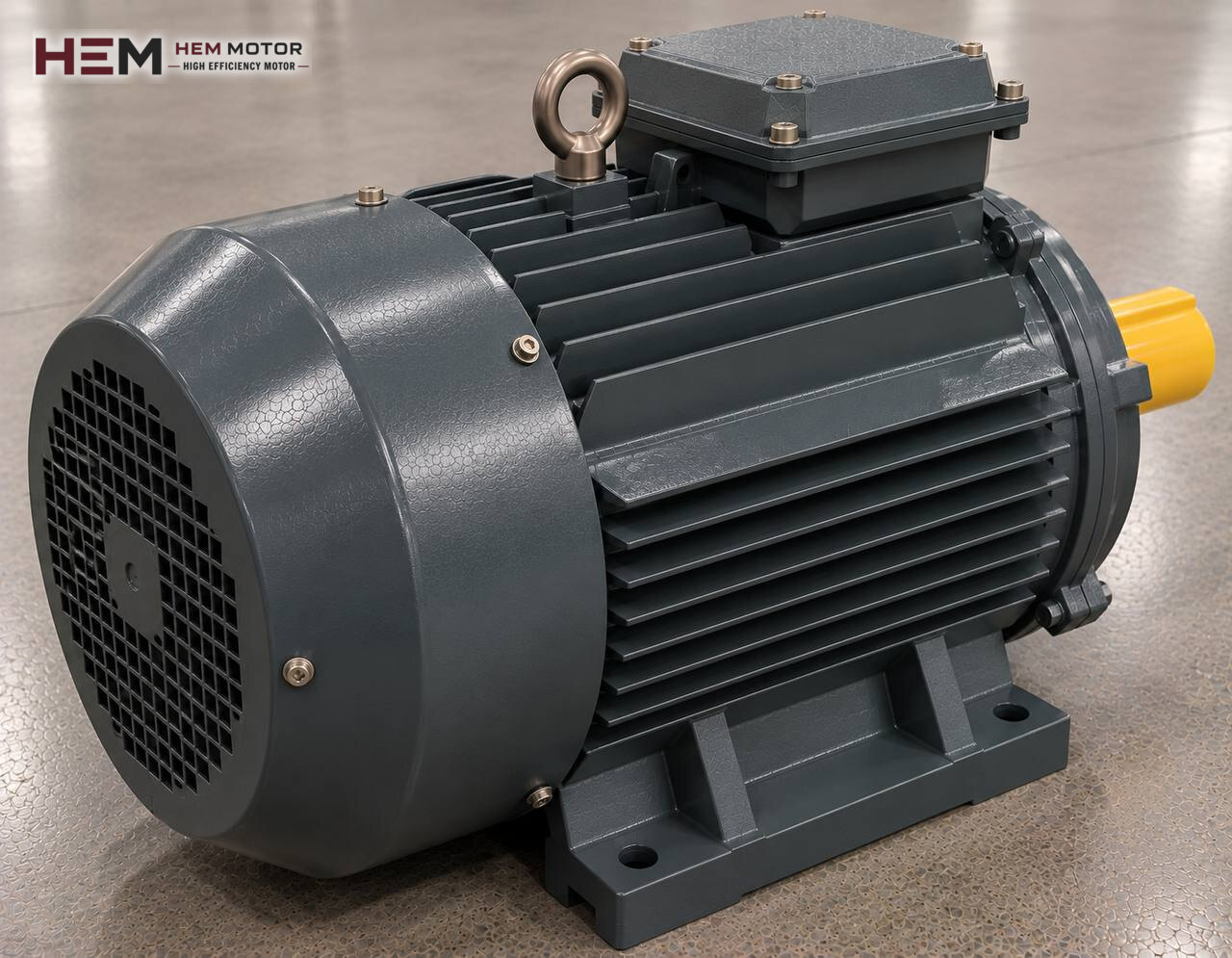
Whether it is a small grinder on a butcher's counter or a large screw-fed machine in a meat plant, the force that produces minced meat comes from a single rotating shaft. This page covers the electric motor that turns that shaft; for the broader picture of food machinery, see our Electric Motors for Food Processing and Preparation Machines page.

Feed screw, knife and plate: what does the motor turn?
Meat drops from the hopper onto the feed screw (worm). The screw compresses the meat and pushes it forward. At the front end, a cross knife rotating with the screw wipes the face of the perforated plate, and the meat leaves through the plate holes as mince.
Most of the load on the motor is this compression resistance needed to press meat against the plate; the cutting work of the knife is small by comparison. The smaller the plate holes, the higher the resistance. A machine that runs easily with a coarse plate may show a clearly higher motor current when mincing fine.
Models with a mixer have a second motor turning the paddles in the hopper. That motor runs slower and more evenly, and it should be assessed separately from the screw motor.
Frozen meat, sinew and blockages: the nature of the load
The load of a mincer is never constant. Fresh, fatty meat flows easily, while half-frozen blocks, sinew and cartilage brake the screw for an instant. These short torque peaks can exceed rated torque, so the motor needs enough margin to handle them without overheating.
The hardest moment is restarting a stopped machine with a full hopper: meat packed in front of the screw loads the motor from the very first turn. Power should not be estimated on the assumption of a no-load start.
Many machines have a reverse button to clear blockages. A three-phase motor is reversed by swapping two phases. A control that waits for the screw to stop completely before changing direction protects both the gearbox and the winding.
As the knife and plate become dull, meat is crushed instead of cut, compression resistance rises and the motor draws more current. If the ammeter on the panel creeps up week after week, check the knife set before the motor.
Speed, gearbox and belt selection
The screw turns slowly; motor shaft speed cannot be passed to it directly. Industrial machines place a gearbox (reducer) between motor and screw, while counter-top machines usually use a belt and pulley or a compact gear train. In this arrangement a 4-pole (1,500 rpm synchronous) motor is the most common choice, and output speed is set by the gear ratio. Matching motors to gearboxes is covered separately on our geared drive motors page.
Some businesses want to adjust screw speed to the fineness of the mince. Our three-phase series can be driven by a frequency inverter. If the screw will run slowly at full load for hours, a separate cooling fan may need to be added to the motor; if the line from drive to motor is long, a dv/dt or sine filter comes into question. Simply state these details in your order.
Sample motors by type of mincer
| Mincing machine | Load seen by the motor | Key criterion | Sample HEM model |
|---|---|---|---|
| Counter-top butcher's mincer | Screw via belt or gears, short duty | Supply type, nameplate power | 1.1 kW 1,500 rpm 90S-4 (aluminium) |
| Mid-size butcher and supermarket machine | Start with full hopper, sinewy meat | Starting torque, plate hole size | 2.2 kW 1,500 rpm 100L1-4 (cast iron) |
| Mixer-grinder | Screw plus separate mixer | Power of each of the two motors | 4 kW 1,500 rpm 112M-4 (cast iron) |
| Industrial mincer (half-frozen meat) | Geared screw, shock torque | Gear ratio, hourly capacity | 7.5 kW 1,500 rpm 132M-4 (cast iron) |
These rows are examples only; the right motor is determined by the real load on the screw, the required speed, the coupling arrangement and the conditions in the room. The nameplate of the motor currently in the machine is the most reliable data to start with.
According to catalogue data, the 100L1-4 delivers 14.5 Nm at a rated 1,450 rpm; the 132M-4 produces 49.1 Nm at 1,460 rpm and draws 14.3 A at 400 V. Comparing these values with the nameplate of the existing motor gives a quick first screening.
Mounting, cold rooms and cleaning
In a mincer the motor usually sits inside the body, flange-mounted to the gearbox or foot-mounted on a base. Depending on frame size, foot-mounted B3, flange B5 and B14, foot-and-flange B34 and B35, or vertical V1, V3, V5, V6 or V15 can be chosen; we confirm flange and shaft dimensions together at the order stage. For flanged versions, see the B5/B14 flange motors page.
Meat processing rooms are cool and humid, and the machine is cleaned with water at the end of the day. All our models on sale are IP55. This protects against dust and low-pressure water splashes; it is not designed for pressure washing, direct food contact or hygienic design. A guard separating the motor from meat and wash water is the machine builder's measure; if a stainless or washdown special motor is needed, state this in your order.
Machines moved from a cold store into a warm room may show condensation inside the motor housing. A condensation heater and PTC/PT100 winding sensors are order options. On machines that block often, a winding sensor provides a second safeguard alongside the motor protection relay. If the fan cover fills with grease and meat scraps the motor overheats, so check the cover's air openings during cleaning too.
Single-phase or three-phase?
Neighbourhood butchers often have only a 230 V single-phase supply. For low-power mincers, our separate single-phase series covering 0.18–5.5 kW can be considered; details are on the single-phase electric motor page. Where three-phase power is available, the motor needs no starting capacitor and a reversing control is simpler to build; for options, see the 3-phase electric motors page.
What to send us for a quotation
Just write the machine type (counter-top, mixer-grinder, industrial), the power (kW) and speed (rpm) of the existing motor, the supply voltage (230 V single-phase or 400 V three-phase), the mounting type (foot or flange) and the quantity. For motors coupled to a gearbox, flange type and shaft diameter also matter.
If you send a photo of your old motor's nameplate, we will identify the equivalent together. All models are in the electric motor shop; the current price is on each product page. WhatsApp and phone details are on the contact page.
Frequently Asked Questions
Why does the motor stop when my mincer gets blocked?
When the screw jams, current rises and the motor protection relay trips. Reverse the machine and remove the jammed meat; if this happens often, check the sharpness of the knife and plate first.
Does the reverse button harm the motor?
Changing direction while the screw is still turning strains the winding and the gears. The control should wait for the machine to stop before reversing.
The motor gets hot with a fine plate; should I move to a more powerful motor?
First check the knife set and the running current. If the current stays above the nameplate value, assess a power increase together with the machine builder; the gearbox and screw must also suit the new power.
Can I hose down the motor of my mincer?
No. A standard IP55 motor is not designed for pressure washing; protect the motor with a guard, or state in your order if a washdown special motor is required.
Can I fit a 2-pole motor instead of a 4-pole one?
If you do, screw speed roughly doubles and torque at the same power is halved. Unless the gear ratio is changed, stay with the same number of poles as the old motor.