English
 Français
 Türkçe
 Español
 Русский

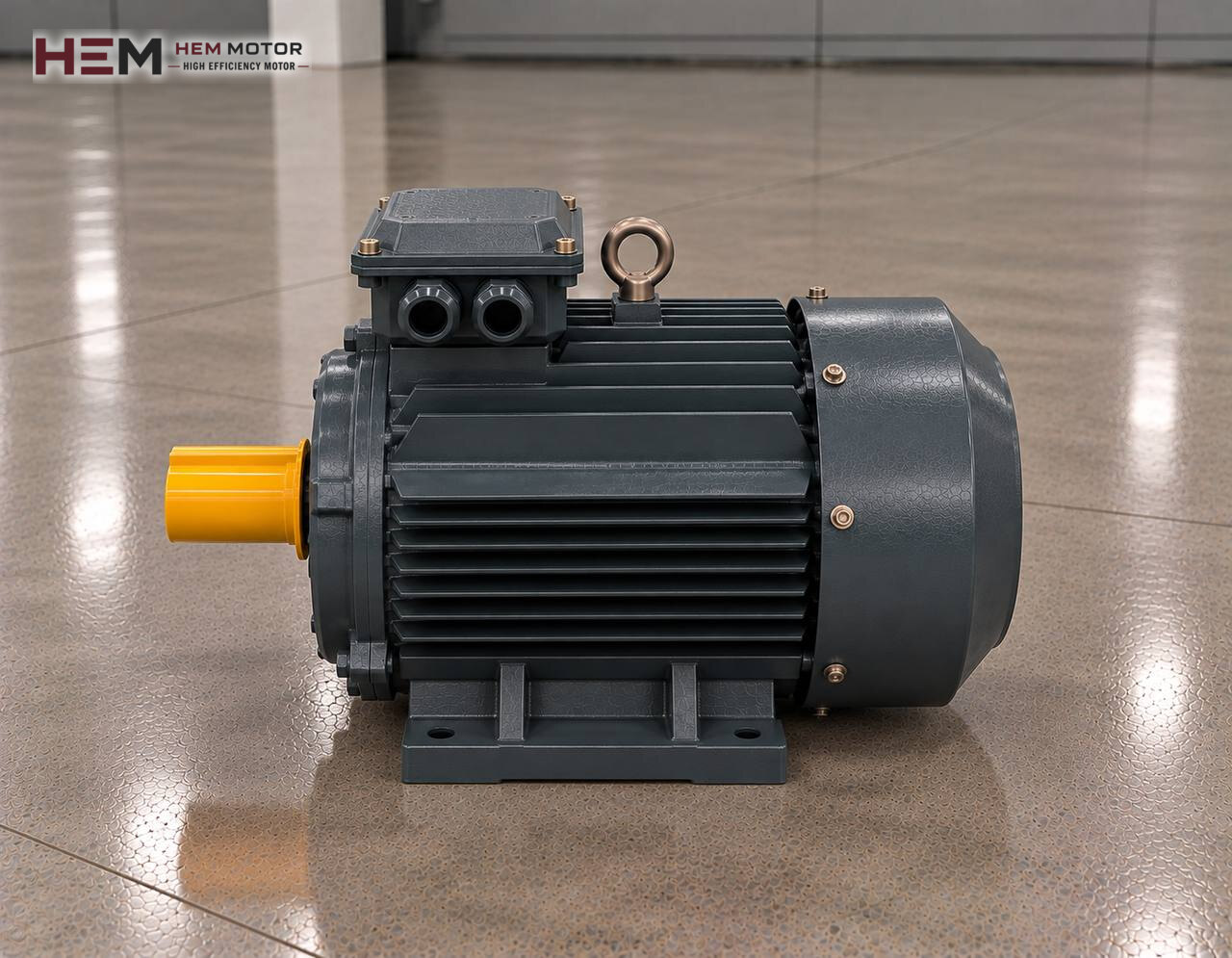
A vegetable and fruit washing machine never runs on a single motor: the air blower that agitates the water, the inclined belt that lifts produce out of the tank, the pump that feeds the rinse sprays and sometimes brush rollers or a rotating drum are each driven separately. This page sits under the section where we cover electric motors for food processing and preparation machines and explains what is expected of the motor at every drive point of a washing line, and how a constantly wet environment narrows the choice.

How many motors are on a washing line?
Lines for lettuce, tomatoes, apples, carrots, peppers or potatoes are arranged differently depending on how robust the produce is, but the moving parts are usually these:
- Air-bubble tank: Air pushed through perforated pipes on the tank floor makes the water boil-like and separates soil and leaf debris from the produce. A side-channel or roots-type blower supplies the air.
- Outlet elevator: An inclined belt with plastic slats lifts produce out of the tank, moving slowly so the water can drain.
- Rinse sprays: Nozzles spraying clean water onto the produce on the belt are fed by a small centrifugal pump. There may also be a separate circulation pump that filters the tank water and returns it.
- Brush or drum washer: For root vegetables, side-by-side brush rollers or a rotating drum with internal paddles scrub the produce clean.
- Draining and drying: After washing, a vibrating strainer or an air-knife fan removes water from the produce.
The air blower: the machine's most continuously running motor
With the tank full, the blower never stops during a shift. Its load depends on the back-pressure created by the water depth in the tank; as the nozzle holes get dirty and narrower, pressure and motor current rise too. Monitoring blower motor current periodically is therefore a simple sign that the holes are clogging. Side-channel blowers are usually coupled directly to the motor and run at 2-pole speed; roots types prefer a belt and pulley. The pressure-relief valve is part of the machine, not of the motor. General rules for blower drives also appear on the compressor and compressed-air motors page.
Builders who want to adjust the air volume to the produce drive the blower motor through a frequency converter: little air for delicate leafy greens, plenty for soiled roots. In this use HEM's three-phase motors are suitable for converter operation; if the motor must stay at low speed for long periods we discuss the need for an extra fan, and with a long cable the need for a filter, together at the order stage.
Belt, brush and drum drives
The outlet elevator and brush rollers turn at low speed; there is usually a gearbox between the motor and the shaft. In brush machines the rollers are linked by chain or gears and all turn from one motor. As the brushes wear, pressure on the produce drops and the load falls; when new brushes are fitted, current may look somewhat higher for the first days. For geared arrangements see our geared motor page.
In rotating drum washers the drum runs on rollers around its outer circumference; the motor turns it through a chain sprocket or a friction roller. Starting is heavier when the drum is full of water and produce, so it is advisable to start the drum empty and open the feed afterwards. The drum's direction of rotation follows the machine builder's design; changing it alters how long the produce stays inside.
The motor against water, soil and detergent
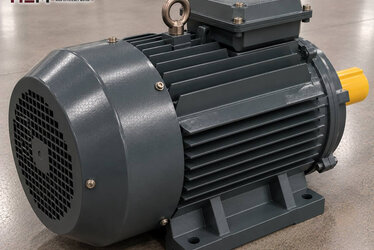
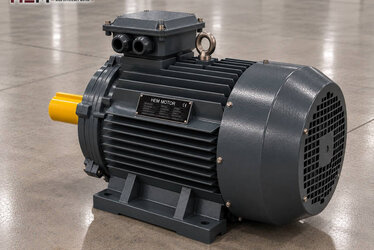
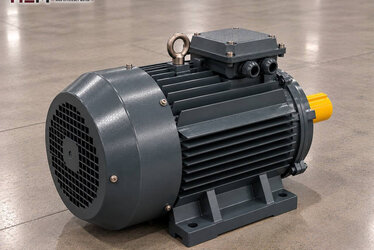
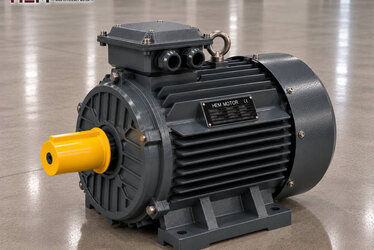
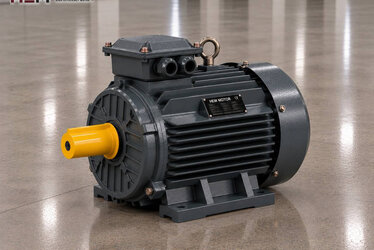
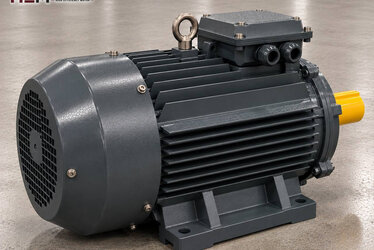
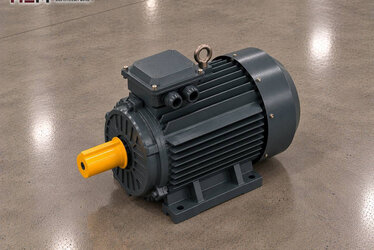
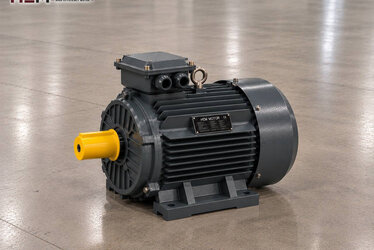
The washing machine is the wettest machine in a food plant. Motors stand at the edge of the tank, right next to splashing water and vapour; at the end of the shift the whole machine is washed with a hose and often with foaming cleaning agent. The IP55 protection class of HEM motors is designed against dust and water splashes; a direct hose or pressurised water jet, chemical foam, submersion of the motor or contact with food are outside the scope of this standard motor. If the motor is to stay in this zone, the machine builder should take a protective measure (raising the motor above tank level, covering it with a stainless hood, shielding it during washing) or a special motor should be chosen; state this in your order.
In plants close to cold stores that are not heated at night, the risk of condensation in the winding is high. An anti-condensation heater and a PTC or PT100 sensor for winding temperature are order options. Soil and leaf debris stuck to the fan cover cuts off the cooling air; a weekly cover clean extends motor life.
Mounting, base frame and small machines
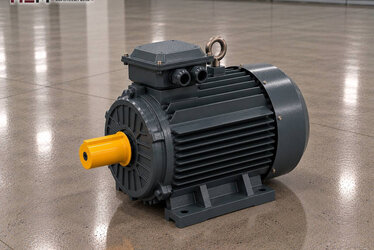
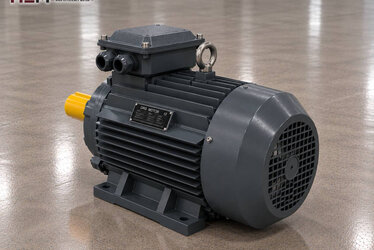
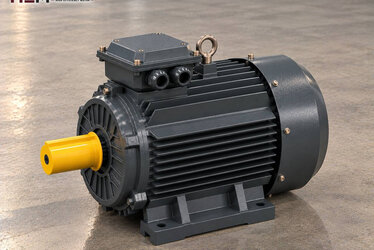
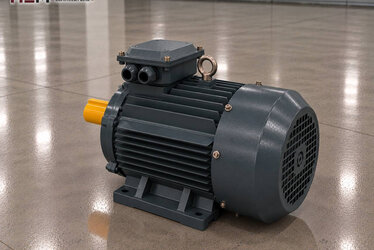
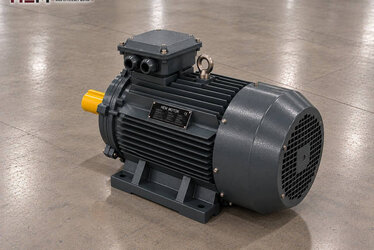
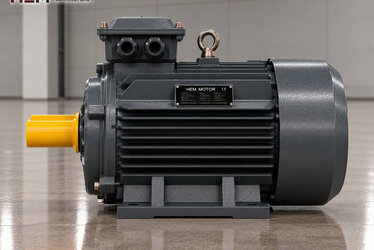
Blower motors usually sit foot-mounted (B3) on a common base with the blower. For belt and brush drives the motor is flanged (B5 or B14) to the gearbox; some compact machines use foot and flange together (B35). HEM offers foot, flange and vertical (V1 etc.) arrangements according to frame size; we settle flange and shaft dimensions together at the order stage.
Bench-type washing machines used in restaurant kitchens and small packing plants are mostly connected to a single-phase supply. For machines of this scale you can look at our single-phase electric motor series covering 0.18–5.5 kW.
Example HEM models for a washing machine
| Drive point | Load character | Point to watch | Example HEM model |
|---|---|---|---|
| Rinse spray pump | Steady, continuous | Pump speed, distance of motor from water | 0.55 kW 80M1-4 (1,400 rpm) |
| Outlet elevator belt | Low speed, even | Gearbox ratio, flange type | 1.1 kW 90S-4 (1,445 rpm) |
| Air-bubble tank blower | Continuous, pressure-dependent | Water depth, nozzle clogging | 2.2 kW 90L-2 (2,895 rpm) |
| Brush roller / rotating drum | Frictional, loaded start | Empty start, chain transmission | 3 kW 100L2-4 (1,450 rpm) |
The motors in the table are for illustration; the right model is determined by considering the machine's load, required speed, mounting type and operating environment together.
What to send us before ordering
A clear photo of the nameplate of the motor to be replaced is enough in most cases; our article on finding an equivalent motor from the nameplate describes this route. If the nameplate is unreadable, send: machine type and the motor's task (blower, belt, brush, drum, pump), power (kW), speed (rpm), supply voltage (single- or three-phase), mounting type, how close the motor is to splashing water and the quantity required.
You can see models and prices in our electric motor shop. For a quote use WhatsApp or phone; the numbers are on the contact page.
Frequently Asked Questions
Why does the blower motor current rise slowly over a few weeks?
The holes in the air pipes on the tank floor narrow with scale, starch or soil; the blower tries to push the same air against higher pressure. Cleaning the holes usually brings the current back to its earlier value.
Can I wash the washing machine's motor with a hose?
A standard IP55 motor is not designed for a direct hose or pressurised water. During washing the motor should be covered or the protective hood provided by the machine builder should be used.
Why does the rotating drum struggle when starting in the morning?
Water and produce residue left at the bottom of the drum overnight make the first turn heavier. Emptying the drum before shutdown and starting it empty in the morning reduces this load.
Can a 220 V motor be used on a small washing machine?
Yes, single-phase motors are common on low-power bench-type machines. HEM's single-phase series covers 0.18–5.5 kW; the required power and speed are taken from the existing motor's nameplate.