English
 Français
 Türkçe
 Español
 Русский

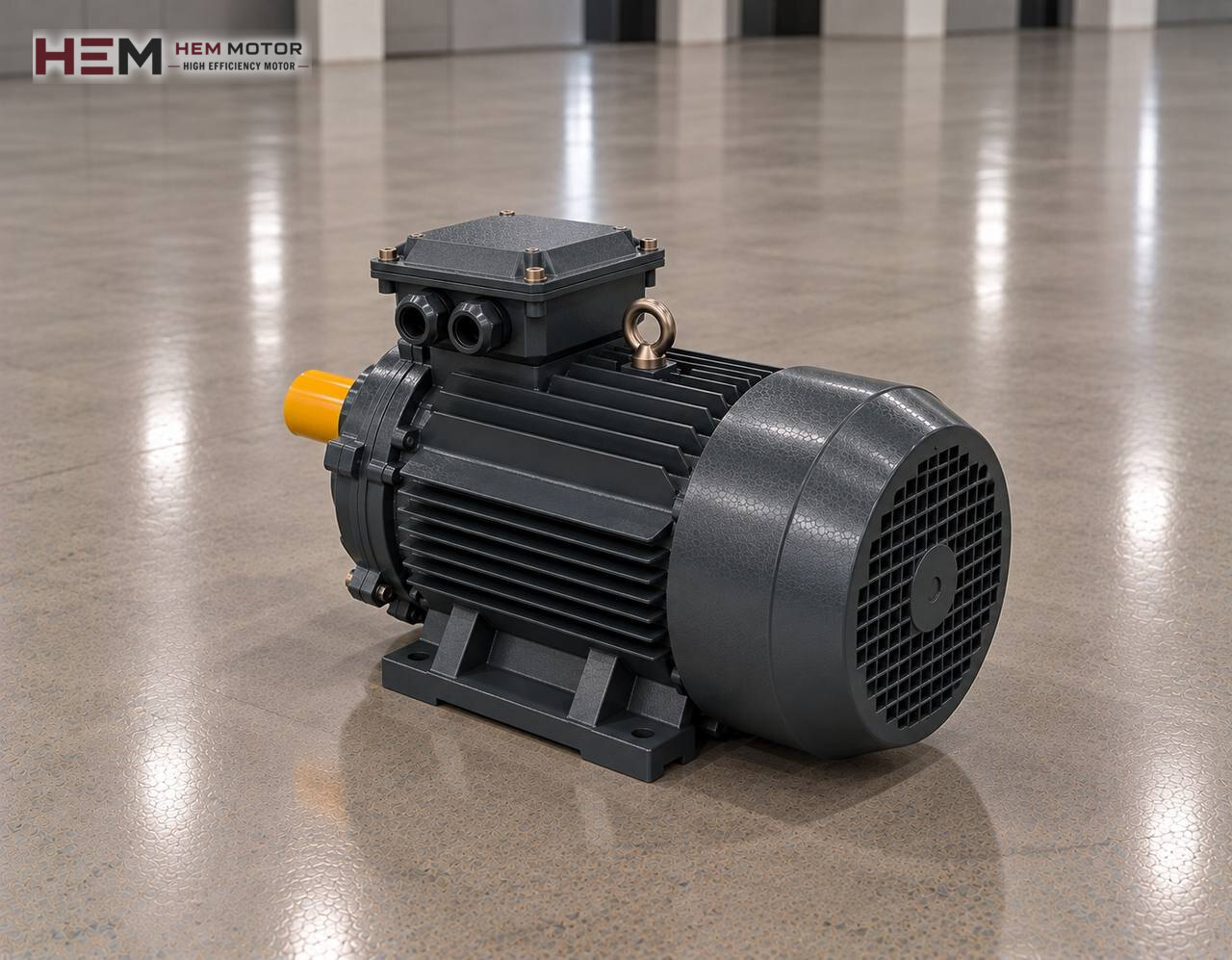
On a slaughter line, a chicken leaving the scalding tank is stripped of its feathers within seconds between the rubber fingers of a plucking machine. Slaughterhouse equipment sits under our main page collecting electric motors used in food machinery; here only the plucker and the drives around the scalding tank are covered.

How Do Drum Pluckers and Disc Lines Work?
In the drum (tub-type) plucker used in small slaughterhouses, a disc with rubber fingers turns at the bottom of a cylindrical tub, and the inner wall of the tub also carries fingers. Scalded birds are thrown in; the rotating plate tumbles them and the fingers rub the feathers off. Several birds are processed at once and a batch is short. A water spray line removes the feathers through the outlet in the base.
In industrial lines the birds pass hanging by their feet from an overhead conveyor. On both sides of the line there are many rows of discs set at an angle; each disc face carries rubber fingers and neighbouring discs turn in opposite directions. Each disc group is usually turned by its own motor via a belt or gearbox. The scalding tank is at the start of the line, head and feet cutting units at the end.
The Load the Fingers Put on the Motor
Plucking load depends on how hard the fingers press on the bird and how many feathers they meet. In a drum plucker the load rises the moment birds are thrown in and falls as the feathers come off. Loading more birds than the tub's capacity strains the plate motor and can damage the skin. On a disc line the load depends on line speed and bird spacing; when the line runs full the load is fairly even.
Scalding water temperature and time also affect the motor indirectly. With too little scalding the feathers hold tight, the fingers meet more resistance and current rises. Too much scalding tears the skin. Setting the scalding correctly, rather than fitting a bigger motor, protects both product quality and drive life.
Speed, Direction of Rotation and Transmission
On disc pluckers, the speed at which the fingers strike the bird determines the plucking result. Disc speed is therefore usually set by pulley ratio or a frequency inverter. HEM three-phase motors can be fed from a drive; if the discs are planned to turn slowly under heavy load for hours, the motor's own fan may not supply enough air and an independent cooling fan comes into question. If the panel is far from the motor, an output filter is also dealt with in the quote; the inverter compatible electric motors page explains these topics in detail.
Opposing disc groups must turn in opposite directions; on an asynchronous motor the direction is easily reversed by swapping two phases. On drum pluckers the plate usually turns via a belt, sometimes via a gearbox mounted directly underneath; for gearbox and flange matching in a vertical-shaft layout, take a look at the electric motors for gear reducers page.
Scalding Tank and the Line's Other Motors
In the scalding tank, a circulation pump or an air blower keeps the water at the same temperature everywhere. The drive pulling the overhead conveyor chain carries birds from the tank at line speed; this is usually a geared motor running continuously. The channel or screw carrying feathers and water, the feet plucking and head pulling machines also turn on separate motors.
On the overhead conveyor motor, the load varies with the number of birds on the line and chain friction; starting with a full line raises the torque demand. On blower and pump drives the load is continuous and set by flow demand.
Hot Water, Steam and Washdown Conditions
The plucking area is the wettest part of a slaughterhouse. Hot water is sprayed, the room fills with steam, feather and blood residue spreads around, and the area is washed intensively at the end of the shift. The IP55 marking on HEM motors protects the motor to a certain level against dust getting in and water splashing from outside. Cleaning with a hose or foam, contact with the product and the expectation of a hygienic housing fall outside this motor's design scope; the motor should be protected in the machine builder's enclosed compartment, and if another solution is needed it should be stated in the order.
In a constantly humid room the motor can draw in moisture while it cools during stops. Against this, a winding heater, and to see how hot the winding gets, a thermistor (PTC) or PT100 element can be requested with the motor. Regular checks of belt guards and the terminal box gasket should also be part of maintenance.
Mounting and Small Slaughterhouses
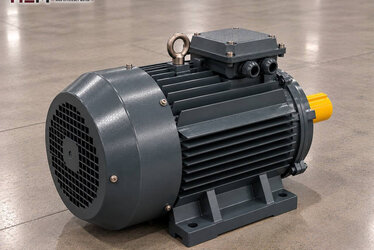
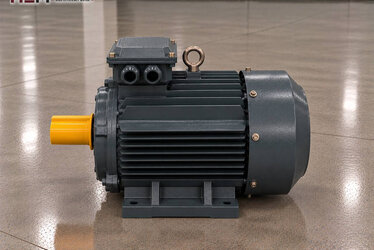
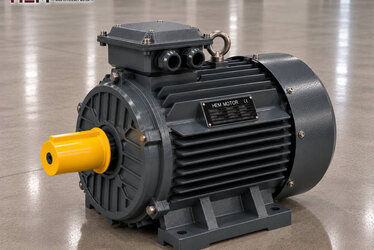
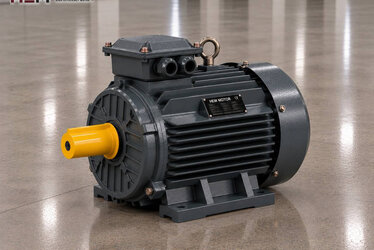
On drum pluckers the motor usually sits under the tub with a vertical shaft; on disc lines it is bolted to the frame by feet or flange. HEM foot, flange, foot-and-flange and vertical designs (B3, B5, B14, B34, B35, V1, V15 and other vertical forms) can be chosen according to frame size; the old motor's flange and shaft dimensions are compared before ordering.
Drum pluckers used on farms and in small businesses are often plugged into a single-phase socket. In that case our single-phase electric motor family, spanning 0.18 kW to 5.5 kW, is an option; whether it can set a tub full of birds in motion should be tested against the machine's load.
Example HEM Models for a Plucking Line
| Unit | Part driven | Point to watch | HEM example |
|---|---|---|---|
| Drum poultry plucker | Finger plate at the base | Vertical mounting, full start | 2.2 kW, 955 rpm, 112M-6 aluminium |
| Disc plucker group | Belt-driven row of discs | Speed setting, direction of rotation | 3 kW, 1,450 rpm, 100L2-4 aluminium |
| Overhead conveyor drive | Chain via a gearbox | Starting with a full line, continuous duty | 0.75 kW, 935 rpm, 90S-6 aluminium |
| Large disc plucking unit | Heavy disc groups | Wet surroundings, winding protection | 5.5 kW, 1,460 rpm, 132S-4 cast iron |
The table is a guide; the final choice is made by considering machine load, line speed, required speed, mounting and wet conditions together.
Information Needed for a Motor Request
Tell us the plucker type (drum or disc line) and the section the motor drives. Add the existing motor's power and speed, the slaughterhouse voltage (230 V single-phase or 400 V three-phase), mounting type, inverter use and how many motors you need. Sharing the nameplate photo of the motor to be replaced makes finding an equivalent easier.
For model prices you can browse our electric motor shop. To request a quote, message the WhatsApp line on our contact page or call our numbers.
Frequently Asked Questions
What can cause the plucker motor to trip its thermal protection often?
Overloading the tub with birds, feathers holding tight due to insufficient scalding, or an over-tightened belt are the most common causes. Also check whether the motor frame is covered with feathers and dirt; this blocks cooling too.
How do I change the direction of rotation of a disc plucker?
On a three-phase asynchronous motor, the direction is reversed by swapping two phase cables in the terminal box. This should be done by a qualified electrician after the power is switched off.
Can I hose down the motor in the plucking area?
No; a standard IP55 motor is not built for hose washing. During cleaning the motor should be covered or remain in the protected compartment; if different protection is needed, state it in the order.
Does adjusting disc speed with an inverter affect plucking quality?
Yes. As bird size and scalding condition change, the right disc speed changes too. Adjusting speed with an inverter makes it easier to balance skin damage against remaining feathers.