English
 Français
 Türkçe
 Español
 Русский

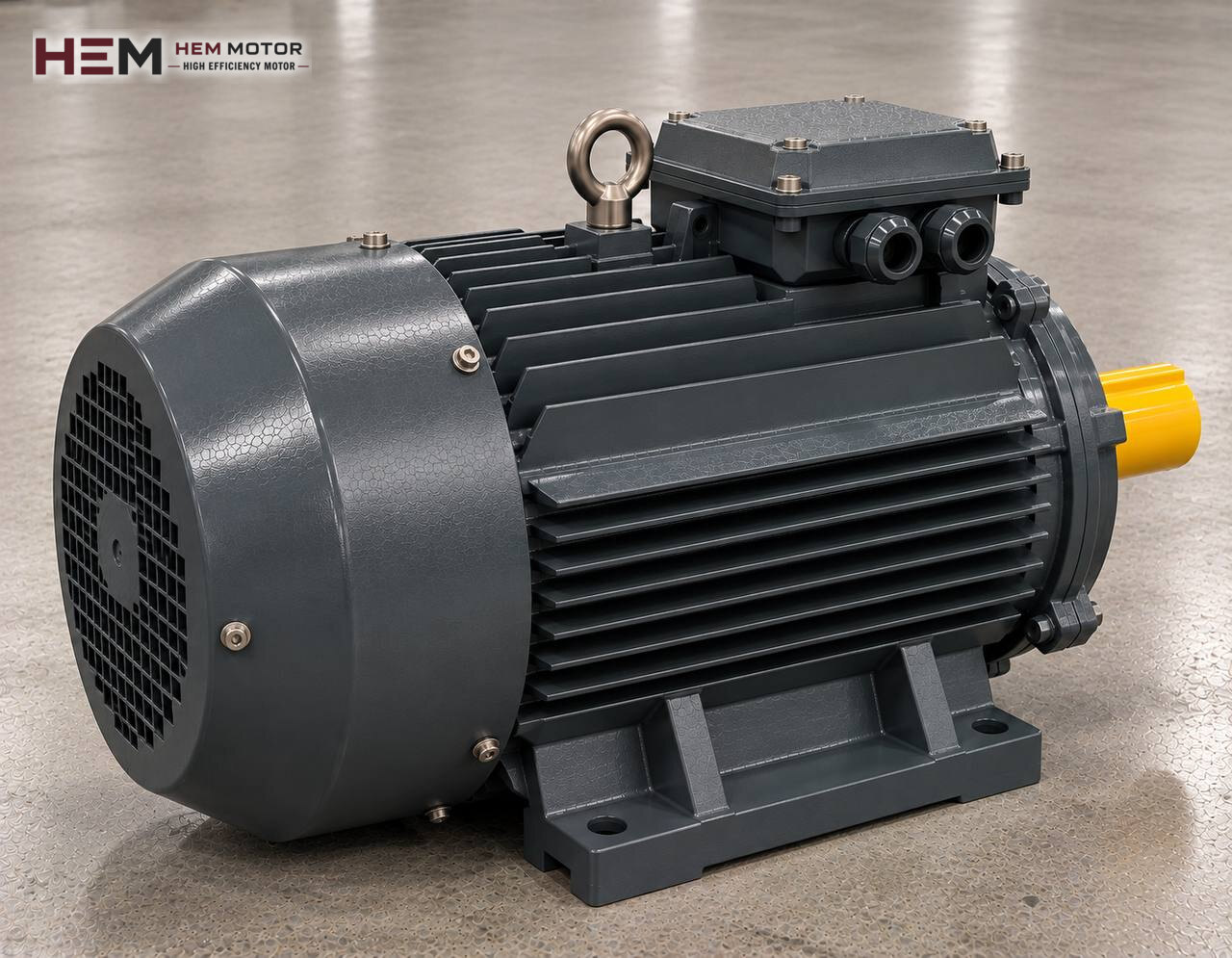
In a machine that roasts hazelnuts, peanuts, chickpeas or coffee beans, the heat comes from a burner or heating elements; turning, cooling and smoke extraction are handled by several separate electric motors. This article is part of the food processing and preparation machine electric motors section and looks only at the drives inside a roasting machine.

How Many Motors Turn Inside a Roaster?
A batch drum roaster usually has four movements. The main motor slowly rotates the perforated or solid drum, and the vanes inside keep turning the kernels over. When roasting ends, the door opens and the product drops into a round cooling tray; the stirring arms in the middle of the tray are turned by a separate motor. A fan under the tray draws room air through the kernels and removes their heat quickly. The fourth motor is the exhaust fan that sends hot air and roasting smoke from the drum to the stack or cyclone.
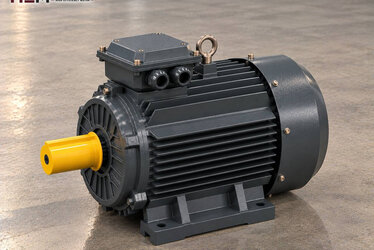
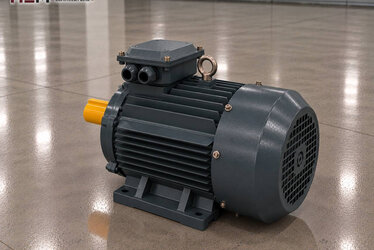
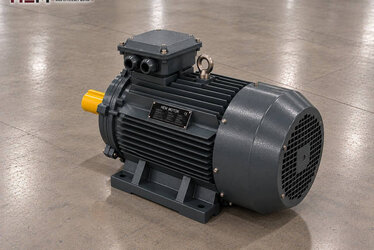
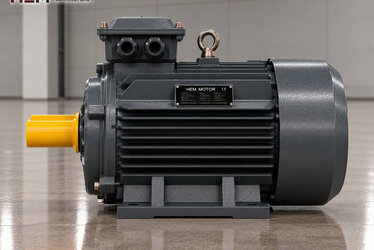
Pan-type machines that roast chickpeas and seeds have a fixed bowl with a stirrer turning inside instead of a drum. Large plants use continuous roasters that carry the product on a belt or vibrating deck through a hot-air tunnel. Whatever the type, the heating side is the machine builder's work; HEM Motor supplies the standard asynchronous motors that provide these movements.
How Does the Load on the Drum Drive Change?
With an empty drum the motor only overcomes the drum's own weight and bearing friction. Once the product is loaded the load rises clearly, because the vanes lift part of the kernels on every turn and drop them again. As roasting progresses the kernels lose moisture and become lighter, so the current falls slightly towards the end of the batch. This change is normal; the full-drum load at the start is the basis for motor selection.
The large mass of the drum and its contents creates considerable inertia at start-up. When the power fails or the burner trips, the drum has to be restarted, because product left in a stationary hot drum burns. For the motor to set a full drum in motion under heavy starting, its power should be chosen from the machine builder's data and the starting method planned accordingly.
Speed, Gearbox and Belt Arrangement
The drum turns at a very low speed; motor speed is reduced by a gearbox, a chain drive or a belt and pulley set. On small machines the motor and gearbox usually sit on the same base at the rear of the drum. For gearbox selection and flange matching, see the electric motors for gear reducers page.
Hazelnuts and coffee, or large almonds and small sunflower seeds, do not roast well at the same drum speed. Many builders therefore drive the drum motor with a frequency inverter and set the speed for each product. HEM three-phase motors can be operated on an inverter; if the drum is kept slow for long periods, the motor's own fan delivers little air and a separate fan is considered. Where cable runs are long, the inverter compatible electric motors page helps you discuss whether a filter is needed.
Cooling Tray and Exhaust Fan
The stirring arms in the cooling tray turn slowly, but hot product dumped into the tray applies a sudden load; this motor may be geared and mounted with a vertical shaft. The fan under the tray and the exhaust fan of the drum carry a continuous load. Since fan power changes roughly with the cube of speed, lowering fan speed reduces motor load considerably; the real difference depends on duct and cyclone resistance.
The exhaust fan carries hot, oily smoke. The motor itself should stay outside this air stream, beside the fan housing, and the heat bridge between shaft and impeller should be taken into account in the machine design.
Heat, Oily Dust and Skin Fragments
The area around a roasting line is hot and the motors stand close to the heat radiated by the drum. Motor ratings are given for a specific ambient temperature; if the motor compartment runs hotter, state this in your order. Oily dust and skin fragments from roasted peanuts and hazelnuts clog the fan cover grille; when the cooling fins on the frame are covered by this layer the motor overheats. Weekly dry cleaning and a check of the fan cover are a good habit.
IP55 limits dust ingress and protects against splashing water. Direct food contact, pressure washing or hygienic design are not conditions this standard motor covers; the motor should remain in the machine's enclosed compartment. A PTC or PT100 sensor to monitor winding temperature and an anti-condensation heater against moisture during long stops can be added as order options.
Mounting Type and Small Roasters
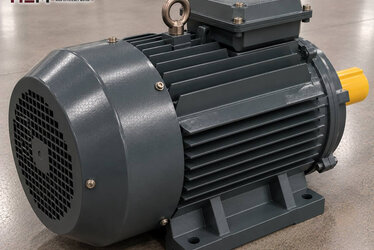
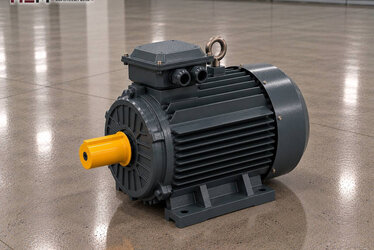
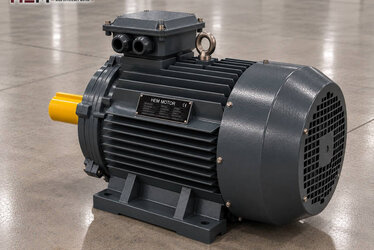
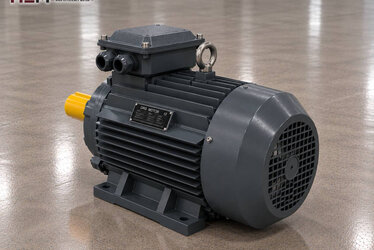
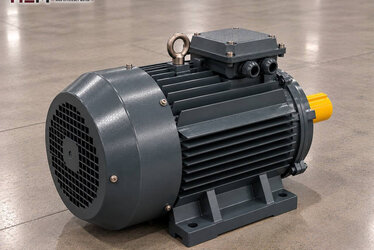
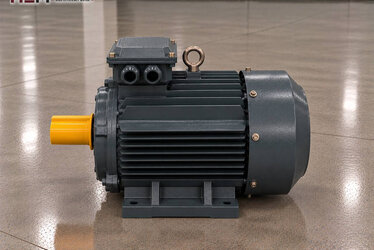
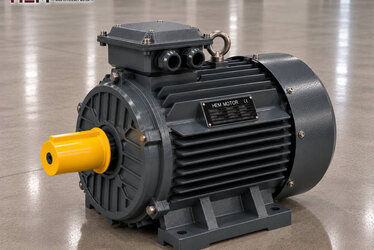
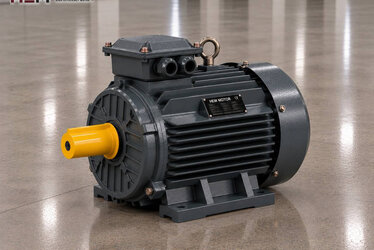
Depending on frame size, HEM motors can be supplied foot-mounted B3, flange-mounted B5 and B14, combined foot and flange B34 and B35, and vertical V1, V3, V5, V6, V15. The flange diameter and shaft size of the old motor are clarified together in the order before replacement.
Small pan and drum roasters in nut shops usually run on 230 V. Where there is no three-phase supply, the single-phase motor series in the 0.18–5.5 kW range can be considered; whether a single-phase motor can start a full drum should be checked for the machine.
Example HEM Models for a Roasting Line
| Movement | Motor's task | Selection point | Example HEM model |
|---|---|---|---|
| Batch drum | Turns the full drum via a gearbox | Loaded start, speed setting | 1.5 kW, 1,445 rpm, 90L-4 aluminium |
| Cooling tray stirrer | Stirs hot product with arms | Vertical mounting, sudden load | 0.55 kW, 1,400 rpm, 80M1-4 aluminium |
| Smoke exhaust fan | Draws hot air from the drum | Continuous load, position away from heat | 1.1 kW, 2,880 rpm, 80M2-2 aluminium |
| Large continuous roaster drum | Turns a heavy drum for long hours | Inertia, hot surroundings | 4 kW, 1,450 rpm, 112M-4 cast iron |
The models in the table are examples; the final choice is made by considering drum capacity, product type, required speed, mounting and operating environment together.
What Information Is Needed for a Quote?
Tell us the machine type (drum, pan or continuous roaster) and which movement the motor performs. Add the motor's power and speed, your supply voltage (230 V or 400 V), mounting type, whether you use an inverter and how many units you need. Sending a photo of the old motor's nameplate speeds up finding an equivalent.
Model prices are listed in our electric motor shop. For quotes and technical questions, reach the numbers on our contact page by WhatsApp or phone.
Frequently Asked Questions
Can the motor restart the drum if the power fails during roasting?
A correctly selected motor sets a full drum moving again. If the power was chosen from the machine builder's data and the starting method suits it, no problem is expected; if the motor struggles, the gearbox and belt condition should also be checked.
Does it make sense to drive the drum motor with a frequency inverter?
Yes, if you roast different products on the same machine. Adjusting the speed to the product makes roast quality easier to control; if long low-speed running is planned, the need for a separate fan is discussed in the order.
Why does the motor draw more current at the start of a batch?
At the start the kernels are moist and heavy, so the drum load is at its highest. As the product dries the load falls; this is the natural behaviour of roasters.
What should I do if the exhaust fan motor often runs hot?
First check for oily dust on the fan cover and frame fins. Then check the temperature of the air the fan draws and the duct resistance; a motor placed too close to the hot air stream also overheats.