English
 Français
 Türkçe
 Español
 Русский

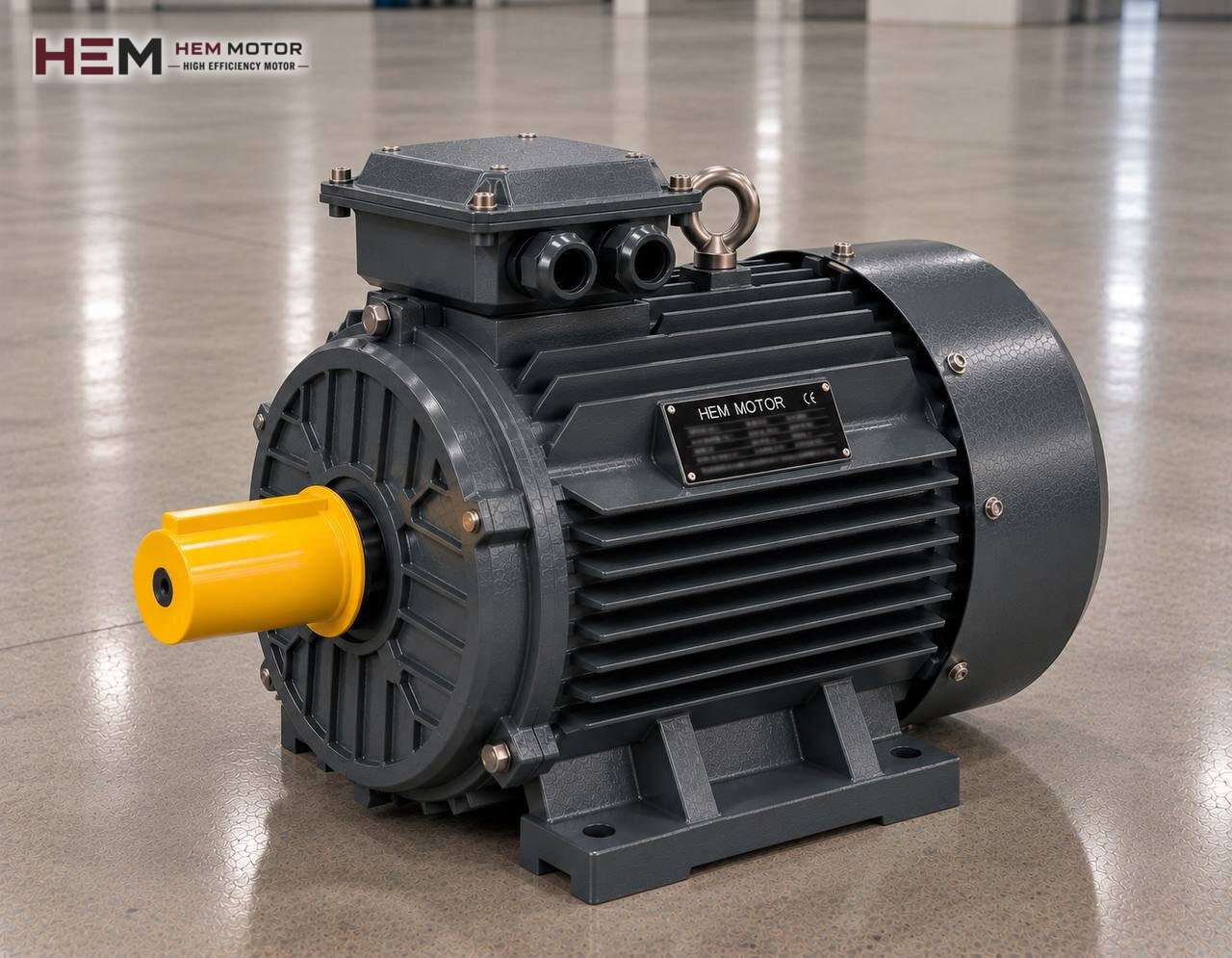
In a plant processing milk, fruit juice, ayran or liquid egg, the pasteuriser takes its heat from a plate heat exchanger and the homogeniser takes the pressure that breaks up fat droplets from its pistons; both get their motion from an electric motor. This page is a sub-topic of our food machine motors guide for the food sector and explains which pump the motor turns, and how, in heat-treatment and homogenisation units, and how starting and continuous operation shape the choice.

Pasteurisation unit: every motor turns a pump
In a plate pasteuriser the product passes between thin stainless plates, first warming in the heat-recovery section, then reaching pasteurisation temperature in the hot-water section, waiting for a set time in the holding tube and being cooled in the cooling section. Everything that rotates in this cycle is a pump:
- Feed (product) pump: Takes the product from the balance tank and passes it through the plates. It is usually a hygienic centrifugal pump directly coupled to a 2-pole motor. Constant flow matters so that the holding time does not change; that is why frequency-converter drive is common.
- Booster pump: Some lines use a second pump to keep the pressure on the pasteurised side above that on the raw side.
- Hot-water circulation pump: Circulates water heated by steam or a boiler through the heating section; it has no product contact and the motor load is steady.
- Chilled or ice-water pump: Feeds the cooling section; the refrigeration unit that prepares this water is outside the scope of this page.
General selection steps for pump motors are on our pump electric motors page, and topics specific to end-suction pumps are on the centrifugal pump motor page.
Homogeniser: a high-pressure piston pump
A homogeniser is in fact a multi-piston (usually three-piston) high-pressure pump. The motor turns a crankshaft through V-belts; the crank moves the pistons back and forth and the product is forced at high pressure through a narrow homogenising valve. Fat droplets shrink in this passage and the milk does not form cream.
From the motor's point of view three features of the homogeniser are decisive. First, the load has a constant-torque character: as long as the pressure setting stays the same, the motor needs similar torque at every speed. Second, the pulsating torque created by the crank at each piston, although smoothed by the belt and flywheel, leaves a vibrating load on the bearings and belt. Third, the most powerful motor of the line is usually on the homogeniser, so the starting method also concerns the supply network.
Homogenisers are normally started with the homogenising valve open, that is, without pressure; once the motor reaches full speed the operator or the automatic system raises the pressure. This makes starting lighter. At larger powers star-delta, a soft starter or a frequency converter is used; which one depends on the machine builder's control design and the capacity of the supply.
Continuous duty, temperature and steam
In most dairies pasteurisation lines run two shifts a day or non-stop; when the product runs out the line switches to the clean-in-place (CIP) cycle and the pumps then circulate hot caustic and acid solution. For the motors this means steady load for long hours. For plants that want to monitor winding temperature, PTC or PT100 sensors can be added at the ordering stage.
The area around the unit is hot and humid: the hot-water section, steam valves and tanks opened during CIP release vapour. In plants that shut down at night condensation can form in the winding; an anti-condensation heater is also an order option. The IP55 protection of HEM motors is designed for dust and water splashes. Washing with pressurised water, chemical foam, product contact or hygienic surface expectations are not among the conditions this motor is built to meet. In positions close to the food zone a protective measure by the machine builder or a special motor is needed; state this condition in your order.
Speed control and belt arrangement
On the feed pump the converter is used to fix the flow according to the holding time. HEM's three-phase motors are suitable for converter drive; since the pump does not run at low speed for long periods an extra fan is often unnecessary, but if the distance between motor and panel is long let us discuss the need for a filter at the order stage. Details are on the inverter-compatible motors page.
On the homogeniser the ratio between the motor pulley and the crank pulley has been calculated for the piston speed set by the machine builder. When the motor is replaced the same number of poles must be kept; otherwise piston speed, and with it flow and pressure, change. Because belt tension directly affects the motor's front bearing, it should be set according to the adjustment instructions.
Mounting and frame choice
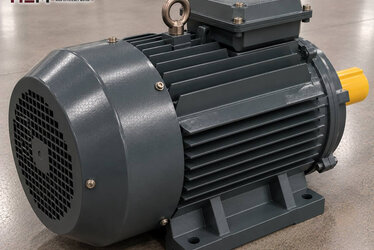
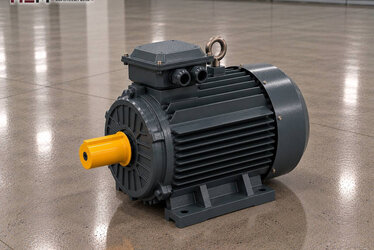
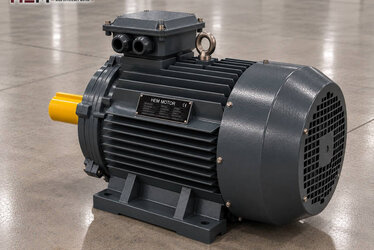
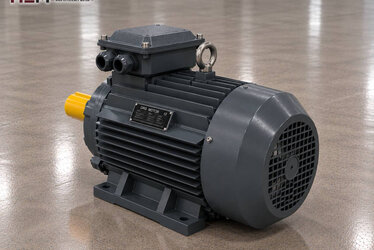
On centrifugal product pumps the motor is usually connected to the pump in a foot-and-flange arrangement (B34 or B35); some close-coupled pumps use a flange-only (B5) motor. The homogeniser motor stands foot-mounted (B3) inside or beside the machine frame on a slide base that allows belt tensioning. HEM supplies all these mounting types (B3, B5, B14, B34, B35) and vertical arrangements such as V1 depending on frame size; flange and shaft dimensions are settled in the order discussion. For heavy, continuous and vibrating loads such as a homogeniser, cast iron frame motors are preferred.
Example HEM models for pasteurisation and homogenisation
| Unit | What the motor turns | Key selection point | Example HEM model |
|---|---|---|---|
| Pasteuriser hot-water circuit | Circulation pump | Steady load, hot surroundings | 1.5 kW 90S-2 (2,895 rpm) |
| Pasteuriser product feed | Hygienic centrifugal pump | Constant flow by converter | 4 kW 112M-2 (2,905 rpm) |
| Small-capacity homogeniser | Three-piston pump, belt-driven | Unloaded start, number of poles | 11 kW 160M-4 cast iron (1,465 rpm) |
| Medium-capacity homogeniser | Three-piston pump, belt-driven | Starting method, belt tension | 15 kW 160L-4 cast iron (1,465 rpm) |
These models are given for orientation; the final decision is made by looking at the unit's load, required speed, mounting type and operating conditions. Because homogeniser power varies over a wide range with capacity and pressure, the existing motor's nameplate is the most reliable starting point.
What to prepare for a quote
Sending a photo of the existing motor's nameplate is usually enough to choose an equivalent; our article on finding an equivalent motor from a nameplate photo explains the process. If there is no nameplate, write down: which machine (pasteuriser pump, booster, hot-water pump or homogeniser), the motor's power in kW, its speed in rpm, the plant voltage, mounting type (foot, flange, belt slide base), how the motor is started, whether a converter is used and how many units are needed.
Models and prices are in our shop. To get a quote or ask a question use our WhatsApp line or phone; you can find the numbers on the contact page.
Frequently Asked Questions
Why does the homogeniser motor trip on starting?
If it is started while the homogenising valve is under pressure, the motor needs high torque at start. Make sure the valve is open; if the problem continues, the starting method and belt tension should be checked.
Can I increase capacity by fitting a 2-pole motor to the homogeniser?
No. Piston speed is set by the machine's design limit; a faster motor overloads the crank, valves and seals. Any capacity increase should be assessed together with the machine builder.
Is a converter essential on the pasteuriser feed pump?
It is not essential but it is common. The converter helps preserve the holding time by keeping flow constant against the resistance that changes as the plates foul.
Do the motors see extra load during CIP?
The cleaning solution has slightly different density and temperature from water, but the pump motors' load is usually close to that in production. What needs real attention is the steam and splashing chemicals around the motor.