English
 Français
 Türkçe
 Español
 Русский

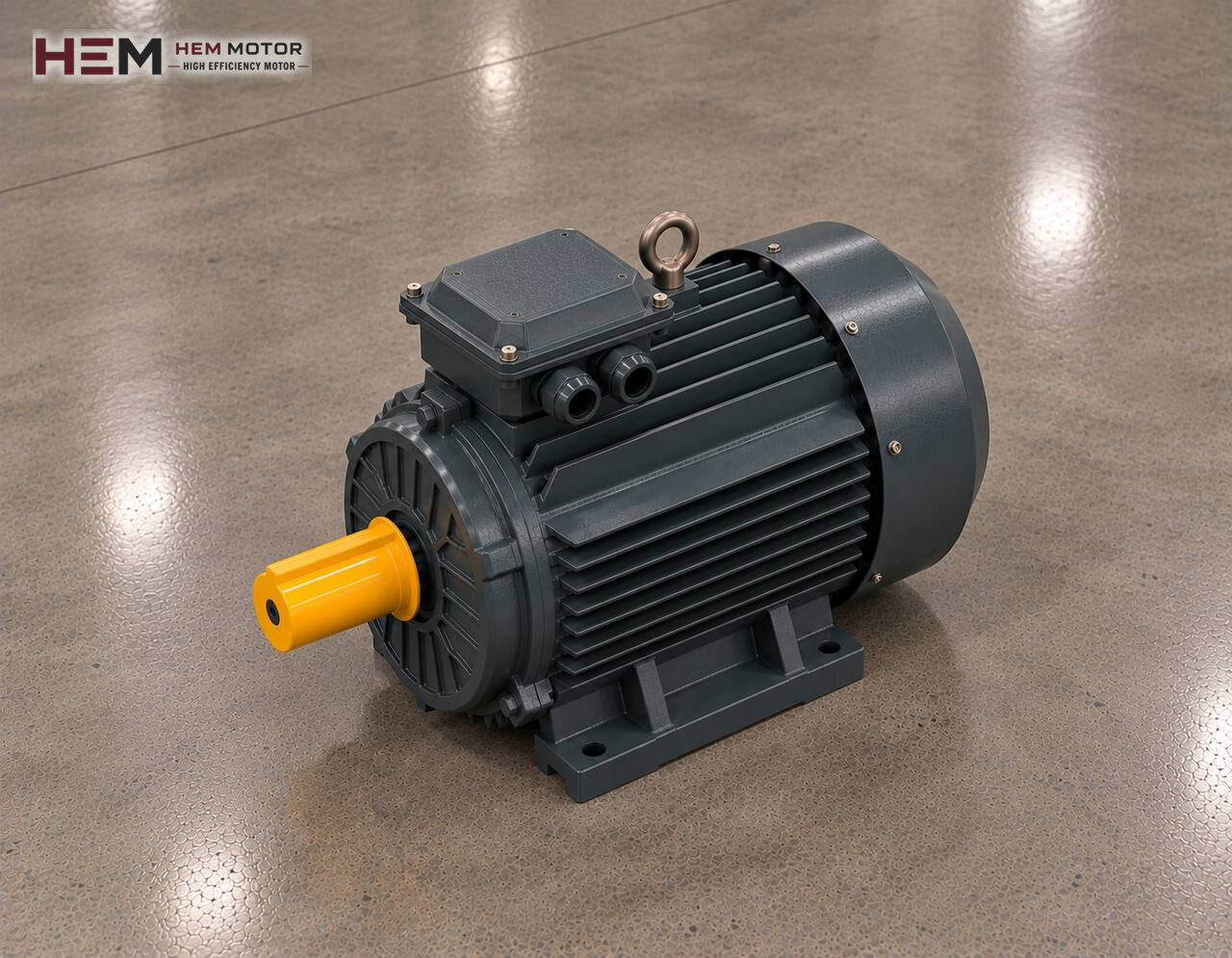
Opening the hard shell of walnuts, hazelnuts, almonds or apricot kernels so that the kernel inside stays whole is delicate work: the shell must break but the kernel must not be crushed. As a sub-topic of the food processing and preparation machine electric motors page, this article covers the motors that drive cracking machines.

Three Ways to Open the Shell
In roller crackers the product passes between two rollers with an adjustable gap between them. The rollers turn towards each other, squeeze the shell and crack it. The gap is set to the millimetre according to nut size, so the product is first graded by size. In this arrangement, common for hazelnuts and apricot kernels, the two rollers are driven either from one motor via gears or a belt, or each by its own motor.
In centrifugal (impact) crackers a fast-turning rotor throws the nuts outwards against a hard ring around it. The shell opens on impact. Rotor speed directly determines the cracking rate. In this design, used for almonds and some walnut lines, the motor runs continuously at high speed. The third way is the conical or disc cracker, where the product is cracked without crushing between a rotating and a fixed surface.
Why Is the Cracking Load Uneven?
With steady feeding, motor current is fairly stable. If too much product suddenly drops from the feed hopper, or a large stone or metal part gets between the rollers, the load jumps briefly. On many machines one roller has spring-loaded bearings; when a hard object arrives it moves back and protects both rollers and motor. This safety belongs to the machine design, not to the motor.
Product moisture also changes the load. An undried walnut shell flexes, needs more force to break and the kernel starts to be crushed. Drying the product to the right moisture before cracking eases both motor and machine. Current that stays high usually means the feed rate or moisture needs adjusting, not the motor.
How Are Rotor Speed and Roller Speed Set?
In an impact cracker, higher rotor speed leaves fewer uncracked nuts but raises the share of broken kernels. The best speed changes with the nut variety. That is why the rotor motor is often driven by a frequency inverter and the right speed is found by cracking tests. Standard HEM three-phase motors are suitable for inverter operation; cases where the motor will stay at full load at low speed for long periods, and installations with a long cable between motor and inverter, should be discussed in the order. For details see the inverter compatible electric motors page.
In a roller cracker the peripheral speed of the rollers is kept low; motor speed is reduced by belt and pulley or a gearbox. On machines where the two rollers should run at different speeds, this difference comes from pulley diameters. For geared drives, the electric motors for gear reducers page guides the matching.
Auxiliary Motors Around the Cracker
A cracking line is more than the cracker. The elevator or screw that carries product to the hopper, the vibrating feeder that feeds the cracker evenly, the sieves that separate the mix into kernel, shell and uncracked nuts, and the aspiration fan that removes light shell pieces with air all run on separate motors. Uncracked nuts are usually returned to the cracker through a return line.
Most of these auxiliaries are small and can be covered by aluminium-frame motors of the 1500 rpm class. On the aspiration fan, motor load changes with fan speed and duct resistance. As fan speed drops, the power demand falls roughly with the cube; the real value depends on the system.
Shell Dust, Vibration and Cleaning
Cracking walnut and almond shells releases a fine, hard and abrasive dust. This dust sticks to the motor's fan cover and frame fins and weakens cooling. Dust extraction around the cracker and regular cleaning of the motor frame with dry air are recommended. For motors working in dust, IP55 limits dust ingress; direct food contact, pressure washing or hygienic design are not conditions this standard motor meets and should be stated in the order if required.
The rotor of impact crackers and badly adjusted rollers of roller crackers create vibration. Checking the motor foot bolts and belt tension at intervals protects the bearings. Plants that want to monitor winding temperature can request a PTC or PT100 sensor, and machines standing idle for long periods out of season an anti-condensation heater, as order options.
Mounting Type and Small Workshops
On roller crackers the motor is usually bolted to the frame foot-mounted (B3) and drives by belt. Impact crackers with a vertical rotor motor need a vertical flange design. Depending on frame size, HEM motors can be supplied as B3, B5, B14, B34, B35 and V1, V3, V5, V6 and V15; flange and shaft dimensions are confirmed in the order by comparing with the old motor.
Small walnut and hazelnut cracking machines in villages are often connected only to a 230 V supply. In such places HEM Motor's single-phase electric motor series covering 0.18 to 5.5 kW can be considered.
Example HEM Models for a Cracking Line
| Machine | Motor's task | What to check | Example HEM model |
|---|---|---|---|
| Twin-roller hazelnut cracker | Turns the rollers slowly by belt | Sudden load, belt arrangement | 2.2 kW, 1,450 rpm, 100L1-4 aluminium |
| Centrifugal almond cracker | Spins the rotor at high speed | Speed setting, vibration | 1.5 kW, 2,895 rpm, 90S-2 aluminium |
| Shell separating sieve | Shakes the sieve box | Bearing load, continuous running | 0.37 kW, 1,340 rpm, 71M2-4 aluminium |
| Industrial walnut cracking line | Drives a large cracker continuously | Dust, heavy start | 5.5 kW, 968 rpm, 132M2-6 cast iron |
These models are for guidance; the final choice is made by considering machine load, required speed, transmission type, mounting and dust conditions together.
What to Send Us Before Ordering
Write the type of your cracking machine (roller, impact, disc) and which part the motor turns. Add the existing motor's power and speed, the supply voltage, mounting type, whether you use an inverter and the quantity you need. A nameplate photo of the old motor makes choosing an equivalent easier.
Model prices are on the shop pages. For a quote, reach us by WhatsApp or phone using the numbers on the contact page.
Frequently Asked Questions
Is the motor damaged when a stone gets into the cracker?
On machines where the rollers move back on spring-loaded bearings, the motor sees a short load peak and no damage is expected if the thermal protection is set correctly. On machines without spring relief, belt slip or a thermal trip may occur; passing the product through a destoner is the best precaution.
Do I need to change the motor to change the rotor speed of an impact cracker?
No. Speed can be adjusted by changing the pulley ratio or by driving the motor with a frequency inverter. An inverter allows quick changeover between products.
Is one motor enough for both rollers of a roller cracker?
On small and medium machines both rollers are usually turned from one motor via gears or belt. If the rollers should run at different speeds or be adjusted separately, two motors are used.
Does shell dust shorten motor life?
Dust alone does not reach the winding, but it coats the frame, spoils cooling and makes the motor run hotter. Regular cleaning and dust extraction largely remove this effect.