English
 Français
 Türkçe
 Español
 Русский

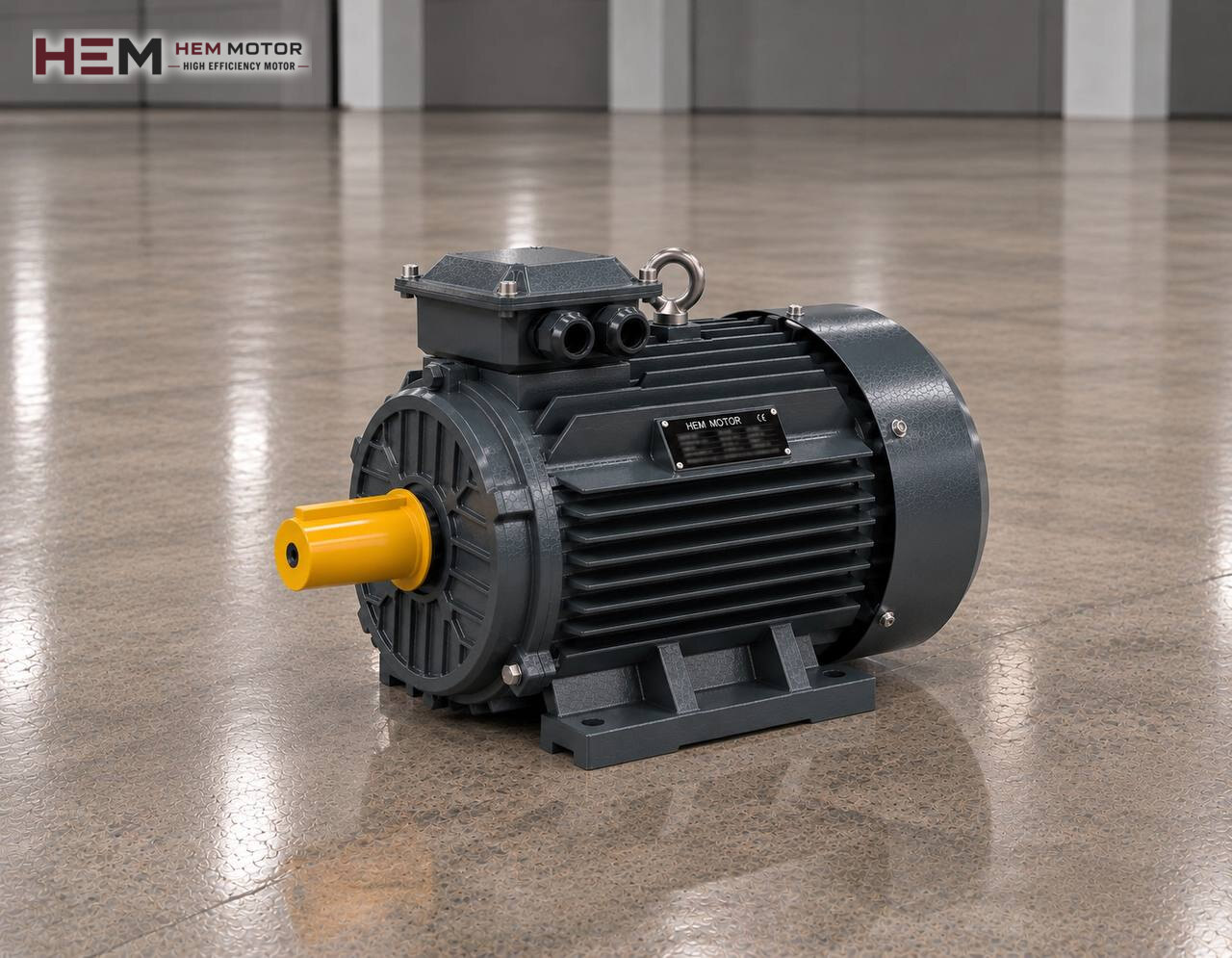
In a stone plant, a slab changes place many times between leaving the block and entering the crate: from the gang saw to calibration, from polishing to cutting to size, then on to drying and packing. Roller conveyors, transfer carts, tilting tables and vacuum lifters take care of this journey. The other machines of the sector are collected on the marble and natural stone processing motors page; this page focuses on the motors of the drives that carry slabs and change their direction.

The particular load of slab handling
A stone slab is heavy, wide and brittle. Unlike carrying a sack or a box of the same weight, bending the slab, letting it knock while passing from one roller to the next or letting it slide during a sudden stop leads to breakage. So the main job of a handling motor is not to deliver great power but to accelerate a heavy mass without jolting, carry it at constant speed and stop it gently at a given point.
Another feature is that the load keeps changing. One section of the roller conveyor is sometimes empty and sometimes holds two or three slabs. A transfer cart travels loaded one way and empty on the return. The motor must have enough torque to start when the load is heaviest, yet should not accelerate needlessly when empty.
Roller conveyors: chain, belt and zoned layouts
The most common carrier in stone plants is a track of steel or rubber-covered rollers. The rollers are usually linked by chains and sprockets, and a single geared motor turns all rollers in a section. Long lines are divided into several zones; each zone has its own motor, and the zones run in sequence so that slabs line up without hitting each other.
These motors start and stop frequently. When a slab arrives the zone runs, and it stops once the slab reaches the machine inlet. Dozens of starts per hour heat the motor more than a continuously running fan motor. With a high number of starts, defining a ramp on a drive both protects the slab and reduces the starting current. For gearbox selection and flange matching see the electric motors for gearboxes page, and for general conveyor design principles the conveyor belt electric motors page.
Transfer cart and tilting table
Between parallel lines, the slab is transferred by a cart moving sideways on rails. The cart travel motor accelerates the weight of both cart and slab and must position it at a specific station along the rail. Positioning is usually done with limit switches or an encoder, with the deceleration ramp left to the drive. If a brake motor is needed so that the cart does not roll on the rails when stopped, state it in your order.
A tilting table lifts and turns a slab arriving horizontally so it can go onto a vertical A-frame or into a crate. On most tables this movement is done by a hydraulic cylinder; the electric motor then only turns the hydraulic pump, and the tilting force is produced by the hydraulic system. Details are on the hydraulic pump electric motors page. On mechanical tilting tables the motor turns the table through a gearbox; the load changes with the table angle and reaches its peak at the start of the movement.
Vacuum lifter and bridge travel
Large slabs are held by vacuum lifters hung from an overhead crane or gantry. The suction pad grips the slab by vacuum, supplied either by a vacuum pump or an air ejector. The vacuum pump motor is small but plays a safety-critical role: to keep the vacuum for a while if power fails, the system has a reservoir and a check valve. This arrangement belongs to the lifter manufacturer.
The motors that move the bridge or trolley are crane drives and come with their own braked drive arrangements. When replacing these motors, the nameplate of the old motor and the brake information must be shared. A broader framework for crane drives is on the handling systems electric motors page.
Wet floors, slurry and frame protection
The slab handling line runs between wet machines. A slab leaving calibration arrives at the rollers with water and slurry on it; dripping water can reach the roller bearings and the motors below them. HEM Motor three-phase motors are IP55: they are protected against dust and splashing water but are not designed to run in standing water, under a water jet or during pressure washing. Placing motors beside the roller track rather than under it, outside the drip line, and fitting a drip shield over them are measures to be taken on the machine side.
In permanently damp plants, a condensation heater that stops water collecting inside the frame during standstill and a PTC or PT100 sensor to monitor winding heating caused by frequent starts are order options. On chain roller conveyors, chain tension and sprocket alignment, and on belt layouts belt wear, come first in periodic maintenance; a slack chain is felt at start-up as a shock on the gearbox and motor shaft.
Example motors for handling drives
| Drive | Type of movement | Point to assess | Example HEM model |
|---|---|---|---|
| Roller conveyor zone | Frequent start-stop, geared drive | Starts per hour, need for a ramp | 0.75 kW 1500 rpm aluminium 80M2-4 |
| Transfer cart travel | Loaded out, empty back, positioning at a station | Need for a brake, cart and slab weight | 1.5 kW 1500 rpm cast iron 90L-4 |
| Mechanical tilting table | Short lifting load that varies with angle | Gearbox connection, starting torque | 4 kW 1500 rpm cast iron 112M-4 |
| Slow roller line for heavy slabs | Low speed, high torque requirement | Pole count, gearbox ratio | 1.1 kW 1000 rpm aluminium 90L-6 |
These rows are examples only. The suitable motor is determined by the weight of the slab carried, the line speed, the required speed, the mounting arrangement and the ambient conditions. The most solid data is the nameplate of the motor to be replaced.
Connection dimensions and speed adjustment
Depending on frame size we can offer foot-mounted B3, flange-mounted B5 and B14, foot-and-flange B34 and B35 and vertical V1, V3, V5, V6, V15 versions; we check with you at the order the flange and shaft dimensions that will fit the gearbox or chain sprocket. The options are listed in the mounting arrangements question.
Drives are widely used on handling lines for soft starting and positioning, and our three-phase motors are suitable for this. If the motor will pull full load at low speed for long periods, the air from its own fan may be insufficient; in that case an independently powered fan is added. If the cable between panel and motor is long, a dv/dt or sine filter is assessed. Mentioning these in your request is enough; details are on the use with an inverter page.
Information to prepare for a quotation
When requesting a motor, send: the machine or drive (roller conveyor zone, transfer cart, tilting table, vacuum pump); power (kW); speed (rpm); mains voltage; mounting arrangement; and how many units are required. On zoned roller conveyors many units of the same motor are used, so the quantity is especially important. If a brake motor is needed, write that too. A nameplate photo of the old motor gives most of this information: find an equivalent motor from the nameplate.
Power and speed options with current prices are in our shop; WhatsApp and telephone details are on the contact page.
Frequently Asked Questions
Slabs knock into each other when the roller conveyor stops; is the motor too weak?
Most often the problem is the way it stops. When the motor is cut from the mains, the rollers run free and the heavy slab keeps sliding. Defining a deceleration ramp on a drive or correcting the zone sequence is usually the solution.
Does a transfer cart motor need a brake?
If the cart travels a short distance on level rails and is stopped by a drive, it may not. With precise positioning or a sloping floor, a brake motor should be considered; state your requirement in the order.
Why do the motors on a zoned roller conveyor run hot?
If the number of starts per hour is high, each start's current heats the winding. Softening starts with a drive ramp and avoiding needless stop-starts reduces heating; a PTC sensor helps monitor winding temperature.
Which motor is replaced on a hydraulic tilting table?
On a hydraulic table the electric motor turns the pump. Motor power is determined by the pump flow and working pressure; with the existing motor's nameplate and the pump information we can choose a suitable model together.