English
 Français
 Türkçe
 Español
 Русский

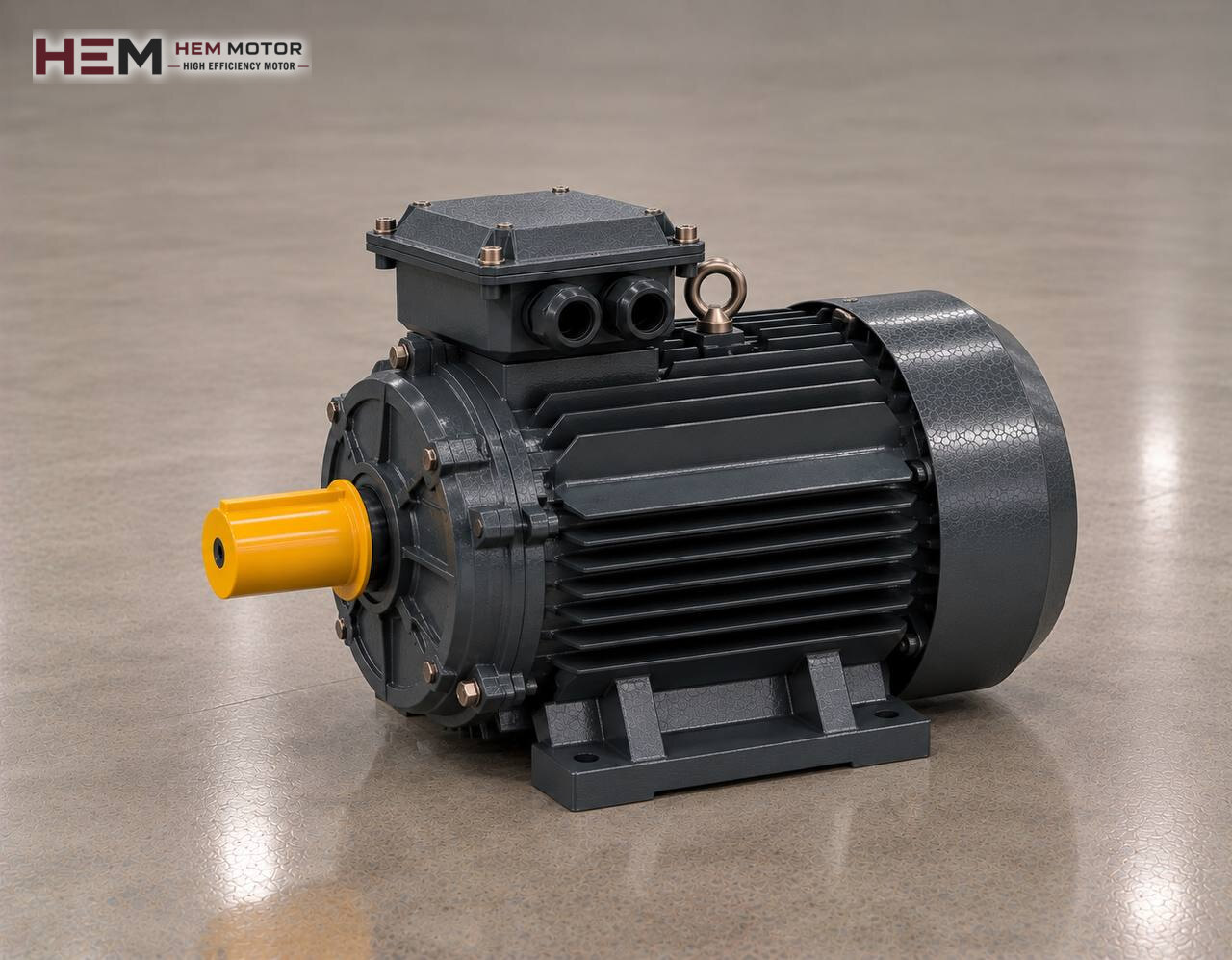
A piece of stone destined to become a worktop, a stair tread, a window sill or a vanity top reaches the customer with its edge on show once it has been cut. The machines that straighten that edge, chamfer its corner and give it a half-round or stepped profile work with many small motors lined up along the same machine. This page deals with those motors; for the other machines in the factory, you can go back to the marble and natural stone processing motors page.

A machine that works station by station
On a straight-line edge machine the stone piece travels along the machine on chain-driven pads or a conveyor belt; pressure rollers above hold it steady. Along the way there is a row of spindles, each turned by its own motor. The first spindles straighten the edge with coarse diamond wheels, the middle ones remove the marks with abrasives of progressively finer grit, and the last spindles polish with felt or polishing wheels. The bevel station breaks the top corner by holding the motor and wheel tilted at a set angle.
On profile machines the wheel itself is shaped: diamond-coated form wheels are used for half-round, quarter-round, bullnose or stepped profiles. A deep profile cannot be cut in one pass; it is opened gradually by wheels that go deeper at successive stations. That is why a profile machine may have more than ten motors.
How hard is each spindle motor worked?
The load on the station motors is continuous but moderate. The coarse stations remove the most stone and motor current is highest there; at the polishing stations current drops noticeably. There is a short load rise the moment the stone piece enters the wheel, and the motor runs idle when the piece leaves. When a long worktop is being processed, the load stays constant for several minutes.
Wrong settings strain the motor most. If the wheel is set too close to the stone or the feed speed is higher than the abrasive can handle, the motors on the first stations heat up. Comparing the load on each station by measuring current shows which wheel is overloaded.
Speed: the role of pole count in direct coupling
On most machines edge wheels are fitted directly to the motor shaft. In this arrangement the wheel speed is the motor speed, and it directly sets the peripheral speed of the abrasive. For high peripheral speed on small-diameter profile and polishing wheels, 2-pole motors (synchronous 3,000 rpm) are common, while 4-pole motors (synchronous 1,500 rpm) are common on large-diameter coarse wheels. Keeping the same number of poles on replacement keeps the wheel within the speed range recommended by its maker.
On some machines the wheel speed is wanted to change with each stone type. HEM's three-phase motors can be fed from a frequency drive. If full load is carried at low frequency for long periods, the motor's own cooling fan may not be sufficient and an externally powered fan may need to be added; if the drive panel is far from the motor, a dv/dt or sine filter is considered. State this in the quotation request; details are in the inverter use question.
Tilted and vertical motors
At straight-edge stations the motor usually stands vertical or horizontal. At bevel stations, however, the motor is flange-mounted on a tilted carrier according to the angle to be cut. In the catalogue the mounting positions are defined as B3 foot, B5 and B14 flange, B34 and B35 combined foot-flange and V1, V3, V5, V6, V15 vertical, offered according to frame size. For a motor that will work in a tilted position, state the angle and whether the shaft points up or down in the order; this information matters for bearings and sealing. Flange and shaft dimensions are again confirmed with you during the order. For connection types, see the flange-mounted electric motors and mounting arrangements pages.
The carrier pad chain or belt is moved by a separate motor and gearbox. Because feed speed needs fine adjustment, this drive often runs on a drive. The electric motors for reducers page helps with geared motors.
Water curtain, stone dust and daily care
Each wheel has its own water line; the water both cools the wheel and binds the stone dust. Because the distance between wheel and motor is short, the motor's front end shield and shaft seal are constantly exposed to this mist. When the seal at the shaft end wears, water can creep inside the motor; the risk increases in shaft-down positions.
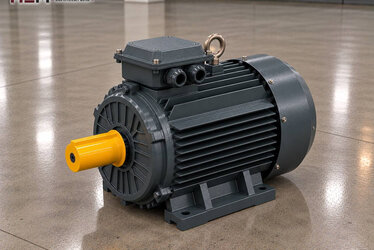
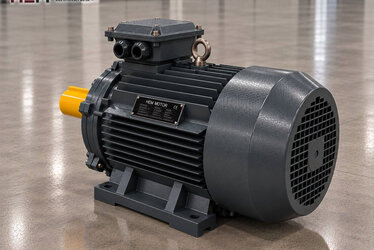
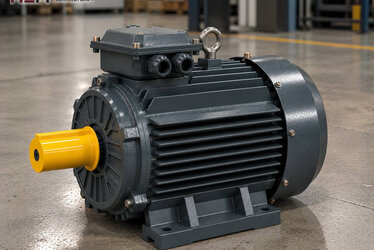
HEM motors are IP55; they withstand dust and splashed water. They are not designed for operation under water, a direct water jet or washing with pressurised water; the guard around the wheel and the splash ring on the shaft are the machine's protective measures. If more protection is required, a measure from the machine maker or a special motor is needed, so state it in the order.
When the machine is washed at the end of the day, motor frames should be wiped with a damp cloth and slurry cleaned off the fan covers. An anti-condensation heater for long stoppages and a PTC or PT100 sensor to monitor winding temperature are among the order options.
Example motors for edge machine stations
| Station | Motor's task | Point to check | Example HEM model |
|---|---|---|---|
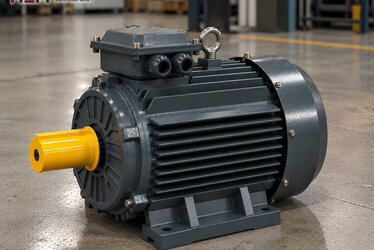
| Coarse straightening | Turning a large diamond wheel with the heaviest cut | Number of poles, flange, shaft end | 4 kW 1,500 rpm cast iron 112M-4 |
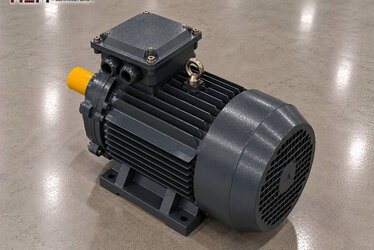
| Honing and bevel | Turning the abrasive wheel in a straight or tilted position | Tilt angle, shaft direction, sealing | 3 kW 1,500 rpm aluminium 100L2-4 |
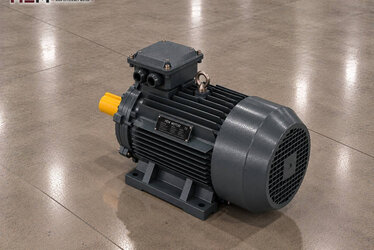
| Profile and polish | Keeping a small-diameter form wheel at high speed | 2 poles, wheel maker's speed limit | 2.2 kW 3,000 rpm aluminium 90L-2 |
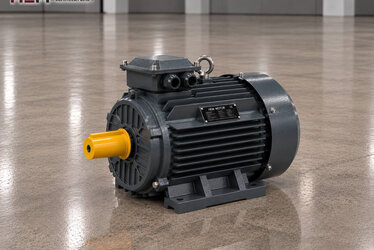
| Pad chain or belt | Feeding the stone piece at adjustable speed through a gearbox | Gearbox connection, operation on a drive | 1.5 kW 1,500 rpm cast iron 90L-4 |
The table gives a starting idea. The exact model is chosen by assessing wheel diameter, required speed, mounting angle and the machine's operating conditions together. The nameplate of the motor on the machine is the shortest route to that assessment.
What to send us before ordering
When requesting a motor for an edge machine, write the following: machine type (straight edge, bevel, profile), which station the motor is on, power (kW), speed (rpm), supply voltage, mounting type and tilt angle, quantity. Those who want to renew all motors together on a multi-station machine can send a list per station. To find an equivalent from the nameplate photo: find an equivalent motor from the nameplate.
Current models and prices are on the buy page. To reach us by WhatsApp or phone, use our contact details.
Frequently Asked Questions
Is a special order needed for the tilted motor on the bevel station?
The motor is flange-mounted on the tilted carrier; it is enough to state the tilt angle and whether the shaft points up or down in the order. Bearing and sealing conditions are assessed on the basis of this information.
Should I choose a 2-pole or a 4-pole motor for a profile wheel?
For a direct-coupled wheel, the decision depends on the wheel diameter and the speed allowed by the wheel maker. Staying with the pole count of the existing motor is the safest route; a change may double or halve the wheel's peripheral speed.
Must all motors on the same machine have the same power?
Not necessarily. Coarse stations need more power, polishing stations less. Still, to make spare-keeping easier, some machine owners prefer motors with the same connection dimensions; make this decision together with the machine maker's data.
Can a motor that took in water through the shaft seal be reused?
First have a rewinder measure the insulation and check the bearings. If the water came in because the guard or seal on the wheel was damaged, a new motor fitted without renewing that part will have the same problem.