English
 Français
 Türkçe
 Español
 Русский

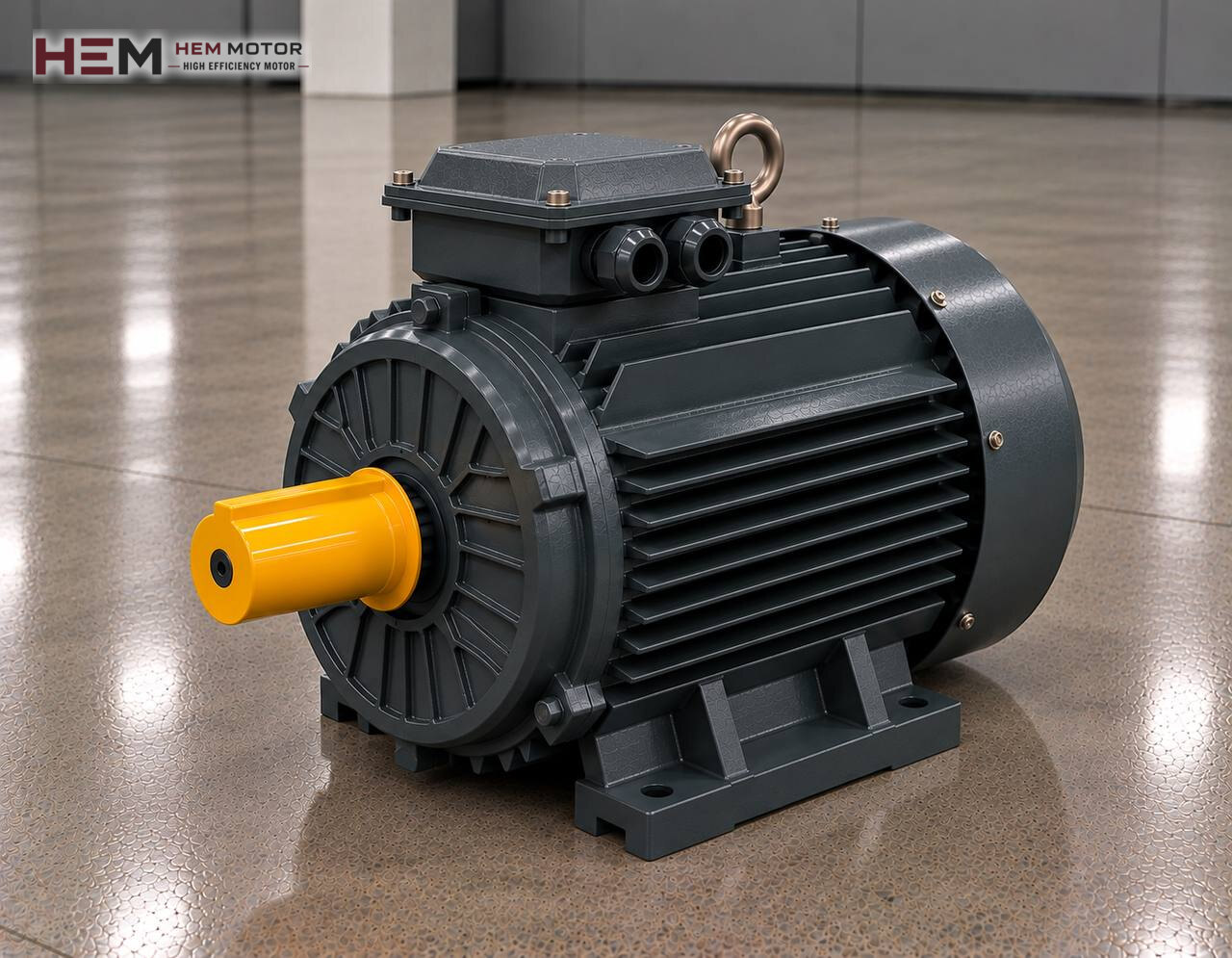
Every machine that cuts stone with a diamond saw or levels a surface with a calibrating head needs a constant flow of water. General information on the other machines in the workshop is on our marble and natural stone processing motors page; here we cover only the pumps that move this water and the electric motor that turns them.

What Jobs Does Water Do in a Stone Workshop?
The first job of the water is cooling. Diamond segments heat up as they grind the stone; if the water stops, a segment burns within seconds and the blade warps. The second job is transport: the fine stone dust produced by saws and calibrating heads turns into slurry with the water and is carried away from the cutting zone. The third is dust control; a wet line releases far less stone dust into the air.
That is why a workshop has a water circuit rather than a single pump. Supply pumps pushing clean water from the tank to the machines, slurry pumps carrying dirty water from the channels under the machines to a settling pond or tank, and the feed pump sending settled sludge to the filter press are all parts of this circuit. The treated water returns to the tank.
Clean Water Supply Pump: The Need for Steady Pressure
The water nozzles of bridge saws, gang saws, cutting-to-size and calibrating machines need a certain pressure and flow. This is usually done with horizontal end-suction centrifugal pumps. Pump and motor either form a close-coupled unit on a common shaft or are joined by a flexible coupling on a baseplate. Details on motor selection for these pumps are on our centrifugal pump electric motor page; for all pump types, see pump electric motors.
On the clean water line the load is fairly even. However, when one pump feeds several machines, the flow changes as machines are switched on and off, and the operating point moves along the pump curve. With all valves fully open the flow grows and the motor current rises. The pump motor should be sized so that even in this fully open case it does not exceed its rated current.
Slurry Pump: Abrasive Liquid and Lower Speed
Water going to the settling pond or the filter press carries marble, granite or travertine dust. This dust behaves like sandpaper; it wears the impeller, the casing and the seal. For this reason slurry pumps often use a four-pole motor (about 1,450 rpm), keeping impeller tip speed and wear low. On the clean water side, a two-pole motor (about 2,900 rpm) can get enough pressure from a smaller pump. The pump manufacturer's curve decides which speed is suitable.
As the slurry gets denser, the power drawn by the pump also rises. A pump sucking the thick layer at the bottom of the pond puts more load on the motor than the same pump delivering clear water. Measuring motor current from time to time is a practical way to notice thickening early.
The Filter Press and Settling Tank Side
In the filter press, slurry is filtered through cloths between the plates and becomes a cake. The feed pump delivers a lot of water against low resistance at the start of filling; as the plates fill, resistance grows and flow drops. The motor load changes throughout this cycle. The mechanism that clamps and opens the plates is usually a hydraulic unit; there the motor only turns the hydraulic pump, while the hydraulic system provides the clamping force. For the motor on that side, see our hydraulic pump electric motors page.
In larger plants, a cone-bottomed settling tank has a slowly rotating scraper rake driven by a geared motor. A small dosing pump adds flocculant chemicals to the water. For such low-power auxiliaries, where only a single-phase supply exists, our single-phase electric motor range (0.18–5.5 kW) can be considered.
Dry Running, Wet Floors and Motor Protection
The most frequent danger for a water pump motor is the pump running on air when the water level in the tank drops. The seal heats up and the impeller is damaged; meanwhile the motor turns at low current, which makes the problem hard to notice. A level float in the tank and a pressure or flow switch on the pump outlet are therefore common precautions.
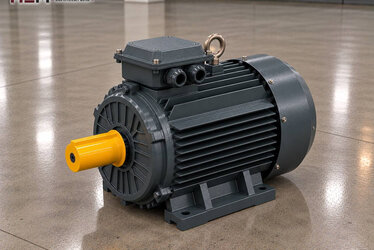
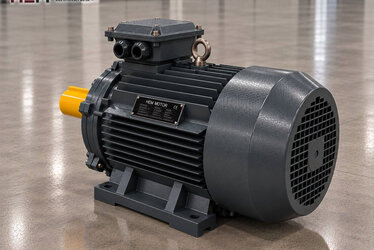
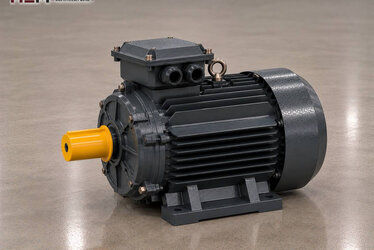
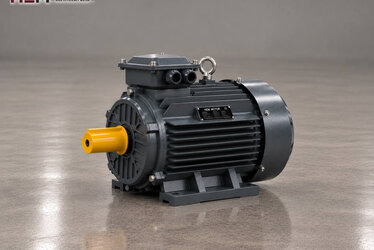
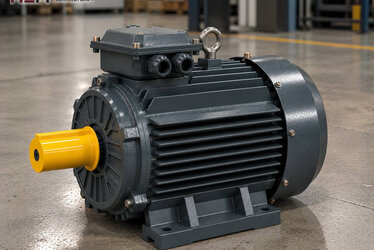
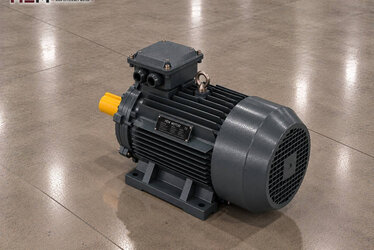
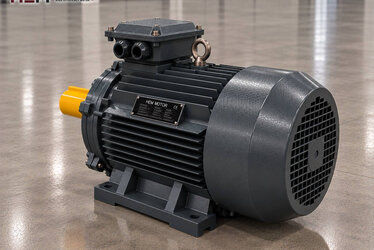
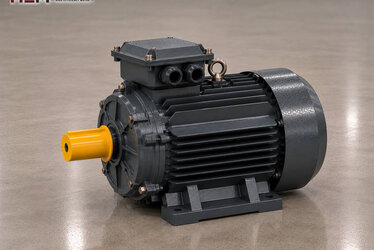
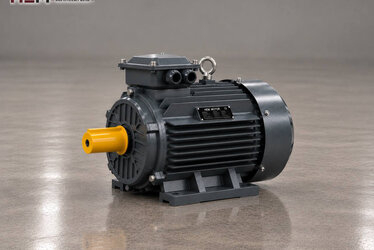
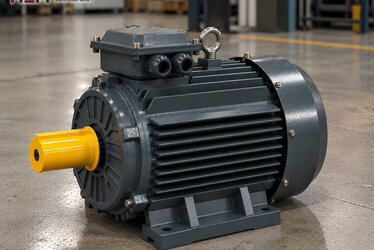
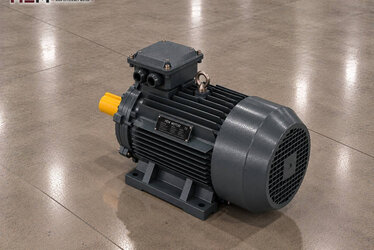
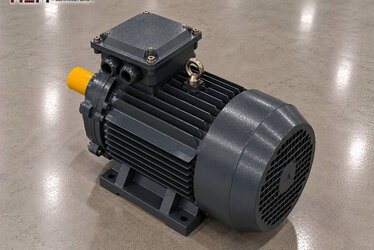
In a stone workshop the floor is always wet and motors sit close to splashing slurry. HEM motors are built with IP55 protection, class F insulation and for 50 Hz. This protection is designed for splashes, not for submersion or pressure washing with a hose. The motor should be placed on a raised base, and water should not be aimed directly at it when the area is washed. If such a need exists, an additional measure by the machine builder or a special motor is required; state it in your order. A condensation heater for long stoppages and a PTC/PT100 sensor to monitor winding temperature can be added with the order.
For mounting, foot-mounted frames are used for pumps on a baseplate and flange-mounted frames for close-coupled pumps. Depending on frame size, foot, flange, foot-and-flange and vertical arrangements are possible; flange and shaft dimensions are confirmed with the order. Some plants run the supply pump from a drive controlled by a pressure sensor; for using our motors with a frequency converter, see our answer to the inverter operation question. Tell us about conditions such as long periods at low speed or a long motor cable when ordering.
Example HEM Models for the Water Circuit
| Pump | Motor load | What to check | Example HEM model |
|---|---|---|---|
| Clean water pump for a single machine | Even, continuous | Nozzle pressure and flow, pump speed | 100L-2 · 3 kW · 2,895 rpm |
| Line pump feeding several machines | Flow varying with the number of open machines | Operating point with all outlets open | 132S2-2 · 7.5 kW · 2,930 rpm |
| Channel and pond slurry pump | Abrasive, depends on density | Slurry density, speed recommended by the pump maker | 132M-4 · 7.5 kW · 1,460 rpm |
| Filter press feed pump | Pressure and flow changing through the cycle | End-of-fill pressure, cycle time | 160L-4 · 15 kW · 1,465 rpm |
These models are examples only; the final choice depends on the pump load, required speed, mounting type and operating conditions.
What to Include in Your Pump Motor Request
Write to us which machine or circuit the pump feeds, the power and speed of the existing motor, the supply voltage, the mounting type (baseplate, close-coupled, vertical) and how many motors you need. If you have the old motor, sending a photo of its nameplate speeds up finding the equivalent model.
All models are listed in our shop; the current price appears on the product page. Our WhatsApp and phone details are on the contact page.
Frequently Asked Questions
Should a cutting water pump use a 2-pole or a 4-pole motor?
The pump is designed for one or the other. Clean water pumps mostly run with 2-pole motors; for pumps handling slurry, a 4-pole arrangement is more common to reduce wear. The speed on the pump nameplate or curve should be taken as the basis.
Why does the slurry pump motor draw more current over time?
As the sludge at the bottom of the pond thickens, the liquid density and the power drawn by the pump increase. A worn impeller also lowers efficiency. Cleaning the pond and checking the impeller usually bring the current back to normal.
What happens if the pump motor gets wet while the machine is washed?
An IP55 motor withstands splashing water, but it is not designed for water aimed directly from a hose. The motor should be placed on a high base and covered during washing. For harsher conditions, state the situation in your order.
Is a three-phase supply required for a small water pump serving one machine?
No. If the pump power fits, our single-phase range from 0.18 to 5.5 kW can be considered. In workshops with a three-phase supply, a three-phase motor is preferred.