English
 Français
 Türkçe
 Español
 Русский

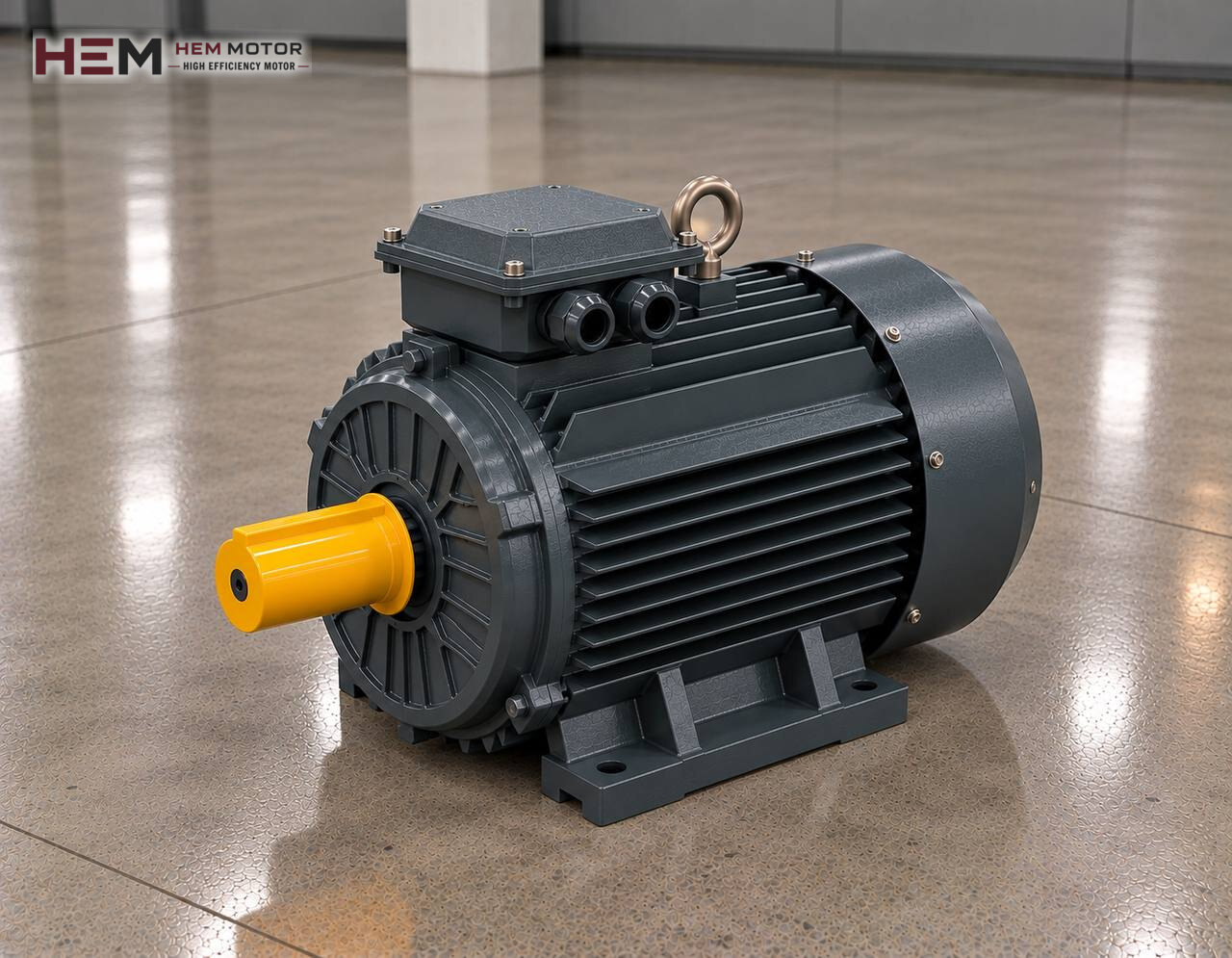
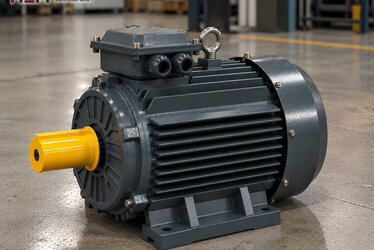
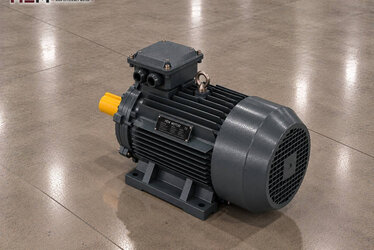
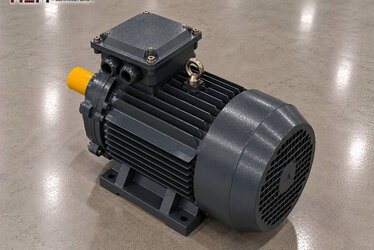
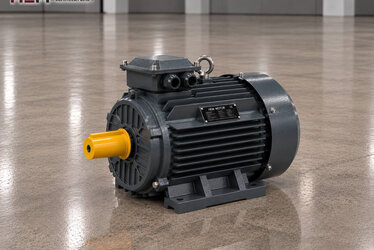
A gang saw (frame saw) splits a block of marble or granite into many slabs in a single pass by driving a set of tensioned blades back and forth. This page covers the three-phase motor that turns the main drive and the auxiliary motions of the gang saw; for the other stone machines in the factory, see the marble and natural stone processing motors page.

How does the blade frame move, and what does the motor carry?
The heart of the gang saw is the heavy steel frame in which the blades are tensioned. This frame travels back and forth horizontally on slides or swing arms. The linear motion comes from a rotating shaft: belts from the motor pulley turn a large flywheel pulley, and the eccentric and connecting rod on the flywheel shaft convert that rotation into reciprocating motion.
For the motor, this means the load changes with every stroke. The frame accelerates in one direction, slows and stops at the end, then reverses. The flywheel absorbs most of this fluctuation; the motor continuously supplies the energy that keeps the flywheel at an average speed. The main motor should therefore be treated not like an impact crusher but like a high-inertia drive that runs fully loaded for long periods.
Starting: getting a heavy flywheel moving
When starting from standstill, the motor must overcome not only friction but also the inertia of the flywheel, pulleys and blade frame. The run-up time is therefore clearly longer than for a pump or fan of the same power. During the long start the windings heat up and a high current is drawn from the supply.
The starting method (star-delta, soft starter or frequency inverter) is decided by looking at the plant's transformer capacity and the gang saw maker's panel design. In star connection the motor torque is low; if the switch to delta happens before the flywheel has picked up enough speed, a second current peak appears. The protection relay must also be set to allow a long start, otherwise the thermal protection trips before the motor reaches speed. A PTC thermistor or PT100 sensor embedded in the winding can be added to the order, so that protection looks at the real winding temperature rather than current.
If the power fails in the middle of a cut, the blades stay inside the stone. A restart is then heavier than a no-load start; doing it with the frame raised slightly, as the machine maker instructs, also protects the motor.
Speed, stroke rate and belt transmission
The number of strokes per minute of the blade frame is set by the pulley ratio together with the motor speed. On gang saws the main motor is usually foot-mounted and belt tension is adjusted with a motor slide rail. Choosing the new motor with the same number of poles as the old one is the easiest way to keep the stroke rate without touching the pulley diameters. If a 6-pole motor, that is one with a synchronous speed of 1,000 rpm, is replaced with a 4-pole motor with a synchronous speed of 1,500 rpm, the stroke rate rises and the blades may be overstressed; in the opposite case cutting takes longer.
On some gang saws the stroke rate is set by a drive instead of the pulleys. HEM's three-phase motors can be fed from a drive. If the stroke rate is kept low for many hours while the motor still carries full load, its own shaft-mounted fan may not cool it enough; a separately powered fan is then added. If the distance between the panel and the motor is large, a dv/dt or sine filter at the drive output is considered. It is enough to write these details at the quotation stage; the topic is also explained in the inverter use question.
In a belt drive, the side load on the shaft end grows as the motor pulley gets smaller and the belt is tightened more. Fitting the pulley close to the shaft shoulder and not over-tensioning the belts directly affects bearing life.
Frame feed, block trolley and slurry pumps
The blade frame descends very slowly into the stone during the cut. This motion comes from a small motor independent of the main drive, with a gearbox and screw spindle; the feed rate is set according to the hardness of the stone being cut. The electric motors for reducers page gives guidance for geared arrangements.
There are other drives around the gang saw as well: travel of the trolley that brings the block under the machine, the pump that sprays water on the blades, and on granite gang saws the pump and agitator that distribute the abrasive slurry of steel shot, lime and water over the blades. The pump electric motors page gives details on motors for water and slurry pumps.
Slurry, moisture and cuts lasting for days
A gang saw cut can take hours depending on the stone type and block height, and days on hard granite. The motor does not stop during this time; its cooling depends on the fins and the fan cover staying clean. If splashed stone slurry dries and sticks to the fins, the motor runs hotter than it should. Regular cleaning is therefore the simplest but most effective maintenance item.
HEM Motor series are IP55 protected: they withstand dust and water splashed from any direction. The motor is not designed to work under a slurry jet, in water or while being washed with pressurised water; in such a position the machine maker's protective measure or a special motor is needed, so state it in the order. An anti-condensation heater can be requested against internal condensation during long stoppages.
Periodic checks should cover belt tension, pulley alignment, bearing noise and temperature, and the terminal box gasket. If the flywheel balance is off, the resulting shaking is also passed on to the motor bearings.
Example motor table for gang saw drives
| Drive | Motor's job | Value to check when selecting | Example HEM model |
|---|---|---|---|
| Main drive (flywheel) | Driving the blade frame via belts and flywheel | Run-up time, number of poles, pulley ratio | 90 kW 1,500 rpm cast iron 280M-4 (SF 1.15) |
| Low-speed main drive | Turning a large flywheel with a slower motor speed | Number of poles, starting method | 110 kW 1,000 rpm cast iron 315L1-6 (SF 1.15) |
| Water or slurry pump | Circulating cooling water or abrasive slurry | Pump flow and pressure, continuous duty | 7.5 kW 1,500 rpm cast iron 132M-4 |
| Frame feed or block trolley | Providing slow feed through a gearbox | Gearbox connection, flange and shaft size | 1.5 kW 1,500 rpm cast iron 90L-4 |
The motors in the rows are for guidance only. Which motor is fitted is decided by looking at the number of blades on the gang saw, the required stroke rate, the mounting arrangement and the site conditions; the old motor's nameplate is the first input to that decision.
Mounting arrangement and dimension check
Depending on frame size, foot-mounted (B3), flange-mounted (B5, B14), combined foot and flange (B34, B35) and vertical (V1, V3, V5, V6, V15) versions are possible; flange and shaft dimensions are confirmed with you when the order is placed. Foot mounting is common on the gang saw main drive; the old motor's foot hole spacing, shaft height and shaft diameter should be compared with the new motor. For the options, see the mounting arrangements question.
Information to send with a quotation request
When asking for a gang saw motor, include the following in your message: that the machine is a gang saw and which drive the motor is on (main flywheel, frame feed, pump); the power in kW; the speed in rpm; the plant supply voltage; the mounting type; the quantity required and how the motor is started. Photographing and sending the old motor's nameplate fills in most of this list by itself; how to do it is explained in the find an equivalent motor from the nameplate article.
You can see the power and speed options with their prices on the shop page. Our WhatsApp and phone numbers are on the contact page.
Frequently Asked Questions
Why might the gang saw motor trip the thermal relay on starting?
Flywheel inertia lengthens the start. If the protection setting does not cover this time, the relay opens before the motor reaches speed. The starting method and relay setting should be reviewed according to the electrical design; simply increasing motor power may not solve the problem.
Can I fit a 4-pole motor instead of a 6-pole one?
If the pulleys stay the same, the stroke rate goes up and the speed intended by the machine maker may be exceeded. If the number of poles is to change, the pulley ratio must be recalculated; the safest route is to stay with the same number of poles as the old motor.
Can the gang saw main motor be driven by an inverter?
It can. If heavy cutting will be done for long periods at a slow stroke rate, a separate cooling fan should be considered, and an output filter if there is a long cable between the drive and the motor. Note that you will use a drive when requesting a quotation.
Is an IP55 motor enough in the slurry environment of a granite gang saw?
IP55 protects against splashed water and dust. The slurry jet should not hit the motor directly and the fins should be cleaned regularly. If the motor sits where it will be constantly wet, a protective cover on the machine side or a special motor solution is needed.
How do I find out how many kW the main motor should be?
The most reliable sources are the existing motor's nameplate and the machine maker's datasheet. The number of blades, block size and stone type affect the power; if you send a photo of the nameplate, we will determine the suitable HEM model together.