English
 Français
 Türkçe
 Español
 Русский

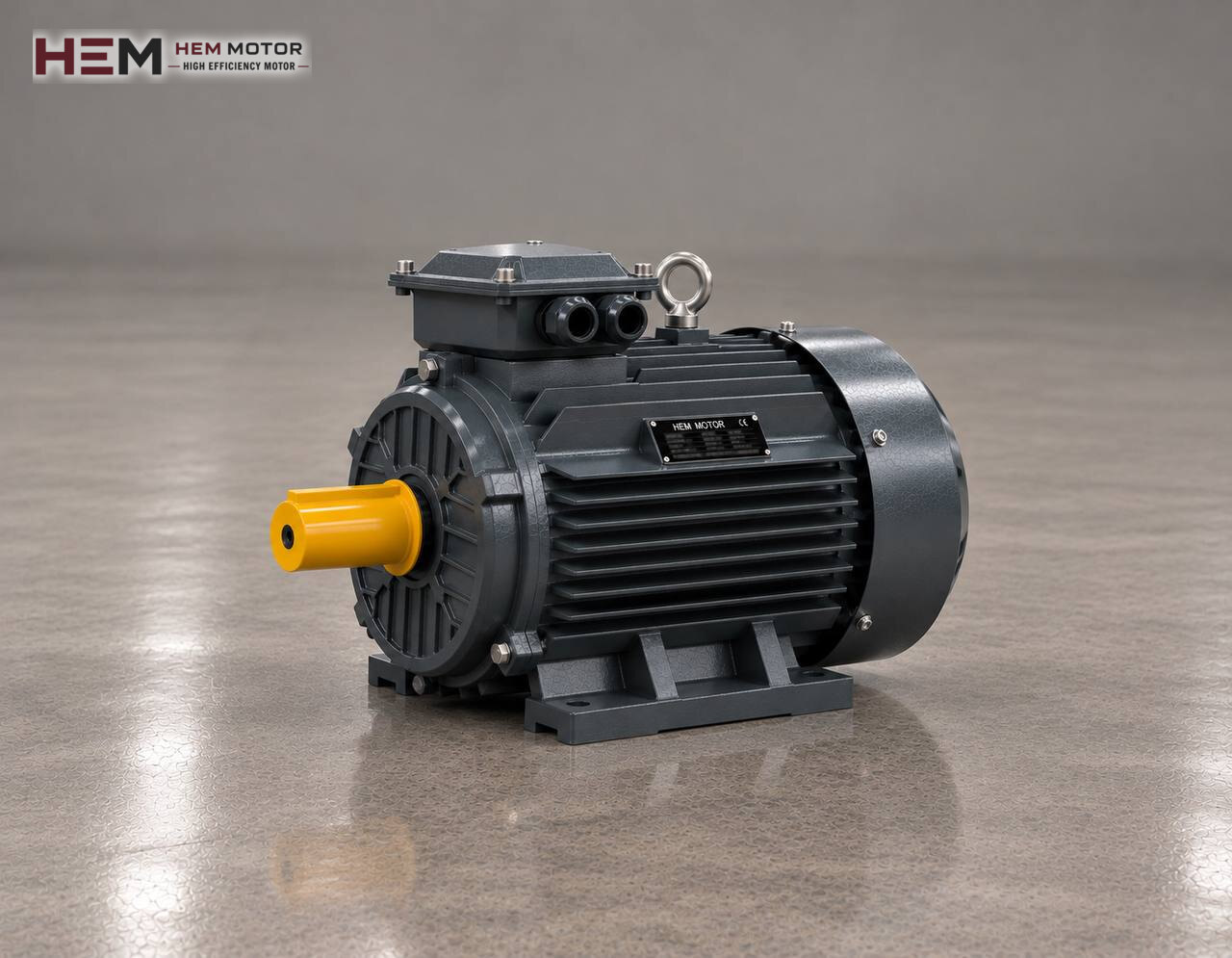
A slab polishing line is the final station that gives a calibrated marble or granite slab its mirror-like gloss. The line has many heads arranged one after another, each working with a finer abrasive than the one before. For the other machines in the plant see the marble and natural stone processing motors page; this page deals with the three-phase motors that turn the polishing line's heads, beam oscillation, belt and the drying fan at the exit.

How gloss is built: abrasive getting finer from head to head
On a polishing line the slab moves slowly on a rubber belt. The first heads carry coarse-grit abrasives that remove the marks left by calibration. On the following heads the grit number gets finer step by step; on the last few heads polishing powder or felt-based polishing stones work. Gloss is achieved only when none of these steps is skipped.
Most heads are of planetary design: the main head rotates while the small abrasive holders underneath oscillate or wobble around their own axes. This motion lets the abrasive touch the stone from every angle and avoids circular marks on the surface. The load seen by the motor comes from rotation together with the friction of this oscillation.
Head motors: many units of the same motor
A polishing line may have twelve, sixteen or more heads, and their motors are usually identical. This has two consequences for the motor side. First, keeping spares becomes easy: a single model fits any head on the line. Second, if all motors start together, a large inrush current is drawn from the plant supply; for this reason the panel design normally brings the heads in one after another.
The head motor is mounted vertically with the shaft pointing down. Little material is removed on the polishing side, so the load on the last heads is clearly lighter than on the first ones. On the other hand, a polishing head touches the stone for a long time at constant pressure; the motor turns for hours at the same point under a steady, moderate load.
Vibration and surface quality
Even the slightest wave on a polished surface shows in the light. That is why bearing condition and balance on a head motor are more critical than on rough cutting machines. Bearing noise or shaking felt at the head should be noticed before gloss suffers. After a bearing replacement, the head should not be lowered onto the stone until the motor has been checked to run quietly and smoothly at no load.
Beam oscillation and belt feed
So that the heads can sweep the full slab width, the head beam oscillates crosswise. The oscillation motor stops and reverses at the ends; a small motor reversing hundreds of times an hour heats up more than a motor of the same rating running in one direction. On some lines oscillation is made with a crank mechanism and the motor runs in one direction; which one applies depends on the machine.
The belt passes the slab under the heads at the required speed. Gloss depends directly on belt speed: a slower belt means longer contact and higher gloss. That is why the belt motor almost always works through a gearbox and is run from a frequency inverter. For geared layouts see electric motors for gear reducers. Loading and unloading slabs onto the line is a separate handling topic and is outside the scope of this page.
Drying at the exit and the water circuit
The slab leaving the line is wet. Most lines have an air knife or fan-driven drying unit at the exit; the slab comes out dry and is inspected. The motor driving this fan runs continuously. Since fan power changes roughly with the cube of speed, changing fan speed quickly affects motor load; the exact value depends on system resistance. For fan drives see fan and extractor motors.
The water fed to the heads is collected, settled and sent back. The pumps in this circuit run on separate motors; the pump side is described on the pump electric motors page.
Wet environment and maintenance
On a polishing line the head motors sit right above the water and fine stone slurry. If the head seals and splash guard are not sound, muddy water climbs up to the motor's lower end shield. Polishing powder also builds up on the fan grille; if grille and fins are not cleaned regularly, the motor runs hot.
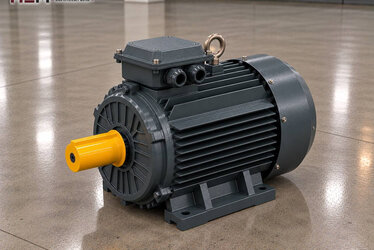
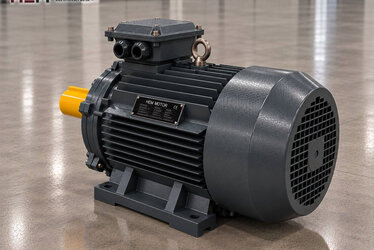
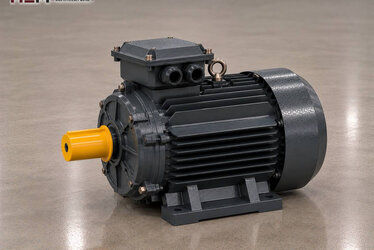
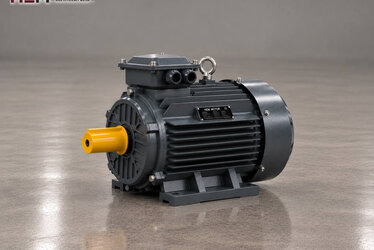
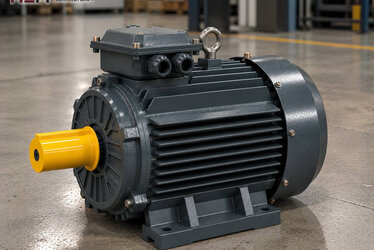
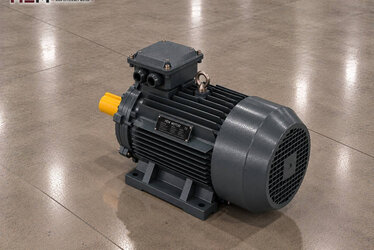
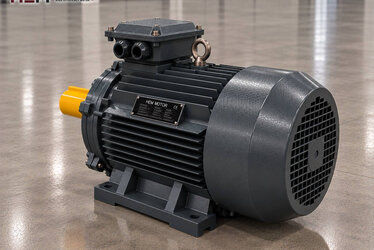
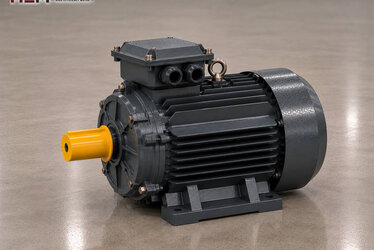
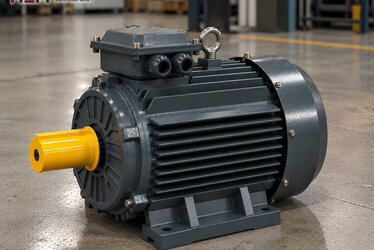
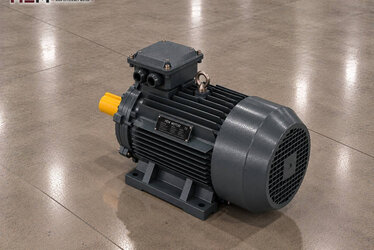
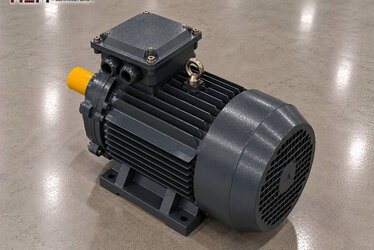
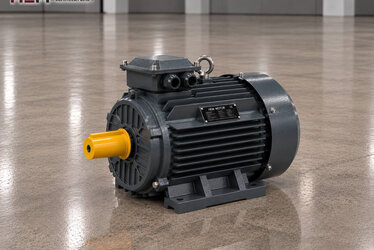
HEM three-phase motors are IP55; they are protected against dust and splashing water. However, standing in water or being washed with a hose or pressurised water lies outside this protection; if the line has such conditions, protective measures by the machine maker or a special motor are needed, state this in the order. When the line stops over the weekend, condensation may form inside the motor; an anti-condensation heater and a PTC or PT100 sensor monitoring winding temperature can be added with the order.
Example motors for a polishing line
| Duty | Load condition | Information to clarify | Example HEM model |
|---|---|---|---|
| Front heads (coarse grit) | Mark removal, medium-high continuous load | Vertical flange, shaft end, quantity | 7.5 kW 1,460 rpm aluminium 132M-4 |
| Polishing heads (fine grit, polish) | Light but hours-long friction | Bearings and balance, vertical mounting | 4 kW 1,450 rpm cast iron 112M-4 |
| Belt drive | Geared, speed set by drive | Gearbox flange, speed range | 1.5 kW 1,445 rpm cast iron 90L-4 |
| Exit drying fan | Continuous, speed-sensitive fan load | Fan speed, duct layout | 3 kW 1,450 rpm cast iron 100L2-4 |
The rows are examples only; they show ratings commonly seen on such lines. The suitable motor is chosen according to the real head load, the required speed, the mounting arrangement and the line environment; the first piece of data is always the old motor's nameplate.
Mounting arrangement and drive
Vertical flange designs are common for head motors; belt and oscillation motors connect to gearboxes by flange, while the drying fan motor is mostly foot-mounted. Depending on frame size, B3, B5, B14, B34, B35 and V1, V3, V5, V6, V15 options are available; we compare the machine-specific shaft end and flange with you before the order. For shaft-down motors the vertical mounting article helps, and for the general list the mounting arrangements question.
If belt or head speed is to be set by a drive, our three-phase motors are suited to it. If the motor will turn at full torque at low frequency for long periods, its own fan does not supply enough air and a separately powered fan may need to be added; if the cable between drive and motor is long, a dv/dt or sine filter comes into question. Write these details when requesting a quotation; more on the inverter operation page.
What is needed for a quotation
When asking for a polishing line motor, send us: the machine (line make, number of heads) and the motor position (head, oscillation, belt, drying fan), power (kW), speed (rpm), supply voltage, mounting type and quantity. For head motors the shaft diameter and length and the flange size are also needed; on multi-head lines, stating the number of spares makes planning easier.
A nameplate photo of the old motor is the quickest start: find an equivalent motor from the nameplate. Options and prices are on the shop page; for WhatsApp and phone use the contact page.
Frequently Asked Questions
Is it right to use the same motor on every head of a polishing line?
On many lines the heads run with the same motor, which makes spares easier. Still, the load on the front and last heads differs; if the machine maker fitted stronger motors on the first heads, this distinction should be kept when replacing.
Gloss has dropped; could the motor be the cause?
Usually the cause is abrasive wear, water setting or belt speed. However, if one head vibrates, a bearing or balance problem leaves waves on the surface. Running the head at no load and checking for noise and shaking is the first step.
The fuse trips when all heads are started together; what should be done?
Many motors starting at once add up their inrush currents. Bringing the heads in one by one at short intervals usually solves the problem. This is a panel setting; there is no need to change motor ratings.
Can the drying fan motor be slowed down with an inverter?
Yes, and the fan load falls quickly as speed drops. The lowest speed at which the slab still dries well is found by trial; stating the operating range in the order is enough.