English
 Français
 Türkçe
 Español
 Русский

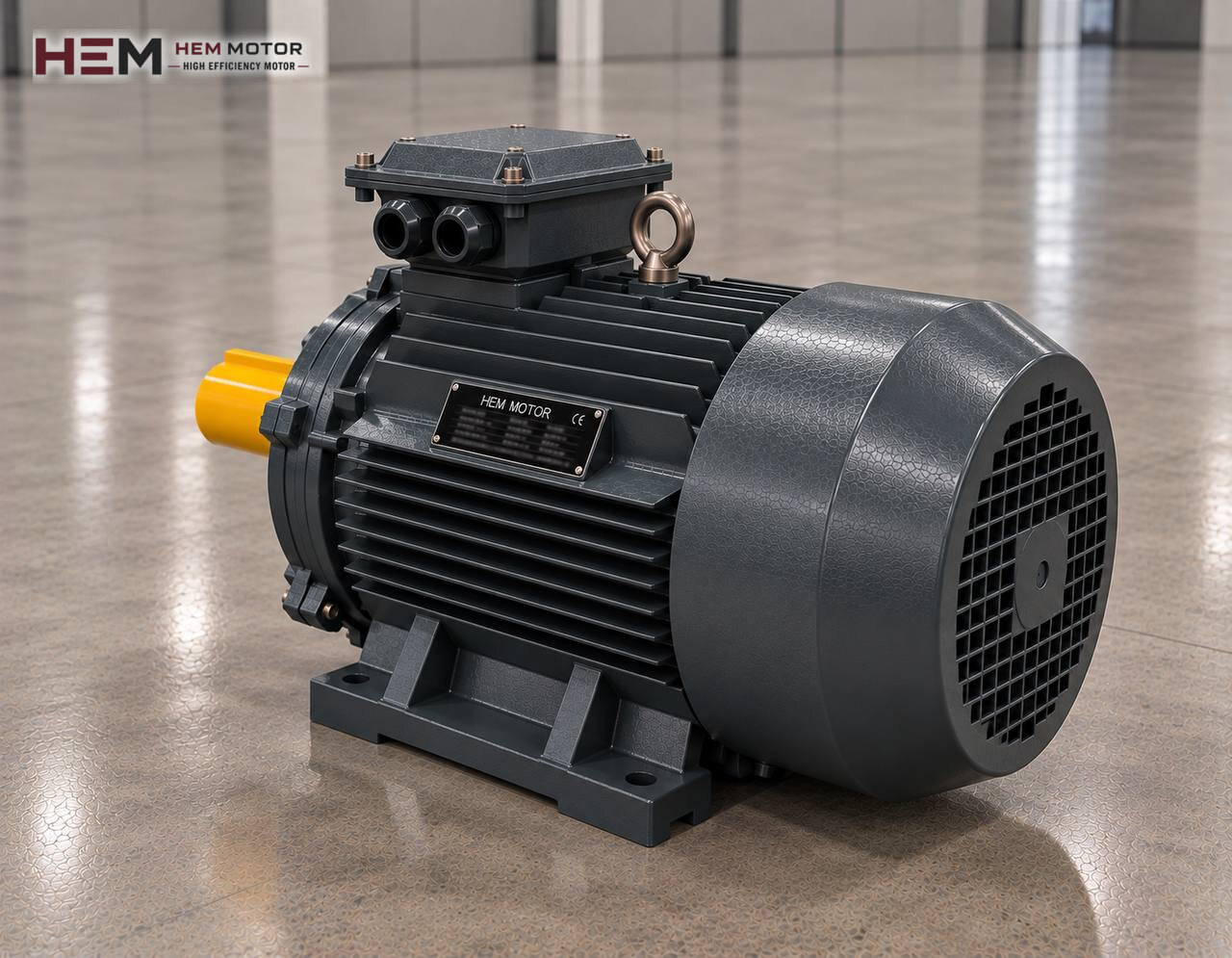
A calibrating machine evens out the thickness of a slab coming from a gang saw or block cutter at every point; a honing and polishing machine then brings that levelled surface to a matt or glossy finish with progressively finer abrasives. In both machines the motor does the same kind of job: it presses a rotating head onto stone moving along a table. For the other machines in a stone factory, see the marble and natural stone processing motors page.

Line layout: heads, belt and bridge
On a typical line the slab travels at constant speed on a rubber-covered conveyor belt. Above the belt, heads are arranged side by side or one behind the other. On the calibrating side the heads are diamond-segment milling tools that remove the slab's excess thickness. On the polishing side each head carries an abrasive of finer grit than the one before; the last heads work for buffing and polishing.
On wide slabs the heads do not stay still. The bridge or beam carrying the heads oscillates left and right across the slab width so that the abrasive sweeps the whole surface. This gives three separate motor duties on one line: the motor that turns the head, the motor that drives the belt and the motor that oscillates the bridge. Each has a different load character.
Head motor: vertical shaft and continuous friction load
On most machines the head motor is mounted vertically with the shaft pointing down. The abrasive is either fitted to a carrier plate sitting directly on the motor shaft, or the motor turns a separate head spindle through a short belt. In the direct arrangement the motor's lower bearing carries both the weight of the head and the reaction to the force pressing it onto the stone; bearing arrangement and shaft end dimensions are therefore important.
The load is not impulsive; the friction between abrasive and stone continues almost as a flat line from the moment the head is lowered until it is lifted. On calibrating heads a lot of material is removed, so the motor runs close to its rated power. The first polishing heads are loaded too; as the abrasive gets finer, the load per head falls. The pressure of the head on the stone is set with a pneumatic or hydraulic cylinder; as this pressure is raised, motor current rises too. Setting pressure while watching the current is a practical way to run the head motor without overheating it.
Belt and bridge drives
The conveyor belt carries the slab from the start of the line to the end. The belt motor is usually connected to a gearbox, and the feed speed determines the line's output; the belt is slowed down as the stone gets harder or the abrasive finer. Most lines use a frequency inverter for speed adjustment. The electric motors for reducers page gives information on geared drives.
The bridge oscillation motor is small but changes direction constantly. A motor that stops at each end and starts in the opposite direction heats up more than a motor of the same power turning in one direction; for these drives the number of starts and the oscillation period should be obtained from the machine maker.
Wet operation and muddy water
Calibrating and polishing are done completely wet. Water is fed from the centre or side of each head; it cools the abrasive and carries the stone dust away as slurry. The head motor sits right above this water. Water vapour climbing along the shaft and splashed slurry can reach the motor's lower end shield when maintenance is neglected.
HEM's motors are IP55 rated; they are protected against dust and splashed water. They are not designed for submersion, continuous water spraying or washing with pressurised water. The seals, splash guard and drip cover on the head are parts of the machine and must be in place and intact; if they are inadequate, additional protection from the machine maker or a special motor is needed, so state it in the order.
On vertical motors with the shaft pointing down, slurry falling on top of the fan cover can block the air inlet. When the line is washed at the end of each shift, a hose should not be pointed directly at the motors. An anti-condensation heater against internal condensation during night stoppages, and a PTC or PT100 sensor to monitor winding temperature, can be added to the order.
Example motors on a calibrating and polishing line
| Task on the line | Nature of the load | Information to confirm | Example HEM model |
|---|---|---|---|
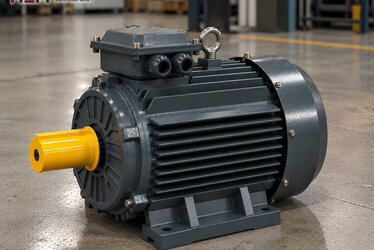
| Calibrating head | Heavy cut, continuous friction close to rated power | Vertical mounting, flange, shaft end, bearing arrangement | 11 kW 1,500 rpm cast iron 160M-4 |
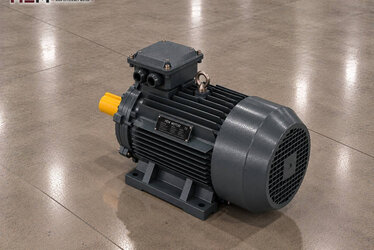
| Honing or polishing head | Continuous load that falls as the abrasive gets finer | Number of heads, flange type, quantity | 5.5 kW 1,500 rpm aluminium 132S-4 |
| Conveyor belt | Adjustable-speed feed through a gearbox | Gearbox connection, inverter operation | 2.2 kW 1,500 rpm cast iron 100L1-4 |
| Bridge oscillation | Small load with frequent reversals | Number of starts, oscillation period | 0.75 kW 1,500 rpm aluminium 80M2-4 |
These rows are given as a guide. Which motor is suitable is decided by looking at the head type, the required speed, the mounting arrangement and the line's operating conditions; starting from the nameplate of the motor on the machine is the right way.
Dimensions and speed when replacing a head motor
Some head motors are made with a shaft length, keyway and flange specific to the machine maker. Even if the kW and rpm on the nameplate are the same, the abrasive plate will not fit if the shaft end is different. The old motor's shaft diameter, shaft length, flange bolt circle and spigot diameter should therefore be measured and sent to us.
Depending on frame size, B3 foot, B5 and B14 flange, B34 and B35 combined foot-flange and V1, V3, V5, V6, V15 vertical positions can be selected; flange and shaft dimensions are verified together during the order. Details are in the mounting arrangements question.
The head speed determines the peripheral speed of the abrasive. If a 2-pole motor is fitted instead of a 4-pole motor on a direct-coupled head, the abrasive turns about twice as fast and may exceed the maker's limit. On some lines the head speed is set by a drive; HEM's three-phase motors are suited to this. If the head will stay at low frequency under full load for long periods, a separate fan may be needed, and an output filter if the cable between drive and motor is long; mention this when requesting a quotation. Details: inverter use.
What to write to us in a motor request
For a quotation, send: whether the machine is a calibrator or a polisher, and whether the motor is on the head, the belt or the bridge; power (kW); speed (rpm); supply voltage; mounting type (vertical flange, foot etc.); how many units are needed. Since several units of the same motor are requested on multi-head lines, the quantity also affects the delivery plan. A photo of the old motor's nameplate and the shaft end dimensions speed things up: find an equivalent motor from the nameplate.
Models and prices are listed in our shop; for WhatsApp and phone, use the contact page.
Frequently Asked Questions
Why might a polishing head motor draw high current all the time?
The head pressure may be set too high, the abrasive may be glazed, or the water may be insufficient. All three increase friction. Pressure should be lowered and the current measured again; if the motor is still above its rated current, the head load exceeds the motor's power.
Can the same motor be used on calibrating and polishing heads?
If the connection dimensions are the same it can be fitted mechanically, but a calibrating head removes more material and therefore usually needs a stronger motor. The power of each head should be determined according to the machine maker's data.
What should be done to keep water out of the lower bearing of a vertical head motor?
The seals and splash guards on the head should be checked regularly to make sure they are intact, and the motor should not be hosed down during washing. An IP55 motor is not protected against continuous water; sealing is provided on the machine side.
Does adjusting belt speed with an inverter affect the motor?
If the belt motor carries full load at low frequency for long periods, its own fan may be insufficient and a separate fan may be needed. It is enough to state the speed range and operating time at the quotation stage.
Is an aluminium-frame motor suitable as a head motor?
Aluminium-frame models cover 0.25–11 kW and are preferred for light head motors. On heavy calibrating heads and at higher power, cast iron frame models come to the fore; the choice is made according to the head's connection dimensions.