English
 Français
 Türkçe
 Español
 Русский

Before a marble, granite or travertine slab becomes a saleable product, it is divided into strips of a set width and pieces of a set length. Two machines share this work: the strip cutting machine splits the slab lengthwise into strips, and the head cutting machine squares off the strip ends and cuts them to the required length. For an overview of the sector, see the marble and natural stone processing motors page; here we cover only the three-phase asynchronous motors that drive these two stations.

Two stations, two different working rhythms
A strip cutting machine carries several diamond discs mounted side by side on one shaft. The slab passes under the discs on a conveyor belt and is split into several strips in a single pass. The spacing between the discs is set with washers and spacer bushes; when the strip width changes, it is the arrangement on the shaft that changes, not the motor.
A head cutting machine works by stopping the strip and passing one or two discs across it. The disc enters the stone, cuts the strip from edge to edge, lifts and returns to its starting point. The strip then advances and the cycle starts again. In other words, one station feeds stone continuously while the other works in an intermittent, back-and-forth motion.
The load seen by the disc motor
The main motor of a strip cutting machine turns under an almost constant cutting load for as long as the slab moves along the belt. The main factors that set the load are the number of discs, the hardness of the stone, the depth of cut and the belt speed. Working a hard stone such as granite at the same belt speed needs more power than marble, so the operator lowers the feed rate on hard stone. For the motor this means a long, steady load close to rated power.
The picture is different for the head cutting motor. The load rises the moment the disc enters the stone and drops to near no-load while the disc travels back in the air. Because the cycle is short, the motor is usually not stopped; the disc keeps turning and only the head moves. This avoids the thermal effect of frequent starts. If the motor is in fact stopped and restarted every cycle, the number of starts per hour should be discussed separately when choosing the motor.
Starting and shaft inertia
A multi-disc shaft, together with its washers and pulley, is a heavy rotating mass. A motor connected directly to the mains draws a high current while accelerating this mass, and starting can take several seconds. For this reason star-delta starting, soft starters or inverters are common on strip cutting machines. The machine's electrical design decides which one is suitable; it is enough to state the method used when ordering the motor.
Transmission layout and speed
On these machines the disc shaft is usually connected to the motor by belt and pulley. The pulley ratio converts motor speed into disc peripheral speed, and the peripheral speed recommended by the disc manufacturer varies with the type of stone. So if the old motor is in the 1,500 rpm class, keeping the new one at the same number of poles is the shortest way to keep the same cutting speed without changing the pulleys.
On some head cutting heads the disc is fitted directly on the motor shaft. In this layout the motor shaft carries the disc, so flange size, shaft diameter and bearing arrangement become even more important; the shaft end of the old motor should be measured before the replacement.
Conveyor, head and lifting drives
The belt that carries the slab and the strip turns with a small geared motor. Since feed speed is adjusted to the stone, the belt motor is driven by an inverter on most machines. The lifting drive that sets the height of the strip cutting shaft and the cross travel of the head cutting unit are also handled by separate small motors. The electric motors for gear reducers page helps with choosing a motor that matches the reducer.
Protecting the motor during wet cutting
At both stations the disc is cooled with plenty of water. The mix of water and stone dust overflowing from the disc guard can reach the motor frame; dried sludge clogs the fan cover grille and the frame fins. As airflow falls, the motor runs hot, which shortens winding life. Cleaning the fan cover and the fins during weekly maintenance is the most effective measure on these machines.
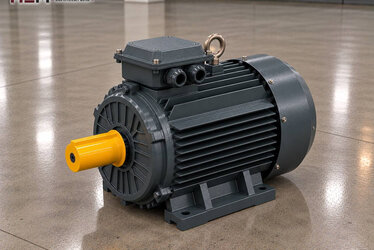
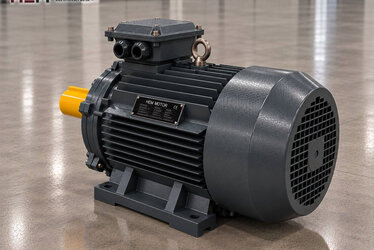
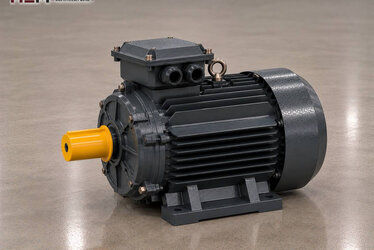
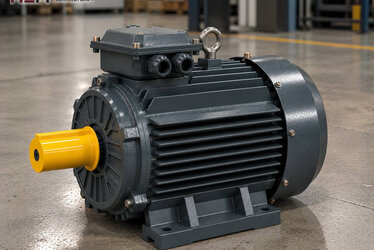
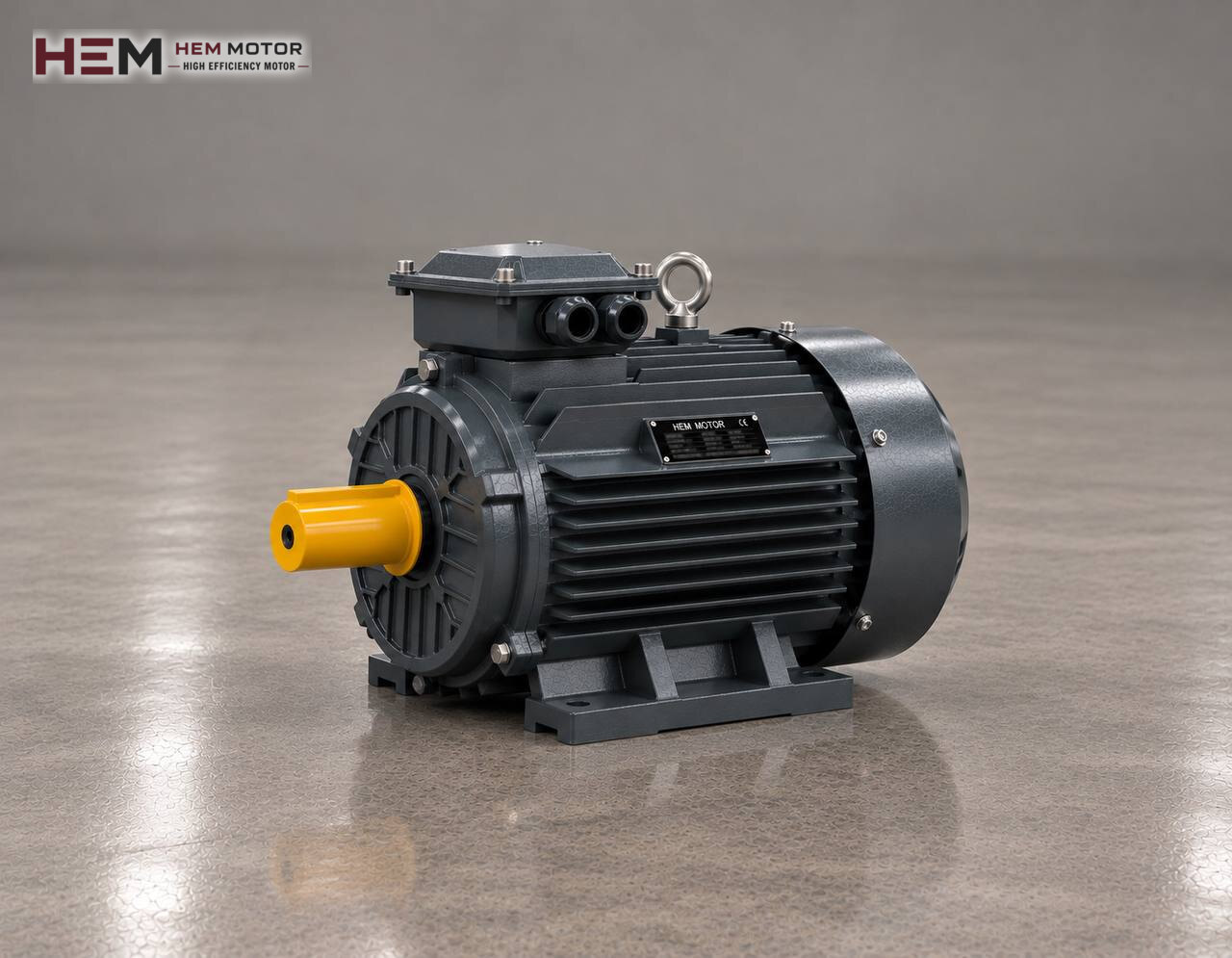
HEM Motor three-phase series are IP55 protected: they are protected against splashing water and dust, but they are not designed to run under a continuous water jet or to be washed with pressurised water. If the motor sits right next to the disc guard, a protective measure from the machine manufacturer such as a splash screen is needed; any special condition should be stated in the order. In workshops that cool down overnight, an anti-condensation heater to keep moisture from collecting inside the frame, and a PTC or PT100 sensor to signal winding overheating, can be added as order options.
Example motors by station
| Drive point | Nature of the load | What to discuss | Example HEM model |
|---|---|---|---|
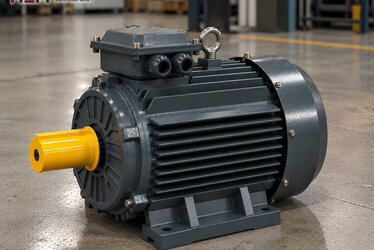
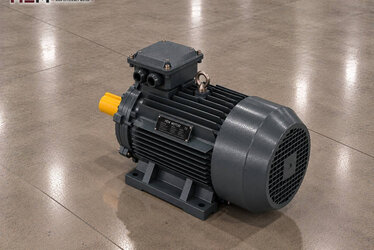
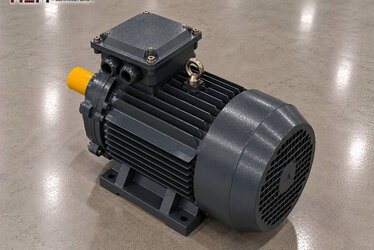
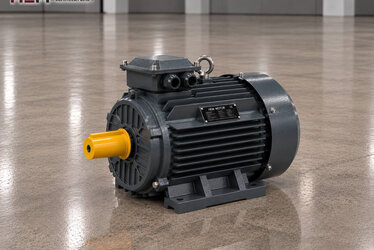
| Strip cutting disc shaft | Long, steady cutting load | Number of discs, starting method, pulley ratio | Cast iron 160L-4 (15 kW, 4-pole) |
| Head cutting disc | Intermittent; high on entry, low on return | Cycle frequency, whether the motor stops | Cast iron 132M-4 (7.5 kW, 4-pole) |
| Conveyor belt | Low speed, through a reducer | Reducer flange, inverter speed control | Cast iron 100L1-4 (2.2 kW, 4-pole) |
| Shaft lifting, head travel | Short duty, frequent reversing | Mounting type, whether a brake arrangement is needed | Cast iron 80M2-4 (0.75 kW, 4-pole) |
These four rows give a starting idea, not a prescription. Which motor is fitted depends on the real load of the station, the required speed, the connection type and the workshop conditions. If a special arrangement such as a brake motor is needed, it should be asked about separately when ordering.
Mounting and inverter operation
Foot-mounted (B3), flange-mounted (B5, B14), foot-and-flange (B34, B35) designs and vertical V1, V3, V5, V6, V15 arrangements with the shaft facing down or up can be supplied depending on frame size. We check together, at the order stage, the flange and shaft end that must match the head or the reducer. Details are in the mounting arrangements question.
Our three-phase motors can be run with their speed adjusted through a drive. If the belt motor will turn slowly for hours while delivering full torque, the air from its own fan may not be enough and a separately powered cooling fan is added. If the panel and motor are far apart, a dv/dt or sine filter is considered against voltage spikes on the long cable. It is enough to state this operating mode in the order. A short note on the subject is on the inverter operation page.
Information to prepare when asking for a quote
So that we can propose the right motor the first time, send us: the machine type (strip cutting or head cutting) and which drive the motor is on, the power (kW) and speed (rpm) of the existing motor, the supply voltage on site, the mounting type and the quantity needed. If the disc shaft is belt-driven, the pulley diameter helps; if it is direct-coupled, the shaft diameter and length.
The most practical way is to send a photo of the old motor's nameplate: finding an equivalent motor from the nameplate. All power and speed options are listed with current prices in the electric motor shop. Our WhatsApp and phone numbers are on the contact page; motors in stock leave from the warehouse in Türkiye.
Frequently Asked Questions
If I add discs to the strip cutting shaft, do I need a bigger motor?
As the number of discs grows, the total section cut at the same belt speed increases and so does the power drawn by the motor. Lowering the belt speed first is one option; if the motor already runs close to its rated current, more power may be needed. Deciding on the basis of a current measurement is the soundest approach.
Should the head cutting motor be stopped after every cut?
On most machines the disc keeps turning and only the head moves. Stopping and restarting the motor every cycle increases the number of starts per hour and heats the winding; if such a control scheme is used, it should be stated in the order.
Does replacing a 4-pole disc motor with a 2-pole motor make cutting faster?
If the pulleys stay the same, the disc peripheral speed roughly doubles and may exceed the value recommended by the disc manufacturer. This is risky for safety and disc life; staying at the same number of poles is recommended.
Does running the conveyor motor at very low speed on an inverter cause problems?
At low speed the motor's own fan blows less air. If it will run at full load and low speed for long periods, a separate cooling fan may be needed; this is stated in the order.