English
 Français
 Türkçe
 Español
 Русский

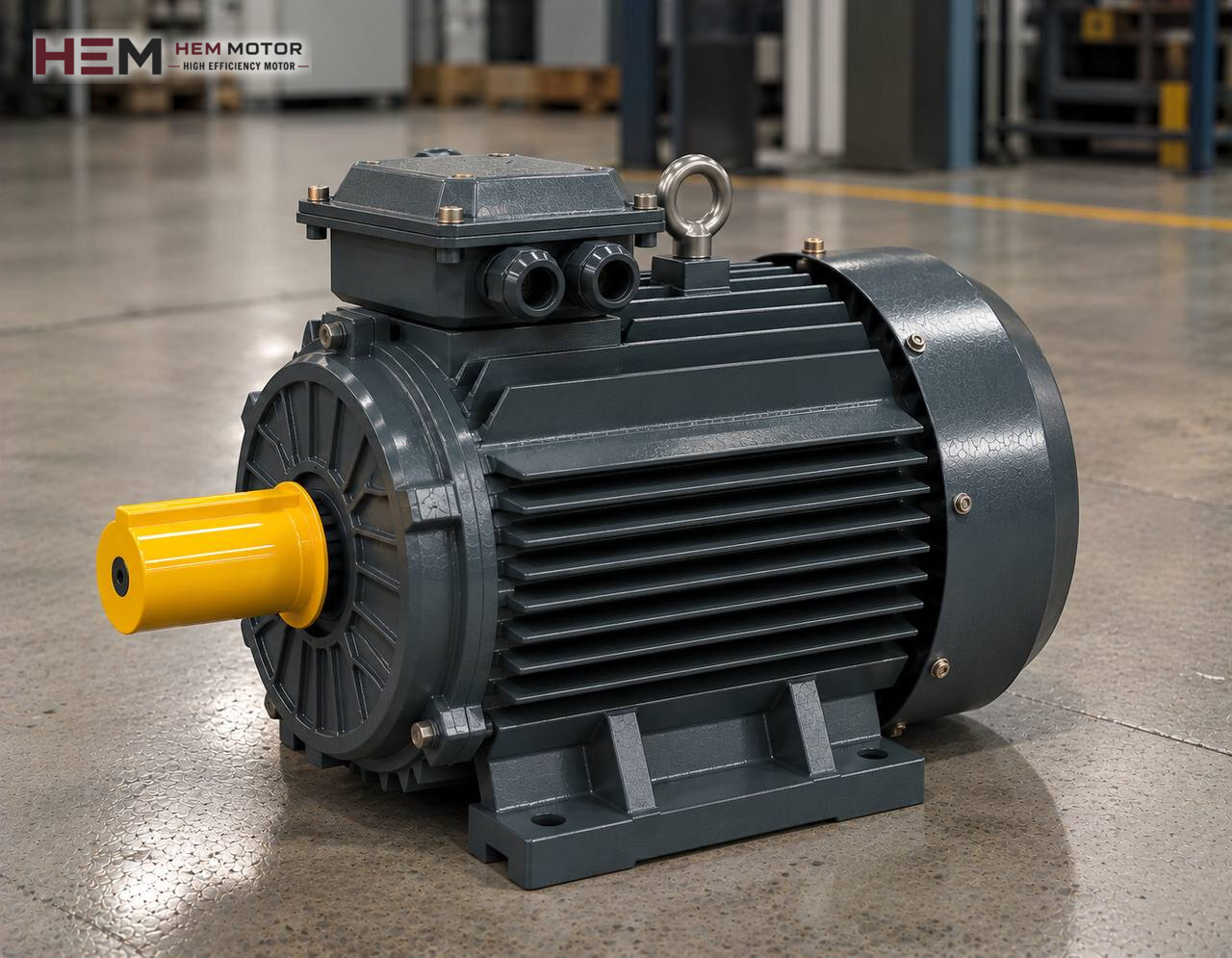
A CNC stone processing machine is a program-controlled machine that uses diamond tools to produce work such as kitchen countertops, sink cut-outs, reliefs, lettering or three-dimensional sculpture from marble and granite. For a general view of the other machines in a marble workshop, see the marble and natural stone processing motors page. This page covers the drives that work beside, below and behind the CNC machine and can be met with a standard three-phase asynchronous motor.

First, the boundary: spindle and axis motors
The spindle that turns the tool on a CNC machine is a special motor that reaches thousands of revolutions per minute and is matched to its own drive. The axis drives that position the bridge, head and table with millimetre precision are servo systems. High-speed spindle motors and servo/stepper motors are not in HEM Motor's 2026 catalogue; when these parts fail, the right address is the machine manufacturer or a spindle service.
A CNC stone machine, however, is not made up of the spindle and axes alone. It needs vacuum to hold the workpiece on the table, water to cool the tool, on some machines hydraulics to lift the table, a conveyor to carry away stone sludge and, in dry work, dust extraction. Each of these drives runs on an ordinary fixed-speed three-phase motor, and they are the subject of this page.
Vacuum pump: the motor that holds the part on the table
The stone slab is held on the table by suction cups. The vacuum under the cups is produced by a pump, usually a rotary vane or liquid ring type, connected to the motor by a coupling or directly by flange. The motor runs without interruption for as long as the machine is working; if vacuum drops during machining, the part slips and the tool or the part is damaged.
So what matters for the vacuum pump motor is long, steady running. The load varies with the volume the pump keeps sealed and with how well the cups contact the surface; on porous or rough stone the pump draws more air. The motor power and speed given by the pump manufacturer should be taken as the basis. In liquid ring pumps the pump water also circulates, so the area around the motor can stay wet; this detail is taken into account when choosing where to mount it.
Cooling water and water recovery
The diamond tool is cooled with water every moment it is in the stone. Water comes from a central line or from the machine's own pump; used water is collected with the sludge, cleaned in a settling tank or filter press and reused. In this loop the feed pump, the sludge pump and sometimes a tank agitator run on separate motors.
Centrifugal water pumps are generally paired with a 2-pole motor of the roughly 3,000 rpm class; for sludge pumps a lower speed may be preferred to reduce wear. For details on the pump side, the pump electric motors page gives broader information.
Hydraulic unit, sludge conveyor and dust extraction
On some CNC stone machines, table tilting, part lifting or door and cover movements are done with hydraulic cylinders. Here the motor turns the hydraulic pump; the cylinder produces the force and the hydraulic circuit the pressure. Motor selection is based on pump flow, working pressure and cycle time; details are on the hydraulic pump electric motors page.
Stone fragments and sludge falling under the machine are carried out by a geared chain or belt conveyor. This drive is a low-speed, continuous load that is occasionally prone to jamming; setting the motor's overcurrent protection correctly is important. When composite stone is machined dry or polished, an extraction fan runs for the fine dust; for the fan side, the fan and extractor motors page is a guide.
The motor against wetness, sludge and vibration
A CNC stone workshop is permanently damp because of cutting water and mist. Auxiliary motors often sit under or beside the machine, within splash range. When stone sludge sticks to the fan cover and dries, the motor's air intake narrows and the frame temperature rises; cleaning the cover grille at regular intervals is therefore important.
HEM Motor's standard series are IP55 protected. This class protects against water splashes and dust; the motor is not designed to stay under a continuous water jet, to be washed with pressurised water or to sit in sludge. If there is such a location, a protective measure from the machine manufacturer or a special motor is needed; it should be stated in the order. In workshops that stay closed over the weekend, condensation can form inside the motor, so an anti-condensation heater, and a PTC or PT100 sensor for winding monitoring, are order options.
Example motors by auxiliary drive
| Auxiliary drive | Motor's task | Basis for selection | Example HEM model |
|---|---|---|---|
| Vacuum pump | Keep vacuum at the cups without interruption | Power and speed required by the pump maker, connection type | 132S-4 cast iron — 5.5 kW, 1,460 rpm |
| Cooling water pump | Supply water to the tool continuously | Flow, head, 2-pole speed | 90L-2 cast iron — 2.2 kW, 2,895 rpm |
| Hydraulic unit | Feed the table tilting and lifting cylinders | Pump flow, pressure, cycle time | 112M-4 cast iron — 4 kW, 1,450 rpm |
| Sludge and chip conveyor | Remove stone debris from under the machine | Reducer connection, protection against jamming | 80M2-4 cast iron — 0.75 kW, 1,420 rpm |
The motors in the rows are there to give an idea. The final decision is made by looking at the real need of the pump, fan or conveyor, the required speed, how the motor will be connected and the workshop environment.
Connection type and use with a drive
Vacuum and water pumps usually seat on the pump with a flange or combined foot-and-flange frame; the conveyor motor is flanged to the reducer. HEM's series include B3, B5, B14, B34, B35 and vertical V1/V3/V5/V6/V15 designs, varying with frame size. The flange diameter and shaft end required by the pump or reducer are verified separately; the options are listed in the mounting arrangements question.
To vary vacuum or water flow according to the program, these motors can be connected to a frequency inverter. If the motor will stay at low speed and full torque on the drive for long periods, an additional cooling fan may need to be added; if the drive panel is far from the motor, a dv/dt or sine filter comes into question. Share your drive operation plan in the order; a short explanation is on the use with a frequency inverter page.
Information needed for a motor request
To clarify your request, send us the machine brand and type, which auxiliary drive the motor runs (vacuum, water, hydraulic, conveyor, dust extraction), the motor power (kW), speed (rpm), mains voltage, mounting type and the quantity needed. For motors coupled directly to a pump, the flange type and shaft diameter are also required.
If the existing motor's nameplate is readable, sending a photo is enough: send the motor nameplate and we will find the equivalent. Models on sale and their prices are on the buy electric motors page; our WhatsApp line and phone are on the contact page.
Frequently Asked Questions
The spindle motor of my CNC stone machine burned out; can a standard motor be fitted instead?
No. The spindle is a special high-speed motor with a tool holder, matched to its drive; a standard asynchronous motor cannot replace it. Such spindle motors are not in HEM Motor's 2026 catalogue; contact the machine manufacturer or a spindle service.
Why does the vacuum pump motor run all the time; can it not be stopped?
Vacuum must be maintained for as long as the part stays on the table; if the motor stops, the holding force at the cups falls. Some machines have a check valve or tank in the vacuum line and the motor can stop briefly, but this depends on the machine design.
The conveyor motor under the machine trips often; what could be the cause?
Stone debris jamming the chain or belt causes a sudden current rise and the protection relay cuts the motor. First check the cleanliness and tension of the conveyor, then compare the relay setting with the current on the motor nameplate.
Should the cooling water pump motor be 2-pole?
Most centrifugal water pumps are designed for about 3,000 rpm, so a 2-pole motor is common. The definitive answer comes from the pump nameplate or the manufacturer's data; if a motor with a different speed is fitted, the pump's flow and pressure change.