English
 Français
 Türkçe
 Español
 Русский

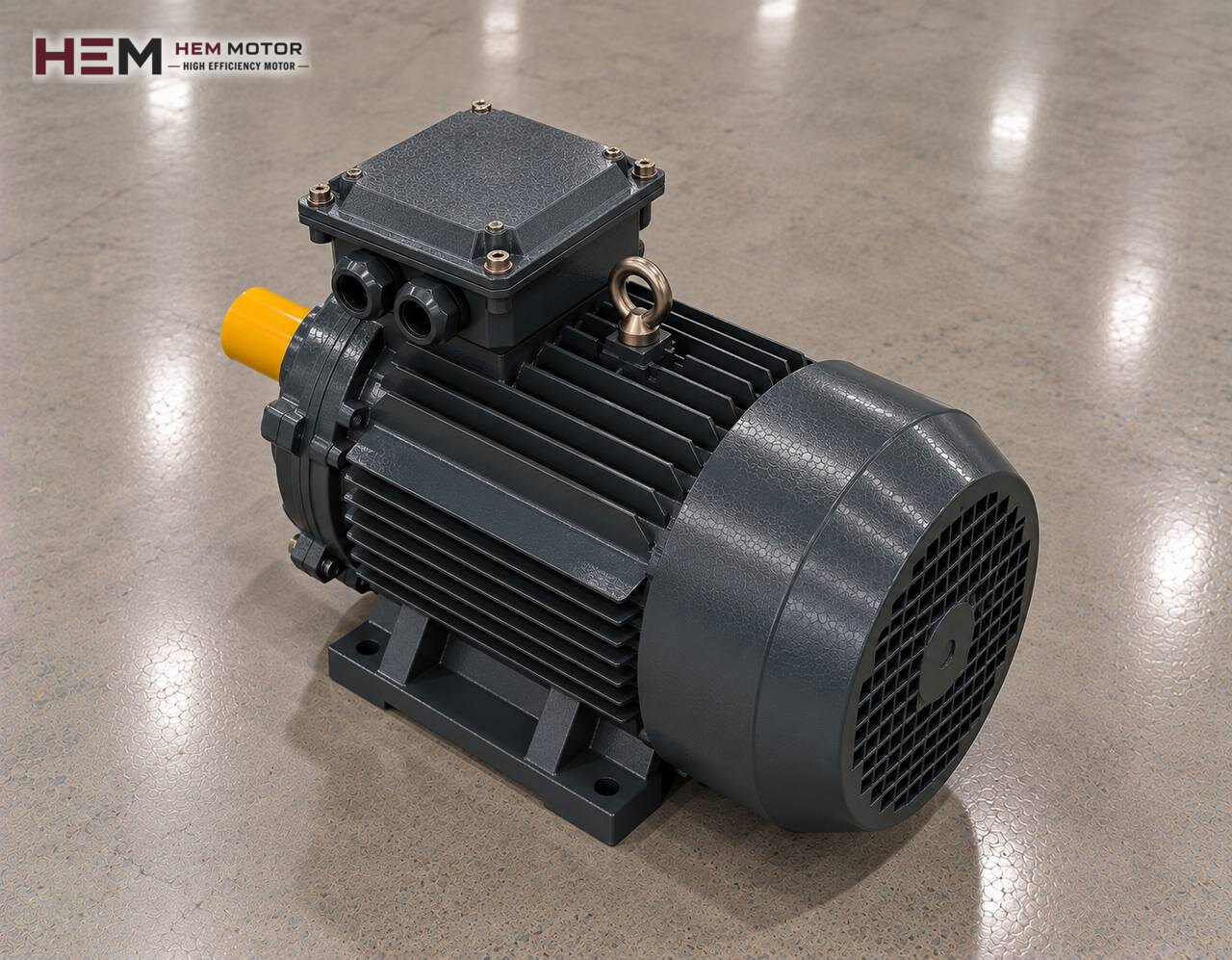
Machines that press concrete blocks, pumice blocks, paving stones and kerbs are the concrete-based branch of the group we describe in general terms on our brick, tile and ceramic production line electric motors page. Here we focus on this one machine only: in the assembly that fills the mould, vibrates and compresses the concrete, strips the product from the mould and moves it out on a pallet, we look at which job the electric motor actually does and how that shapes motor selection.

What Turns Inside the Machine During One Pressing Cycle?
Semi-dry concrete with the consistency of moist earth arrives from the mixer. The feed box slides over the mould and fills the cavities. Then the lower table vibrates and the tamper head comes down from above; vibration and pressure together compact the concrete. The mould lifts, the product stays on the production pallet, the pallet is pushed forward and an empty one takes its place.
This cycle takes a few seconds and repeats without pause throughout the shift. The electric motor does not perform most of these movements directly. In current machines hydraulic cylinders produce the movement of the mould, the tamper head and the feed box; vibration comes from separate drives; the mixer, material belts and pallet handling run on their own motors. To choose the right motor, you first need to identify which movement is involved.
Hydraulic Unit Motor: Force Comes from the Pump and Cylinders
In a hydraulic block machine the pressing force is created not by the motor but by the chain of pump, valve block and cylinders. The motor's task is to turn the pump; its power is assessed from the pump flow, working pressure and cycle time, based on the pump manufacturer's data. We explain the logic of this calculation separately on our hydraulic pump electric motors page.
The unit motor usually runs for the whole shift while its load fluctuates within the cycle: as the cylinder approaches quickly, flow is high and pressure low; at the moment of pressing, pressure peaks. Pumps are mostly connected to a 4-pole motor of the 1500 rpm class through a flexible coupling and a pump bell housing. That is why foot-and-flange B35 or flange B5 frames are common on these machines.
Older Mechanically Driven Machines: Flywheel and Eccentric
On some older or simpler machines pressing is done through an eccentric shaft and flywheel turned by the motor via belts. In this arrangement the motor must first accelerate a heavy flywheel; the start takes longer and current stays high during that time. The thermal relay setting and the starting method should be planned around the flywheel inertia, otherwise the protection may trip before the start is complete.
If the motor on such a machine is to be replaced, the power and speed on the old motor's nameplate are the most reliable starting point. The pulley diameter should be kept; if the speed class changes, the number of strokes changes too.
Vibration Drive, Mixer and Pallet Line
The vibration table is shaken by shafts carrying unbalanced weights that rotate at high speed. A standard motor can turn these shafts through belts or cardan shafts; some machines instead use vibration motors bolted directly to the table, which are a separate product type. In the standard motor arrangement the motor starts and stops every cycle and part of the shaking reaches its bearings; the motor base, belt tension and fixing bolts should be checked at short intervals.
The mixer, whether planetary or horizontal shaft, must be able to start with a full pan; this is a heavy start and the drive is usually through a gearbox (electric motors for gearboxes). The aggregate batching and cement screw side resembles a concrete plant; you will find those motors on the concrete plant electric motors page. The pallet feeder, product outfeed belt and cuber are small geared drives.
Starting, Speed Adjustment and Winding Protection
The hydraulic unit motor usually starts with the pump unloaded and pressure relieved, so star-delta starting is common. For mixers and flywheel drives that start loaded, a soft starter or a drive is considered; the decision also depends on the plant's supply conditions.
On machines with adjustable vibration frequency the motor is driven by a frequency converter. HEM's three-phase series are suitable for this kind of speed control (inverter-compatible electric motors). If the motor will run at low speed with full torque for long periods, an external fan may be needed; if the cable between drive and motor is long, a dv/dt or sine filter is considered. Please state these conditions with your order. A PTC or PT100 sensor in the winding and an anti-condensation heater that prevents moisture build-up during standstill can be added as order options.
Mounting, Cement Dust and Water
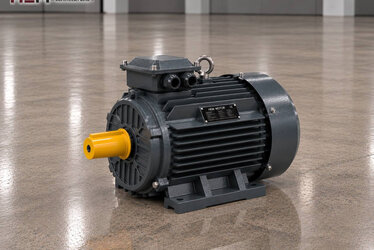
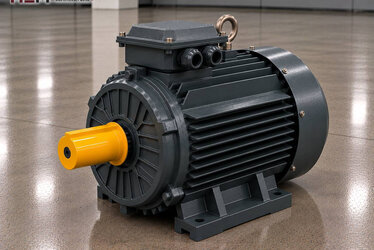
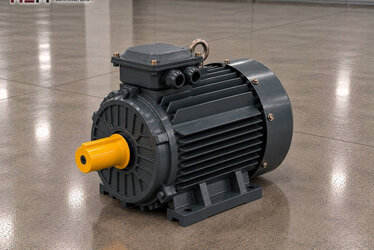
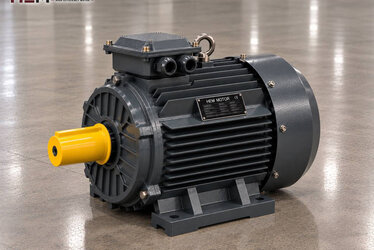
Depending on frame size, our motors are offered in B3, B5, B14, B34, B35 and vertical V1/V3/V5/V6/V15 arrangements; flange and shaft dimensions are confirmed with the order. For details see the mounting arrangements question.
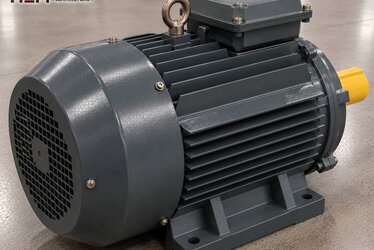
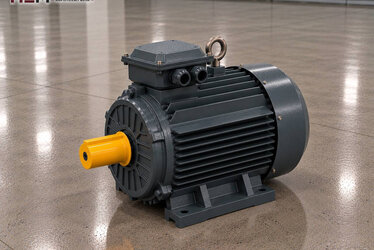
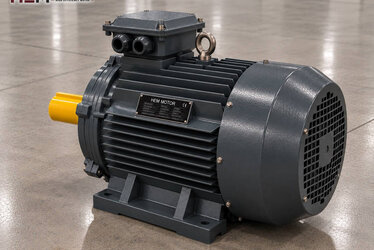
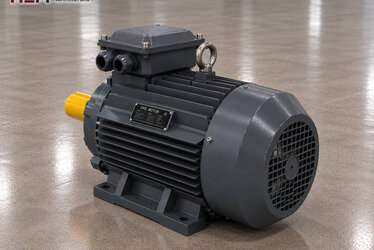
All models are IP55 protected, have class F insulation and are designed for 50 Hz supply. On a block yard, cement dust and mould oil vapour stick to the motor's cooling fins; if the gaps between fins are not kept clean, the motor heats up. If the mould and table are washed with a hose, keep the motor away from direct water jets: a standard IP55 motor is not designed for washing with pressurised water. In such a case the machine builder's protective measure or a special motor is required; please state it with your order.
Example HEM Models for a Block Machine
| Drive point | Load seen by the motor | Value to check when selecting | Example HEM model |
|---|---|---|---|
| Hydraulic unit pump | Continuous rotation, pressure fluctuating within the cycle | Pump flow, working pressure, cycle time | 180L-4 – 22 kW, 1,470 rpm |
| Large hydraulic unit (twin pump) | Same load, higher total flow | Number of pumps and total flow | 200L-4 – 30 kW, 1,475 rpm |
| Concrete mixer | Start with a full pan, continuous geared load | Pan charge, gearbox input speed | 160M-4 – 11 kW, 1,465 rpm |
| Vibration shafts (with standard motor) | Frequent start-stop, shaking | Vibration frequency, pulley ratio | 132M-4 – 7.5 kW, 1,460 rpm |
The models in the table are examples only; the actual selection is made once the machine load, required speed, mounting and operating conditions are clear. For other ratings you can browse the cast iron frame models.
What Information Should You Send for a Quotation?
The machine type and brand, which movement the motor provides (hydraulic unit, mixer, vibration, belt), the required power (kW) and speed (rpm), supply voltage, mounting type and quantity form the basis of the quotation. If you send a photo of the old motor's nameplate following the steps on the send your motor nameplate page, finding an equivalent is faster.
You can browse ready models in our shop and reach us by WhatsApp or phone using the numbers on our contact page. The current price is shown on each product page.
Frequently Asked Questions
Does replacing the hydraulic unit motor with a more powerful one speed up the block cycle?
Not on its own. Cycle speed is set by the pump flow and the valve arrangement; as long as the pump stays the same, a larger motor is simply less loaded. If flow is to be increased, pump and motor should be assessed together.
Can a standard three-phase motor be used instead of a vibration motor on the vibration table?
It depends on the machine design. On machines that take vibration from unbalanced shafts connected by belts or cardan shafts, a standard motor turns those shafts. A vibration motor bolted directly to the table is a product of a different design; the motors on this page do not replace it.
Why are 4-pole motors mostly seen on hydraulic units?
Most hydraulic pumps on block machines are designed to run at around 1500 rpm. Even so, the deciding factor is the speed range allowed by the pump manufacturer; keeping the speed class on the existing motor's nameplate is the safest approach.
If the motor on a block machine often overheats, what should be checked first?
First check whether the cooling fins are clogged with cement dust, then the pressure relief setting of the hydraulic unit; if the unit stays at high pressure even when idle, the motor runs at full load all the time. Imbalance between phase voltages and whether the measured current exceeds the nameplate value should also be checked.