English
 Français
 Türkçe
 Español
 Русский

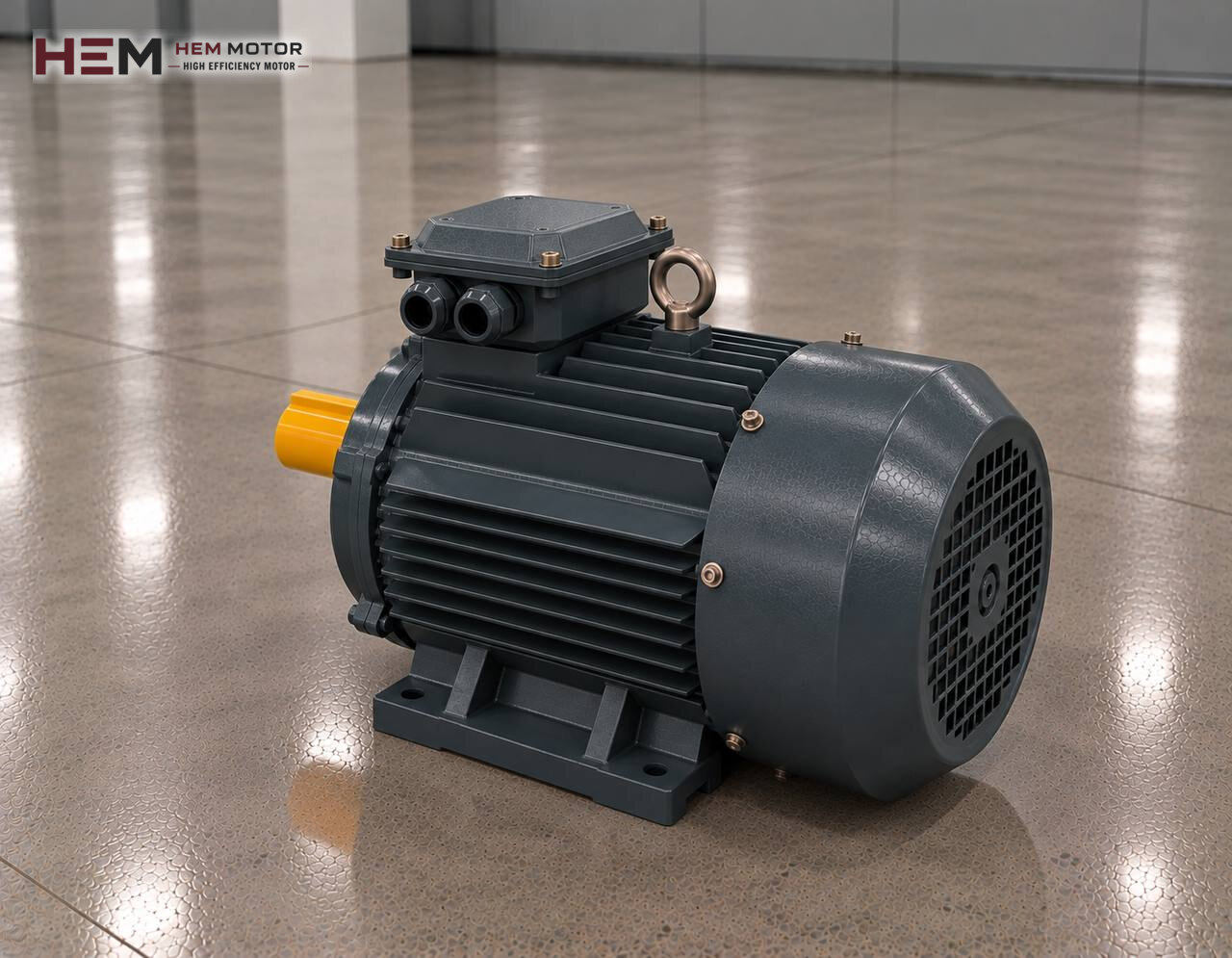
Porcelain tiles and large ceramic slabs coming out of the kiln need their edges squared and sized before they go into the box, and some products also need a polished surface. On squaring (rectifying) and polishing lines this work is done by many electric motors turning diamond-tooled spindles and abrasive heads. For the whole line see the brick, tile and ceramic production line motors page; here we only discuss the machines that bring the fired tile to its final size and gloss.

How Does a Fired Tile Enter the Machine?
The tile enters the machine on a belt, held on both sides by pressure belts. At the first station diamond wheels on each side grind the opposite edges; the tile is then turned ninety degrees in a rotating unit and passes to a second machine for the other two edges. Small stones that cut a fine chamfer on the edges sit on the same line. In this sequence every diamond wheel turns with its own motor, so a single line may consist of dozens of motors.
On the surface side the tile passes under rotating abrasive heads hung from a bridge. The heads are arranged from coarse to fine grit; the first heads level the surface, the later ones give a semi-polished (lappato) or fully polished finish. The bridge moves the heads back and forth across the tile width so that no marks remain on the surface.
The Motor's Role on Edge Grinding Spindles
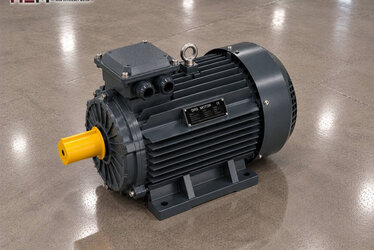
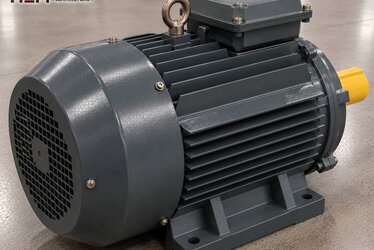
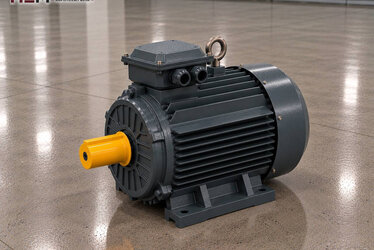
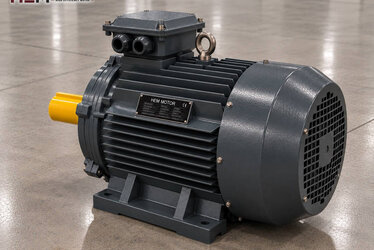
An edge spindle turns the diamond wheel either mounted directly on the motor shaft or through a short spindle bearing unit. Because the wheel needs enough cutting speed at its rim, these motors are chosen as 2-pole (3,000 rpm class) or 4-pole (1,500 rpm class) on most machines. The load is fairly even; it rises as the tile enters the wheel and falls as it leaves. A worn or clogged wheel raises the load noticeably, so monitoring the current also shows when the wheel needs attention.
In a direct-coupled arrangement the motor shaft run-out and bearing condition show up in the quality of the tile edge. A vibrating spindle leaves waviness and chips on the edge. Bearing replacement intervals and coupling alignment therefore deserve care on spindle motors.
Polishing Heads and the Oscillating Bridge
A polishing head carries a rotating plate pressed against the tile surface; the abrasive pieces on the plate may also perform small oscillations. Head motors are therefore larger than edge spindle motors and carry the load created by friction on the tile surface. When head pressure is increased, motor current rises too; the operator's setting must be taken into account when selecting the motor.
Most heads work with a downward-facing vertical shaft; the motor is mounted in a suitable vertical arrangement. The drive that oscillates the bridge, on the other hand, is a small, geared motor that changes direction constantly. Because this oscillation motor reverses frequently, attention is paid to starting current and contactor life.
Water, Slurry and Ceramic Dust
Squaring and polishing are wet processes. Diamond wheels and abrasives are cooled with water all the time; slurry splashes and mist are never absent from the machine. The IP55 protection of HEM motors covers splashing water and dust; a direct water jet or permanent immersion is outside what this protection allows for. The motors should be protected by the machine's water curtains and guards; if a harsher condition applies, state it in your order.
Dried slurry clogs the fan cover and cooling fins; cleaning at the end of each shift keeps the motor temperature low. On machines that stand idle at weekends, moisture can get into the winding; an anti-condensation heater and a PTC/PT100 winding sensor are order options. For the motor of the pump feeding the water circuit, see the pump electric motors page.
Belt Speed, Inverter and Mounting
Line output is set by the speed at which the tile advances on the belt. The belt motor is usually geared and its speed is adjusted by a frequency converter; on polishing heads, too, a converter can be used to change head speed. Drive operation suits HEM's three-phase series; if the motor will carry full load at low speed for long periods, a separate cooling fan should be considered, and an output filter if the drive cable is long. Share these operating conditions when requesting a quote; details are on our inverter-driven motors page.
Head and spindle motors usually sit on the machine by a flange. Depending on frame size, foot-mounted B3, flange B5 and B14, foot-plus-flange B34 and B35, and vertical V1, V3, V5, V6, V15 options are available; flange and shaft dimensions are checked together at the order stage. The flange-mounted motors page explains the difference between flange types.
Example HEM Models for a Ceramic Squaring Line
| Machine section | What it does | Point to check | Example HEM model |
|---|---|---|---|
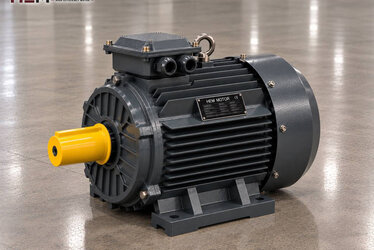
| Edge grinding spindle | Turns the diamond wheel directly | Wheel speed, shaft run-out, flange | 5.5 kW, 2,930 rpm, 132S1-2 cast iron |
| Squaring (levelling) head | Levels the surface with coarse abrasive | Head pressure, vertical mounting | 11 kW, 1,465 rpm, 160M-4 cast iron |
| Polishing (lappato) head | Gives gloss with fine abrasive | Head speed, inverter use | 15 kW, 1,465 rpm, 160L-4 cast iron |
| Conveyor belt or bridge oscillation | Slow movement through a gearbox | Reversing frequency, gearbox input | 1.5 kW, 1,445 rpm, 90L-4 cast iron |
These pairings are for guidance only; the right motor is determined by the real load of the head or spindle, the required speed, the mounting method and the machine environment. The power and speed given by the line builder always take precedence.
Information to Send for a Quotation
Tell us which machine and station the motor is for (edge spindle, squaring head, polishing head, belt), the motor power (kW), speed (rpm), plant voltage, mounting type (foot, flange, vertical) and quantity. If the line has many of the same motor, add the number you want to keep as spares. A nameplate photo of the existing motor is enough in most cases.
Model prices are shown on the product pages in our electric motor shop. To reach us by WhatsApp or phone, use the details on the contact page.
Frequently Asked Questions
Why does the current on an edge grinding spindle rise over time?
As the diamond wheel wears or clogs with slurry, it starts rubbing instead of cutting and the motor is loaded more. A rising current usually means the wheel needs dressing or replacing; bearing and coupling condition should also be checked.
Can a polishing head motor run vertically?
Yes, heads usually have a downward-facing vertical shaft and the motor is mounted in a suitable vertical arrangement. State the vertical mounting and flange size in your order; the bearing arrangement is confirmed according to shaft direction.
Is a standard IP55 motor enough on a wet machine?
IP55 is suitable for splashing water and mist, but a direct water jet or submerged operation is outside the scope of this protection. The machine's guard should protect the motor; if the environment is different, state it in your order.
What should I do to change the head speed?
Changing the pulley ratio or using a frequency converter are the two options. If the motor will run at low speed on a converter for long periods, its cooling is evaluated separately; tell us about this mode of operation in your order.