English
 Français
 Türkçe
 Español
 Русский

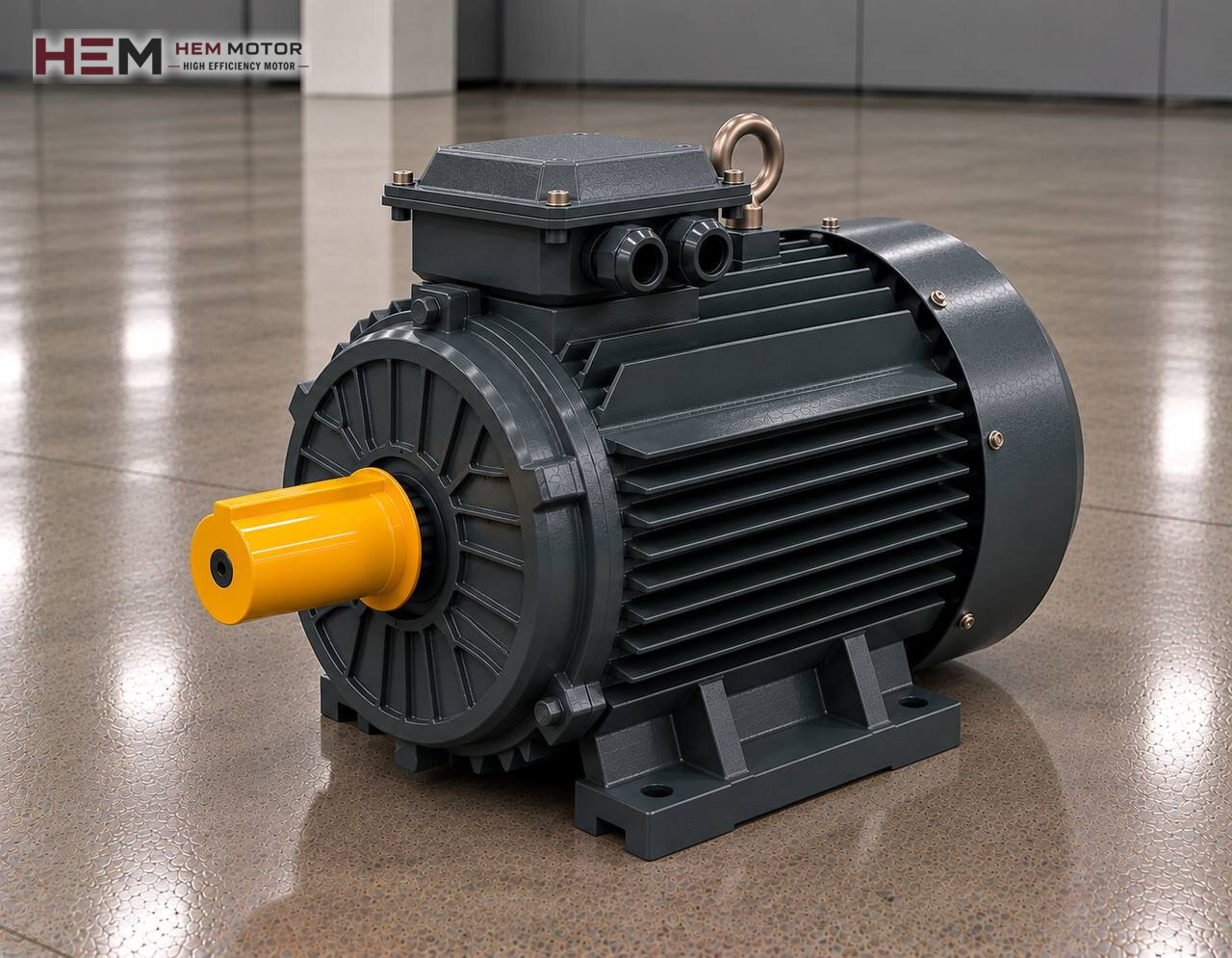
Clay from the pit must first be broken up and refined before it can become a brick or a roof tile; this work is done by the roller machines in the preparation section. You can take a general look at the motors of the whole line on our brick, tile and ceramic production line electric motors page. This page covers two machines from the point of view of the motor that turns them: the clay crusher that breaks up large lumps and the roller mill that crushes clay by passing it through a narrow gap.

What Do the Rolls Do in the Crushing and Milling Stage?
In the preparation line clay usually passes through more than one roller machine. The first stage does the rough work: rolls with teeth, bars or grooves grip and break hard clay lumps, dried crusts and small stones. In the next stage rolls with smooth, hardened surfaces are set very close to each other; as the clay passes through this narrow gap it is crushed, lime grains and sand inside it are ground, and the texture of the body becomes uniform.
The two rolls usually do not turn at the same speed. The speed difference makes the clay not only squeeze between the rolls but also slip and tear. On the motor side this means each roll carries its own load: the faster roll generally does more work.
One Motor per Roll: Transmission Arrangements
In the common arrangement each roll has its own motor, connected to the roll shaft by V-belts over a large pulley. The large pulley both reduces speed and acts like a flywheel, storing energy during sudden shocks. On some small machines a single motor turns both rolls together through gears or a chain; in that case the speed difference comes from the gear ratio.
On slower rough crushers a gearbox may sit between motor and roll. For connection details in this arrangement see our electric motors for gearboxes page. Whatever the arrangement, the pulley diameters and the motor's pole number together set the peripheral speed of the roll; both should be kept when the motor is replaced.
Shock Load and Stone Jamming
The load of a clay crusher is irregular. Clay from the feed belt sometimes reaches the roll loose, sometimes as lumps compacted like adobe; motor current fluctuates accordingly. On the rough crusher this fluctuation is large; on the fine roller mill it is smoother.
The real risk is a hard stone or a piece of metal that cannot be crushed getting between the rolls. On most mills one of the rolls is held by springs or a hydraulic cushion and moves back to open the gap when such a piece arrives. This safety device belongs to the machine; the motor's job is not to withstand it. Even so, belt slip, an overcurrent relay and a correctly set motor protection switch are needed so the motor is not damaged at such moments.
Starting, Roll Turning and Speed Selection
Mills start as empty as possible; when the line is stopped, feeding is cut first and the rolls are run clear. After an unplanned stop, however, clay remains between the rolls and the motor has to start under load. That is why plants where star-delta starting is not enough use a soft starter or frequency converter; starting the two roll motors one after the other at a short interval also eases the supply.
The roll surface of fine roller mills wears over time and is corrected by turning on the machine. Because this requires the roll to rotate very slowly, some plants run the main motor on a drive or use a separate auxiliary drive. HEM's three-phase series are suitable for speed control with a frequency converter (inverter-compatible electric motors); for long periods at low speed with full torque an external fan may be needed, and if the cable is long a dv/dt or sine filter is considered. Please state these conditions with your order.
Wet Clay, Dust and Mounting
The crusher section lives in two environments that change with the season: in the rainy period wet, sticky clay splashes onto the motor, in the dry period fine clay dust settles everywhere. Our motors are built with IP55 protection, class F insulation and for 50 Hz supply. If dust covers the cooling fins the motor heats up; the fins should be cleaned regularly. If a water jet is used to clean the rolls, the motor must not take water directly; IP55 is not designed for pressure washing, so in this case the machine builder's protective measure or a special motor is required, please state it with your order.
An anti-condensation heater to prevent moisture during long stops and a PTC/PT100 sensor to monitor winding temperature can be added as order options. In a belt-driven arrangement the motor usually sits on a foot-mounted B3 frame on a tensioning slide rail. Depending on frame size, B3, B5, B14, B34, B35 and vertical V1/V3/V5/V6/V15 options are offered; flange and shaft dimensions are confirmed with the order.
Example HEM Models for Clay Crushers and Roller Mills
| Machine | Load faced by the motor | Information to check | Example HEM model |
|---|---|---|---|
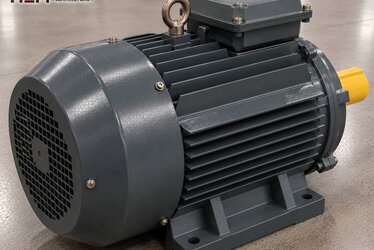
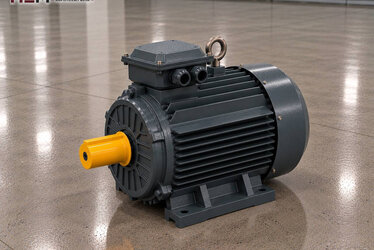
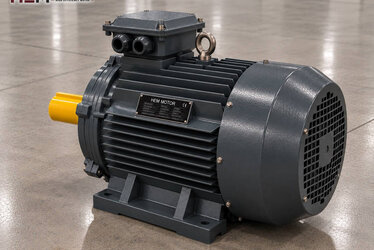
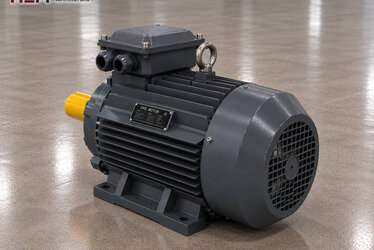
| Rough clay crusher (toothed roll) | Fluctuating, shock; stones and lumps entering | Roll speed, pulley ratio, gearbox or not | 225M-6 · 30 kW · 980 rpm |
| Roller mill – fast roll | Continuous, load rising as the gap narrows | Roll diameter and peripheral speed, gap setting | 250M-4 · 55 kW · 1,485 rpm |
| Roller mill – slow roll | Continuous, usually lighter than the fast roll | Speed difference between the two rolls | 225M-4 · 45 kW · 1,485 rpm |
| Large fine mill (6-pole arrangement) | Heavy continuous load, heavy pulley inertia | Pole number and power of the existing motor | 315S-6 · 75 kW · 985 rpm · SF 1.15 |
The models in the table are given as examples; the final selection is made according to the machine load, required speed, mounting type and operating conditions. You can find other ratings and speeds in the cast iron frame motors list.
What Is Needed to Order a Mill Motor
It is enough to tell us the machine type (rough crusher or fine mill), which roll the motor turns, the existing power and speed, supply voltage, mounting type and how many motors are needed. If two motors are being replaced for two rolls, sending both nameplates together helps keep the speed difference. For the nameplate photo you can use the send your motor nameplate guide.
You can see the models on our shop page and use the details on our contact page for WhatsApp or phone. The current price is shown on the product page.
Frequently Asked Questions
Do the two motors of a roller mill have to be the same power?
Not necessarily. Because the faster roll often does more work, the two motors have different ratings on some machines. When replacing, keeping each roll's own nameplate value is the right approach.
Why does the motor heat up more when the mill gap is narrowed?
As the gap narrows the clay is crushed more and the torque needed to turn the roll increases. The motor draws a higher current at the same speed. If current is constantly above the nameplate value, the gap, feed quantity or roll surface wear should be reviewed.
Is belt slip on a clay crusher harmful to the motor?
Brief slip protects the motor to some extent at the moment of a jam. But a belt that slips constantly heats up, wears the pulley and lowers the roll speed. Belt tension should be checked regularly and worn belts replaced as a set.
Can a 4-pole motor be fitted instead of the existing 6-pole mill motor?
Only if the pulley ratio is recalculated. If the pulleys stay the same, the roll's peripheral speed rises, the speed difference between the two rolls is upset and crushing quality changes. Such a change should be planned together with the machine builder's values.