English
 Français
 Türkçe
 Español
 Русский


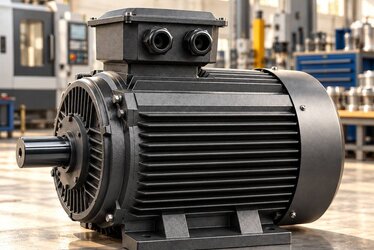
On a nut roasting machine, the drum motor and the fan motor are two motors that do two separate jobs on the same machine and see very different loads. The drum motor slowly turns a heavy, unbalanced mass at low speed through a gearbox or chain; the fan motor runs at high speed, passing hot air through the product or cooling the roasted product. To tell them apart during a replacement or new order, the nameplate, the connection type and the motor's position on the machine are read together.
Which motors are on a roasting machine?
Drum-type nut roasting machines heat products such as hazelnuts, peanuts, seeds, chickpeas, almonds and coffee inside a rotating cylinder. Depending on the machine type and size, there may be between two and five motors on it.
- Drum drive motor: turns the roasting cylinder. It usually works through a gearbox, chain and sprocket, or rollers around the drum.
- Hot air or exhaust fan motor: passes hot air from the burner through the drum, or extracts smoke and husk dust.
- Cooling tray agitator motor: the roasted product discharged into the cooling tray is stirred by arms. This is also a low-speed geared drive.
- Cooling fan motor: draws air from under the cooling tray to cool the product quickly.
- Burner fan: the burner's own combustion air fan; it comes with the burner and is usually a part supplied by the burner manufacturer.
Simply saying "roaster motor" in an order does not specify which of these motors is meant. A nameplate photo and information on where the motor sits on the machine prevent confusion from the outset.
Features that distinguish the drum motor from the fan motor
The easiest way to tell the two motors apart on site is to look at the mechanical part they are connected to and the speed on the nameplate. The table below summarises general tendencies; the final decision is always made from the existing nameplate.
| Feature | Drum motor | Fan motor |
|---|---|---|
| Typical speed | Mostly 4 or 6-pole (about 1,450 or 950 rpm) | Mostly 2 or 4-pole (about 2,900 or 1,450 rpm) |
| Connection | Gearbox flange, chain sprocket or belt | Fan impeller directly on the shaft or by belt |
| Load character | Constant torque, high resistance when starting with a full drum | Load rising rapidly with speed, light at start |
| Critical point | Starting torque, gearbox ratio, direction of rotation | Speed and impeller match, proximity to hot air |
| Fault symptom | Does not start with a full drum, thermal relay trips | Airflow falls, motor gets very hot |
The nameplates of these two motors can sometimes show the same power. For example, a 1.5 kW drum motor may be 6-pole, while a fan motor of the same power may be 2-pole. In that case ordering by power alone results in a motor at a completely wrong speed.
Drum motor: full start and constant torque
A roasting drum, together with the product inside, is a heavy and unbalanced mass. The product gathers on one side of the drum, and the motor has to lift this mass on every revolution. Torque is almost constant, regardless of speed.
The hardest moment is the start. If the drum has remained full after a power cut or a stop, the motor has to lift the weight of the product from the very first turn. For this reason, with the drum motor:
- The gearbox ratio and motor speed should be kept the same as the existing machine; if drum speed changes, roasting time and product colour change.
- Direction of rotation should be checked at first start; some drums turn in reverse for discharge, which is done by the reversing arrangement in the panel.
- If drum speed is adjusted with an inverter, the general statement on our website applies: our three-phase series are suitable for speed control with a frequency inverter; for long periods of full-torque operation at low speed an external fan may be needed, and if the cable between drive and motor is long a dv/dt or sine filter is considered.
Fan motor: speed, impeller and hot air
The power drawn by a fan rises roughly with the cube of speed. For this reason speed is a far more critical parameter for the fan motor than for the drum. If a 2-pole motor is fitted instead of a 4-pole fan motor, the impeller doubles in speed and the power required rises roughly eightfold; the motor is overloaded within the first minutes. Conversely, if a 4-pole motor is fitted instead of a 2-pole fan motor, airflow falls, roasting time increases and the product is not roasted evenly.
The position of the fan motor also matters. On hot air fans the motor should sit outside the hot gas flow, on a base or bracket attached to the housing; while the impeller draws hot air, the motor should take its own cooling air from a cool environment. A standard motor is not designed to run directly inside a hot gas flow. There should be a heat-break flange or spacer between the motor and the hot housing, and the motor's fan inlet must stay clear. If the ambient temperature around the motor is high, this should be stated in the order.
Husk dust and oily smoke build up on the motor frame and fan cover; this layer reduces cooling. Periodic cleaning noticeably reduces fan motor overheating problems. For an overview of fan applications, see the fan and exhaust fan motors page.
If it is clear which motor you are replacing and what its speed is, review suitable HEM Motor models and current prices.