When the motor of a centrifugal pump fails during the irrigation season, the first question is usually "how many kW and what speed?" The power is written on the nameplate, but speed often causes confusion: some farmers assume a faster motor will deliver more water, others try to couple a motor of a different speed that happens to be at hand. In a centrifugal pump, speed is a value tied to the pump design and is not changed at will. In this article we look at the difference between 1,500 and 3,000 rpm motors from the irrigation pump's point of view and explain, step by step, which information should be gathered before deciding.
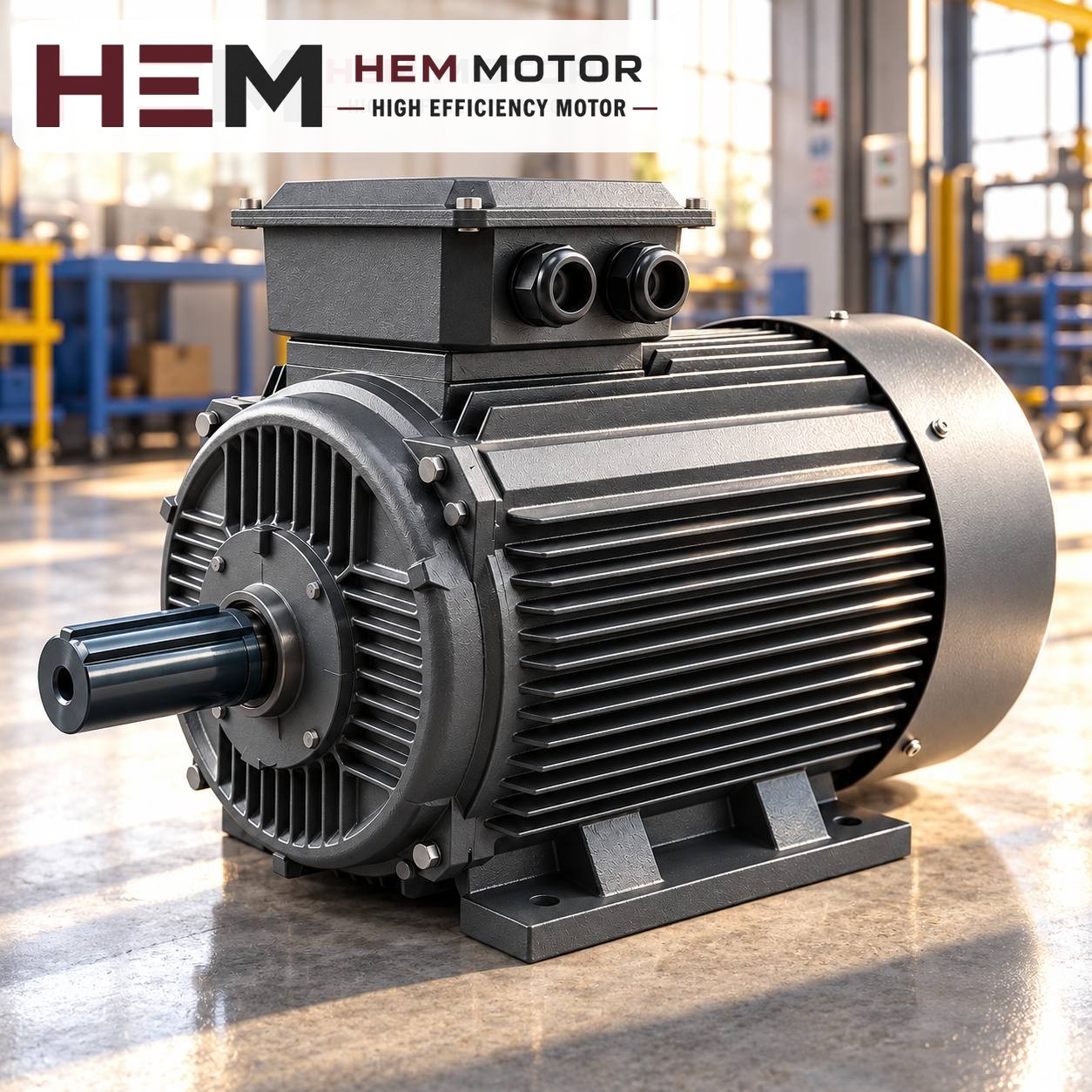
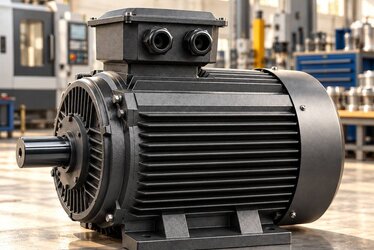
On irrigation pumps the motor often runs outdoors, exposed to dust and moisture (representative image).
Why is pump speed set by the impeller, not by the motor?
The impeller of a centrifugal pump is designed to deliver a given flow and head at a given rotational speed. The speed shown in the pump manufacturer's catalogue or on the pump nameplate is therefore not a suggestion but the operating point on which the curve is based. When choosing the motor, the task is to find the motor whose synchronous speed is closest to the speed the pump requires: a 2-pole (3,000 rpm synchronous) motor for a pump marked about 2,900 rpm, and a 4-pole (1,500 rpm synchronous) motor for a pump marked about 1,450 rpm.
The effect of changing speed is not linear. According to the pump affinity laws, flow rises in direct proportion to speed, head with the square of speed and the power absorbed by the pump with the cube of speed. Roughly speaking, running a pump designed for 1,450 rpm at 2,900 rpm means trying to multiply the head by four and the power by eight. Such a motor either trips on overcurrent within the first minutes, or the pump casing, the gland and the pipework are stressed far above their design limits. Conversely, coupling a 1,500 rpm motor to a 3,000 rpm pump gives a pressure too low to bring water to the field.
Differences between 1,500 and 3,000 rpm motors on an irrigation site
Once speed has been set by the pump, knowing what each option brings on site is also useful in new projects where the pump has not yet been chosen. The comparison below describes general tendencies; the pump manufacturer's values always come first.
Topic
2-pole (3,000 rpm synchronous)
4-pole (1,500 rpm synchronous)
Pump size
Smaller impeller pump for the same flow and pressure
Larger impeller, bulkier pump
Shaft torque
About half the torque at the same power
About twice the torque at the same power
Wear in sandy water
Because of the high peripheral speed, the impeller and wear ring may wear faster
Lower speed, generally longer life in abrasive water
Suction conditions
Needs higher suction pressure; cavitation risk rises with deep suction
More tolerant when drawing from a pond or canal
Noise
Higher noise level
Quieter running
On irrigation pumps that draw from a canal, a pond or an open tank, the suction lift and the sand in the water often push the speed decision towards 1,500 rpm. On compact pumps that feed high-pressure drip and sprinkler lines with clean water, 3,000 rpm is common. The decision is taken together with the pump selection; the motor is the result of that decision.
The speed on the motor nameplate and pump compatibility
Synchronous speed and the rated speed on the nameplate are not the same. Under load an asynchronous motor turns slightly below synchronous speed; this slip is natural. The nameplate of HEM Motor's 11 kW 4-pole cast iron model reads 1,465 rpm, and that of the 11 kW 2-pole model reads 2,945 rpm. The 1,450 or 2,900 rpm values in a pump catalogue also refer to these rated speeds, so small differences do not mean a mismatch.
When determining power, the motor power given by the pump manufacturer and the value on the existing motor's nameplate are what count. On the pump curve, the absorbed power rises when the operating point shifts to the right (for example during the first filling when the line is empty, or when a valve is fully open). Pump manufacturers take this into account when they specify the motor power; settling for a smaller motor on site can cause the thermal relay to trip on the hottest days of the season. For an old motor whose nameplate cannot be read, proceeding with the pump model and impeller diameter from the pump nameplate is safer than guessing.
Prices and technical data are on the product pages; choose a model and order online.
Mounting and coupling: close-coupled pump or pump on a separate baseplate?
Irrigation pumps are installed in two basic arrangements. In the separate-baseplate (coupled) arrangement, the pump and motor stand on a common baseplate with a flexible coupling between them; the motor is foot-mounted (B3). In this arrangement the shaft height and the foot hole spacing are decisive when replacing the motor; if the IEC frame code stays the same, the replacement is expected without touching the baseplate. In the close-coupled (monobloc) arrangement, the pump casing sits directly on the motor flange and the impeller is often fitted on the motor shaft. Here the flange size and shaft extension must match the pump exactly; it should not be assumed that a standard motor fits every close-coupled pump directly.
The IEC frame of 2-pole and 4-pole models of the same power is sometimes the same and sometimes different. At 11 kW both models use the 160M frame; at 18.5 kW the 2-pole model uses 160L and the 4-pole model 180M. Even when the frame code is the same, the shaft and bearing dimensions should not be assumed to be identical; check them in the 2D technical drawings by frame size. Mounting arrangements are offered according to the frame and the flange size is confirmed with the order; details are in the mounting arrangements question.
Example models: two speeds at 11 and 18.5 kW
For two power ratings often seen in field irrigation, HEM Motor's cast iron frame models are as follows. All models have IP55 protection, class F insulation and a 400/690 V (Δ/Y), 50 Hz supply; on a 400 V network they are connected in delta.
160M-4: 11 kW (15 HP), 4 poles, 1,465 rpm, IEC 160M, 20.4 A at 400 V, rated torque 71.7 Nm. For pumps with 1,450 rpm impellers drawing from a canal.
160M1-2: 11 kW (15 HP), 2 poles, 2,945 rpm, IEC 160M, 19.6 A at 400 V, rated torque 35.7 Nm. For pressure-line pumps with 2,900 rpm impellers working with clean water.
180M-4: 18.5 kW (25 HP), 4 poles, 1,470 rpm, IEC 180M, 33.5 A at 400 V, rated torque 120.2 Nm.
160L-2: 18.5 kW (25 HP), 2 poles, 2,940 rpm, IEC 160L, 32.5 A at 400 V, rated torque 60.1 Nm.
Note that at the same power the currents are close to each other, while the torque differs by roughly half. This difference explains why a 4-pole motor may need a larger frame. General information on pump motors is on the pump electric motors page, and agricultural applications are on the agricultural machinery motors page.
Hypothetical example: the motor of a pump next to a pond
The following situation is not a real customer application but an example built to show the order of decisions. Assume that the nameplate of a centrifugal pump on a separate baseplate, drawing from a pond, reads 1,450 rpm and 11 kW, and that the old motor's nameplate shows a 160M frame. In this case the right candidate is the 4-pole 160M-4. Having a 2-pole motor at hand does not make it suitable, even in the same 160M frame; the pump would be forced to turn twice as fast. On the coupling side, the shaft diameter is compared with the technical drawing, then the direction of rotation is checked against the arrow on the pump casing.
Electrical and environmental conditions to watch on site
Starting: On pumps of 11 kW and above, star-delta starters, soft starters or frequency inverters are often used. The general rule for operation with a frequency inverter is explained in the inverter use question; if the cable between drive and motor is long, the need for a filter is discussed with the order.
Long lines and voltage drop: For pumps at a wellhead or in the middle of a field, the cable from the transformer to the motor is long. If the voltage drops during starting the motor is strained; the cable cross-section should be checked in the electrical design.
Phase protection: Phase loss and imbalance are common on rural networks. A motor protection circuit breaker and a phase monitoring relay are the cheapest way to protect the motor.
Environment: IP55 protection is against dust and water splashes; it is not suitable for sunken pump rooms where the motor could end up under water. Install the motor at a height that flood water cannot reach; in direct sunlight a simple shade helps cooling.
Arrangements that draw water from inside a well are different: submersible pump motors are a separate product and are not the subject of this article. For well arrangements driven by a motor standing at the surface, see the deep well pump motor page.
Information needed for the order
So that we can quickly identify the right motor for your irrigation pump, send the following together:
The speed and motor power (kW or HP) on the pump nameplate, and the pump model name if possible
A photo of the old motor's nameplate and its IEC frame code
The arrangement: coupled on a separate baseplate, or close-coupled with a flange
Network voltage and starting method (direct, star-delta, soft starter, drive)
You can review suitable models and current prices on the buy electric motors page. If you are replacing an existing motor, send us the motor nameplate and we will identify the model that suits the pump together; for other questions, use our contact page.
HEM Motor Models Related to This Article
The cards show example models related to the topic. A suitable motor is not chosen by power alone: compare speed, voltage, mounting, shaft and connection dimensions on the product page; if unsure, send a photo of the existing motor’s nameplate on WhatsApp.
When replacing the drying fan motor of a glass washing machine, three things must stay the same as on the old motor: the number of poles (and therefore the fan speed), the motor's ... More Details
On a cold storage condenser, a standard three-phase motor can be used if the fan propeller is fitted to the shaft of a separate IEC-frame motor or driven by a belt. In external-rot... More Details
The motor for the circulation pump of a fabric dyeing machine is chosen not by looking at the machine's capacity but according to the pump's own data: flow, head, pump speed and th... More Details
When a stenter fan motor is replaced, two conditions are decisive: the temperature where the motor sits must be at a level a standard IP55, class F motor can work in, and the new m... More Details
A standard three-phase motor is the right choice for the hot air fan of a shrink packaging machine only if the motor frame stays outside the hot zone of the tunnel. The fan impelle... More Details
What strains the pump motor on a bottle washing machine is often not the electrical load but the motor's surroundings: steam rising from hot caustic solution, label pulp stripped o... More Details
We use necessary and optional cookies to improve your experience, enhance content and analyse traffic. Under the GDPR, optional (analytics/marketing) cookies are only used with your explicit consent. Please choose your preference below.
Cookie Policy
 English
 Français
 Türkçe
 Español
 Русский