Glass Washing Machine Drying Fan Electric Motor: Humidity, Speed and Mounting Compatibility

Glass Washing Machine Drying Fan Electric Motor: Humidity, Speed and Mounting Compatibility

When replacing the drying fan motor of a glass washing machine, three things must stay the same as on the old motor: the number of poles (and therefore the fan speed), the motor's mounting orientation on the machine and the way the fan impeller is connected to the shaft. In addition, the compartment where the motor sits must be dry; humidity and water mist coming from the wet washing section are the most common cause of failure in drying fan motors. If these conditions are met, a standard IP55 three-phase motor is widely used for this task.

In plants processing flat glass (insulating glass lines, before tempering, before laminating), a horizontal washing machine passes the glass between brushes, rinses it and then dries it with air knives. This article deals with the fan and motor in the drying section; brush and conveyor drives are separate subjects.
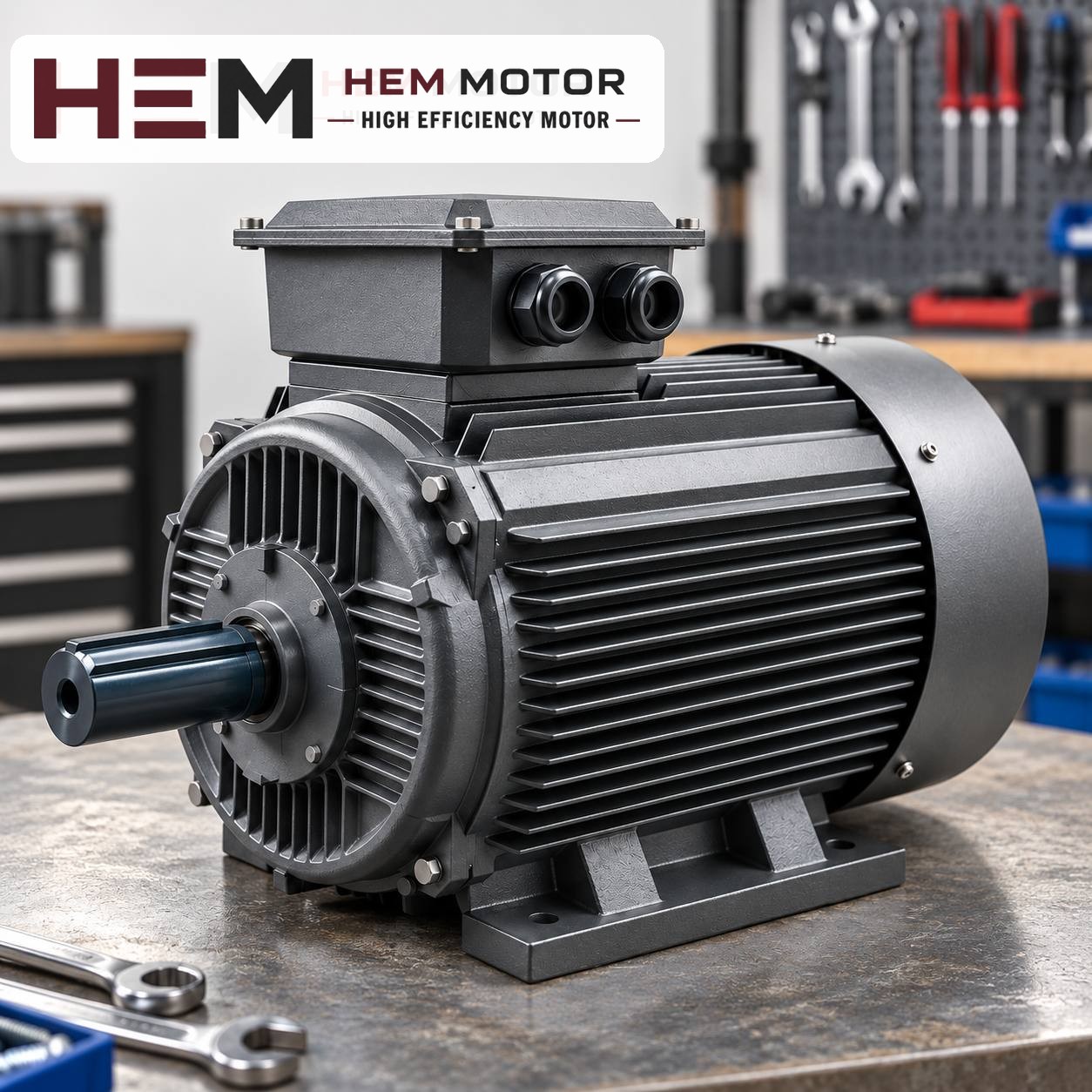
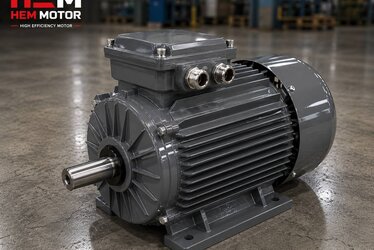
Three-phase electric motor on a workshop bench
Before replacement, the old motor's nameplate, shaft end and mounting orientation are recorded (representative image).

How does the drying section work?

There are two or more air knives that blow air at high velocity through a narrow slot onto the upper and lower surfaces of the glass. These knives strip the water film off the glass surface and push it back. The air is supplied by a centrifugal fan (on some machines a high-pressure blower), usually standing on top of or beside the machine. Because the air knife slot is narrow, the fan has to generate high pressure; this is why drying fans usually run with a 2-pole motor, i.e. at a rated speed of about 2,900 rpm.

On some machines there is a heater at the fan intake; heated air speeds up drying. In this case the air pushed by the fan is warm, but if the motor sits upstream rather than downstream of the heater in the airflow, it is not affected by hot air. The position of the heater and the air temperature the motor sees are stated in the order.

Speed condition: why is keeping the number of poles essential?

According to the fan laws, pressure changes with the square of speed and power drawn with the cube of speed. Because the air knife needs high pressure, the drying fan is very sensitive to speed:

  • 4-pole instead of 2-pole motor: Speed falls to about half and pressure drops to a quarter. Water spots remain on the glass surface; drying does not work.
  • 2-pole instead of 4-pole motor: Speed doubles and power demand rises about eightfold. The motor and impeller cannot carry this; the impeller becomes dangerous due to overspeed.
  • Belt-driven fans: The pulley ratio determines fan speed; pulley diameters must also be kept when the motor is replaced.

So the first check in a replacement is the speed and number of poles on the old motor's nameplate. A motor referred to as "3000 rpm" shows a rated speed such as 2,895 or 2,905 rpm on its nameplate; this difference is due to slip and is normal.

Humidity: where should the motor stand?

In a washing machine, the brushing and rinsing sections are permanently wet; water mist from these sections circulates inside the machine body. If the drying fan intake draws in this mist, two problems arise: humid air is blown onto the glass from the air knife, and the fan casing and motor are constantly exposed to moisture.

  • The motor should stand in a dry section separated from the wet section by a partition panel, or outside the machine.
  • The fan intake should, if possible, take ambient air away from the wet section and through a filter.
  • If water drops are seen on the motor frame, moisture traces in the terminal box or white scale on the fan cover, the intake and partition arrangement are faulty.
  • In plants where the wash water contains detergent or descaler, check separately whether mist reaches the compartment where the motor is located.

HEM Motor models have IP55 protection and class F insulation. IP55 protects against dust and water sprayed from any direction; continuous operation inside water mist or under pressurised washing pushes the limits of this protection. The humidity condition of the compartment where the motor stands should be clearly written in the order.

Filter and air path: check these first when drying deteriorates

A common mistake when drying gets worse is to blame the motor. Yet a clogged fan intake filter, glass dust or scale in the air knife slot, crushed flexible hoses or a disturbed knife angle give the same symptom. A clogged filter reduces fan flow; in a centrifugal fan, when flow falls, the current drawn by the motor also falls. In other words, drying has deteriorated while the motor appears relieved.

To find out whether the motor is really faulty, current and speed are measured, bearing noise is listened to and winding insulation resistance is checked. If these measurements are normal, the problem is in the air path.

You can see HEM Motor models suitable for drying fans and current prices on the buy electric motors page.

Prices and technical data are on the product pages; choose a model and order online.

Mounting compatibility: orientation, shaft and impeller connection

Drying fans can be found on the machine in horizontal foot-mounted (B3), flanged or vertical positions. If the impeller is fitted directly on the motor shaft, shaft diameter, shaft length and key size are critical; a badly seated impeller creates serious vibration at high speed. Mounting options are offered according to the frame and the flange size is confirmed with the order; details are explained in the mounting arrangements question. Compare shaft and flange dimensions with the 2026 technical and product catalogue.

On some machines the fan speed is changed with a frequency inverter according to glass thickness. HEM Motor's three-phase ranges are suitable for inverter speed control; for long periods of full-torque operation at low speed an external fan may be required, a dv/dt or sine filter is considered if the cable is long, and these conditions are stated with the order (inverter question). Running above 50 Hz, however, can quickly exceed the motor power because of the fan law.

Example models

The actual power is determined from the old motor's nameplate. The following are examples of 2-pole models that may be found on drying fans:

ModelPowerRated speedIEC frameFrameVoltage
90L-22.2 kW2,895 rpm90LAluminium230/400 V
100L-23 kW2,895 rpm100LAluminium230/400 V
100L-23 kW2,895 rpm100LCast iron230/400 V
112M-24 kW2,905 rpm112MAluminium400/690 V

Between 3 kW and 4 kW the voltage rating changes; on a 400 V supply, a 230/400 V motor is connected in star and a 400/690 V motor in delta. For fan applications, you can also see the fan and extractor motors page.

Hypothetical example: replacing a drying fan motor

The following situation is hypothetical. Suppose that on the washing machine of an insulating glass line, the bearing of the drying fan motor has started running noisily. The nameplate shows 3 kW, 2-pole, 100L and 230/400 V; the motor stands on top of the machine, right behind the washing section.

  • The 100L-2 model with the same power and number of poles is selected; the impeller shaft size is verified against the technical drawing.
  • White scale is seen on the motor's fan cover; it becomes clear that the fan intake was drawing mist from the wet section. The intake mouth is moved outside the machine and a filter is added.
  • Because of the humidity around the motor, the cast iron frame option is preferred; the electrical values are the same.
  • On the 400 V supply the motor is connected in star, and the direction of rotation is checked against the arrow on the fan casing.

Conclusion and information to send for a quote

The right motor for a glass washing machine's drying fan is the model with the same number of poles as the old motor, the same mounting orientation and compatibility with the same shaft-impeller connection; in addition, the motor must be kept in a dry compartment. For a quote, send a photo of the existing motor's nameplate, the number of poles, mounting arrangement, shaft end size, voltage, whether an inverter is used and the humidity condition of the motor compartment. Review suitable models and prices on the buy electric motors page. Send a photo of your current motor's nameplate, its speed and mounting details through the send motor nameplate page and request a quote for the right model; for other questions, use our contact page.
Frequently Asked Questions

Can I use a 4-pole motor instead of a 2-pole one on a drying fan?

No; speed falls to about half and the air knife pressure drops to a quarter, so the glass does not dry. Keep the old motor's number of poles.

Drying has got worse — is the motor faulty?

First check the intake filter, the air knife slot and the hoses. With a clogged air path the motor draws less current and looks healthy; if current, speed and insulation measurements are normal, the problem is in the air path.

Is an IP55 motor sufficient on a washing machine?

If the motor stands in a dry compartment, IP55 is widely used. Continuous water mist or operation under pressurised washing pushes the limits of this protection; state this condition in the order.

Can I increase fan speed with an inverter?

Above 50 Hz, fan power rises with the cube of speed, so the motor can be overloaded quickly. If a speed increase is needed, the motor power and the impeller's speed limit should be assessed together.

HEM Motor Models Related to This Article

The cards show example models related to the topic. A suitable motor is not chosen by power alone: compare speed, voltage, mounting, shaft and connection dimensions on the product page; if unsure, send a photo of the existing motor’s nameplate on WhatsApp.

2.2 kW 3000 rpm Aluminium Frame Electric Motor 90L-2

90L-2

2.2 kW · 3000 rpm

  • Aluminium frame · IEC 90L
  • 2895 rpm · IP55
  • Mounting: B3 foot; flange (B5/B14/B35) depending on frame — confirmed with the order

US$146.49 (€130.73)

View product
3 kW 3000 rpm Aluminium Frame Electric Motor 100L-2

100L-2

3 kW · 3000 rpm

  • Aluminium frame · IEC 100L
  • 2895 rpm · IP55
  • Mounting: B3 foot; flange (B5/B14/B35) depending on frame — confirmed with the order

US$168.72 (€150.57)

View product
3 kW 3000 rpm Cast Iron Frame Electric Motor 100L-2

100L-2

3 kW · 3000 rpm

  • Cast iron frame · IEC 100L
  • 2895 rpm · IP55
  • Mounting: B3 foot; flange (B5/B14/B35) depending on frame — confirmed with the order

US$176.76 (€157.74)

View product

Similar Articles