English
 Français
 Türkçe
 Español
 Русский

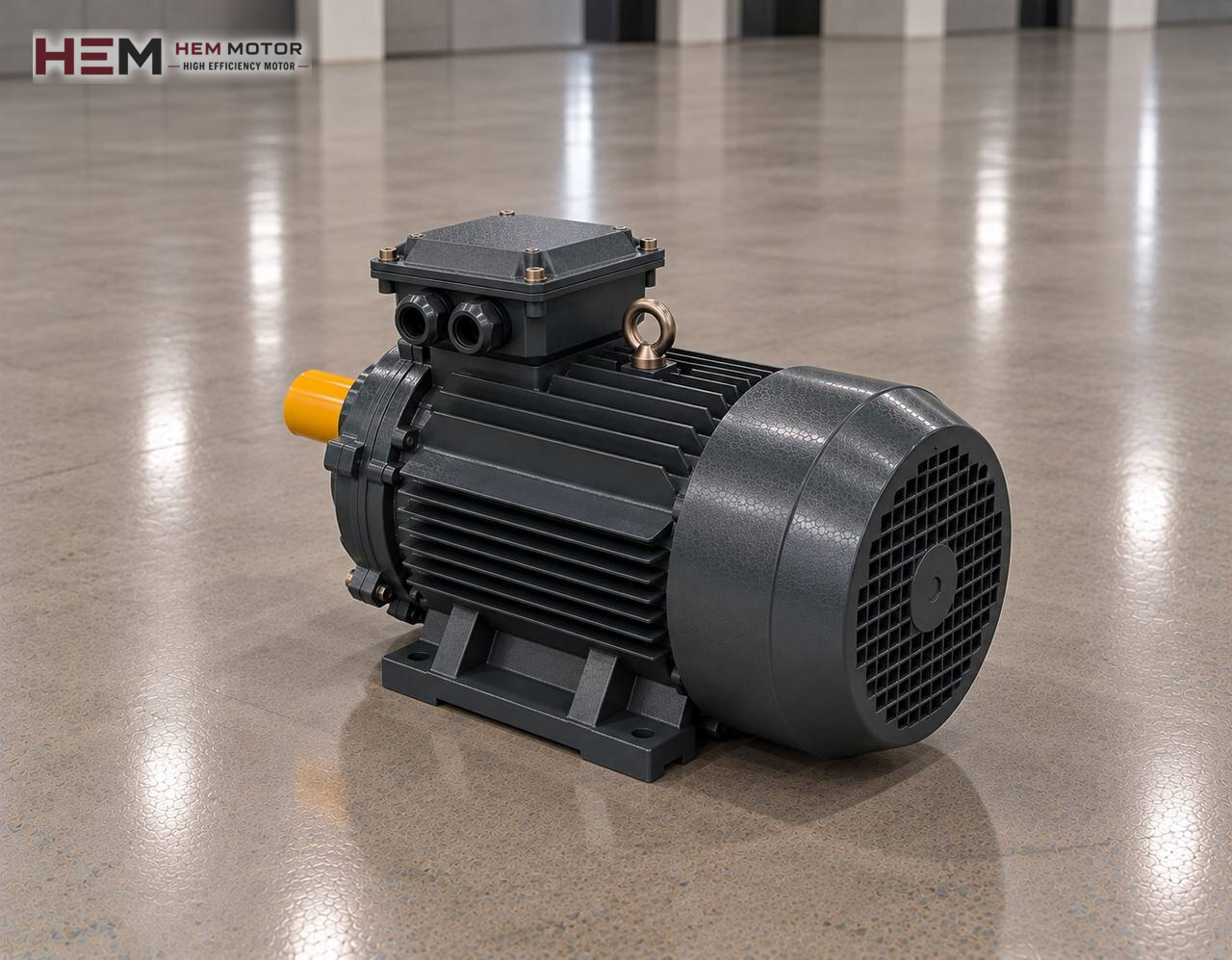
In a crushing and screening plant the hopper is the first point where rock enters the machinery; the feeder at the hopper outlet decides how fast material reaches the crusher, and in most plants the same machine also removes up front the fine fraction that does not need crushing. This page describes the electric motors that drive under-hopper feeders and pre-screening (grizzly) feeders; if you want an overview of the whole plant, the electric motors for crushers and stone crushing plants page is a good start.

Which feeder is working under the hopper?
The first step in choosing the motor correctly is knowing what the feeding element under the hopper is, because machines known by the same name ask very different things of the motor.
Vibrating and grizzly feeder
A chute or pan rests on springs and is shaken by shafts with eccentric weights beneath it. The rock moves forward in small hops with this motion. In the grizzly type, the last section of the pan has thick bars with gaps between them; soil and small particles drop through these gaps while large rock goes straight to the crusher. The primary crusher thus deals only with material that really needs crushing. The eccentric shafts are usually turned by a belt drive from a standard three-phase motor attached to the frame.
Belt hopper feeder
A short, heavy belt runs slowly just below the hopper outlet. It is common at intermediate aggregate stockpiles and ahead of secondary crushers. Here the motor turns a gearbox, and belt speed sets the material flow.
Hydraulic push feeder
A plate on the hopper floor is pushed back and forth by a cylinder. In this arrangement the electric motor turns the hydraulic pump, not the plate; selection is based on pump flow and pressure. For details see the electric motors for hydraulic pumps page.
Motor load on an eccentric-shaft feeder
On a vibrating pan, most of the energy the motor uses goes into continuously shaking the mass rather than throwing rock forward. The load is fairly steady; however, when a truck dumps large blocks onto the pan, the compression of the springs and the brief strain on the eccentric shafts are passed on to the motor.
The moments that really need attention are starting and stopping. While accelerating, the machine passes through the natural frequency of the spring system; for a few seconds the pan swings more than usual and the motor briefly draws high current. On stopping, the same zone is crossed in reverse. For this reason some machine builders specify controlled deceleration via an inverter or a damping arrangement on the machine side. Eccentric weights are usually designed for a vibration frequency set by the speed of a 4-pole motor and the belt pulley ratio; when replacing the motor, its speed and the pulley diameter should therefore stay the same as before.
Belt, pulley and motor base
On a vibrating feeder the motor does not sit on the shaking pan but on a separate base fixed to the stationary frame. The distance between pan and motor changes slightly with every oscillation; V-belts are kept long enough to absorb this movement and belt tension is set with the oscillation in mind. Too much tension places a permanent side load on the motor bearings; too little lets the belt slip, overheat and break.
This base is built for a foot-mounted (B3) motor and sits on a tensioning slide rail. If a foot-and-flange or vertical arrangement is needed, HEM can provide a suitable design depending on the frame; dimensions that must match the slide rail or gearbox are cross-checked at the order stage. The pulley should be fitted as close to the motor as possible; a pulley far from the shaft end increases the force on the bearing.
On a belt hopper feeder, by contrast, the motor is connected to a gearbox input by flange or coupling. On this side the gearbox ratio is set by the machine builder; the roadmap for the motor is on the gearbox motors page.
Adjusting the flow: inverter and gate control
There are two ways to change the feed rate. Mechanically, the gate at the hopper outlet is raised or lowered or the angle of the eccentric weights is changed. Electrically, the motor is driven by a frequency inverter; on a vibrating feeder, lower speed reduces vibration amplitude and flow, while on a belt feeder belt speed directly sets the flow.
HEM three-phase motors can be run on an inverter. If the motor will turn for hours well below rated speed under load, its own fan may be insufficient, in which case a separately powered cooling fan is added; if the inverter sits in a panel far from the motor, a dv/dt or sine filter is considered according to cable length. Write all of this in the order notes. On a vibrating feeder, lowering the speed too much can bring the pan close to the resonance zone; ask the machine builder for the minimum speed. The topic is also covered on the inverter-compatible motors page.
Maintenance in a dusty, vibrating environment
The pre-screening point is the dustiest place in the plant: soil falling between the bars becomes airborne, and the motor is usually inside this cloud. The IP55 enclosure keeps dust ingress below a harmful level, but a thick dust layer building up on the frame reduces cooling. The fan cover grille must not clog, and the fins should be cleaned regularly.
Even though the motor stands on a fixed base, vibration from the pan is transmitted to the frame. Periodically tightening the foot bolts, making the cable entry flexible and secure, and checking terminal box connections are important here. An anti-condensation heater for plants washing wet rock and for long stoppages, and a PTC sensor for operators who want to monitor winding temperature, are order options.
Example motors and selection table
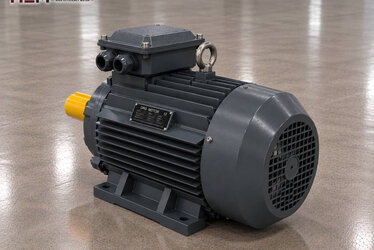
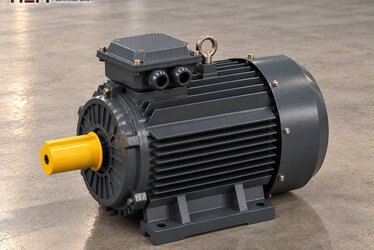
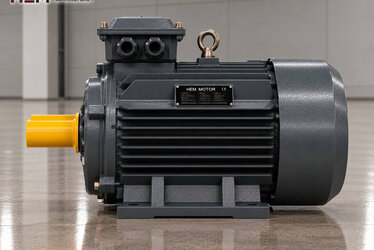
The speed class commonly found on eccentric-shaft feeders is 1500 rpm. For example, the cast iron 160M-4 (11 kW) model delivers 71.7 Nm at a rated speed of 1,465 rpm; the 15 kW 160L-4 produces 97.8 Nm at the same speed. On a heavy grizzly feeder the 22 kW 180L-4 model provides 142.9 Nm at 1,470 rpm. For small belt hopper feeders used with a gearbox, the 4 kW 112M-4 is a model worth checking.
| Feeder type | Motor connection | Point to settle in the order | Example HEM model |
|---|---|---|---|
| Vibrating pan feeder | V-belt to eccentric shaft | Speed, pulley diameter, belt direction | 160M-4, 11 kW |
| Grizzly (pre-screening) feeder | V-belt to two eccentric shafts | Resonance crossing at start, stopping method | 180L-4, 22 kW |
| Inverter-driven vibrating feeder | Belt, speed-controlled | Minimum speed, external fan | 160L-4, 15 kW |
| Belt hopper feeder | Flange or coupling to gearbox input | Gearbox flange and shaft size | 112M-4, 4 kW |
| Hydraulic push feeder | Coupling to hydraulic pump | Pump flow and pressure | According to pump data |
These rows are for guidance and do not replace a final selection; the decision is made by looking at the feeder's actual load, the required speed, the connection type and site conditions.
What you need to send us
Write the feeder type and make together with the motor power (kW), speed (rpm), supply voltage, mounting type, pulley or gearbox connection and the quantity needed. If it will run on an inverter, add that too. When an existing motor is being replaced, sending a photo through the send your motor nameplate page speeds things up.
You can see power and frame options with prices on the buy page. Our WhatsApp and phone numbers are on the contact page; motors ready in the warehouse ship from within Türkiye.
Frequently Asked Questions
Can a standard motor replace the vibration motor on a vibrating feeder?
No, these are different machines. An external vibrator motor (vibromotor) is a special product carrying unbalanced weights on its frame and is not included in HEM Motor's 2026 catalogue. The standard three-phase motor is the one that turns the shaft by belt on an eccentric-shaft feeder.
Why does the grizzly feeder shake hard for a while when starting?
While accelerating, the machine passes through the natural frequency of the spring system and the amplitude rises briefly. This is normal; if it lasts long, the starting method, belt tension and spring condition should be checked.
Can I replace the old feeder motor with a 1000 rpm motor?
Lowering the speed without changing the pulley ratio changes the vibration frequency and the flow. If a change is necessary, a new pulley ratio should be requested from the machine builder.
Can a hopper feeder motor run outdoors in the sun?
An IP55 motor is suitable for outdoor conditions. A light canopy against direct sun and rain extends its life; if the ambient temperature is high, state it in the order.