English
 Français
 Türkçe
 Español
 Русский

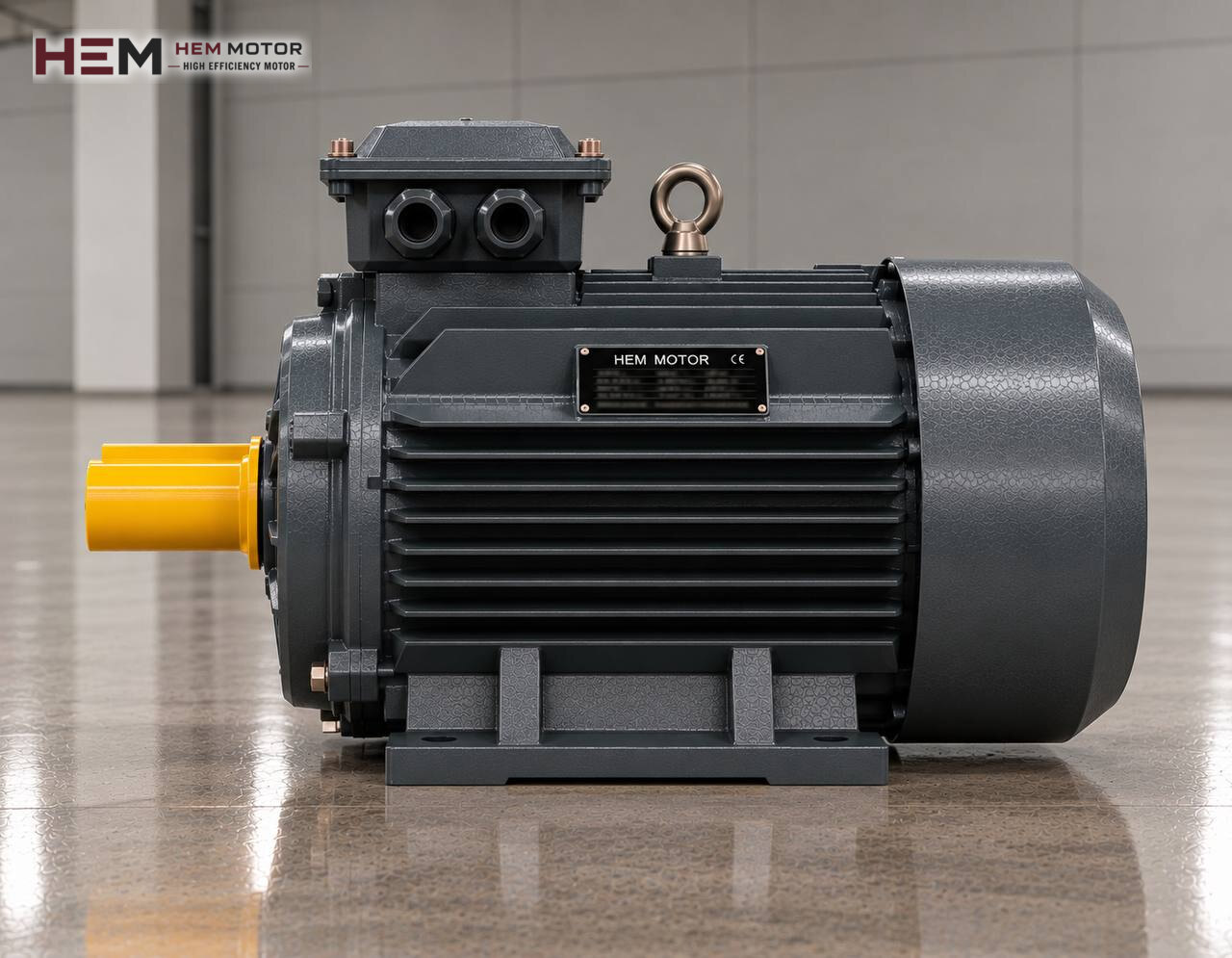
In a cone crusher, stone is broken by being squeezed between an open bowl at the top and a mantle gyrating inside it. The motor turns a horizontal pinion shaft; the pinion drives the eccentric bushing through a bevel gear, and the mantle makes a circular gyrating movement inside the bowl. As the gap between mantle and bowl liner narrows, the stone is trapped and broken by pressure. That is why the cone crusher is common at the second and third stages and on hard, abrasive rock. The general layout of the line is on the electric motors for crushers and stone crushing plants page; here we cover the main motor that turns the pinion shaft and the auxiliary motors beside it.

Crushing by compression: the load the motor sees
Unlike impact crushers, rotor speed does not determine the product in a cone crusher; the product is set by the closed side setting (CSS), the narrowest gap between mantle and bowl. The narrower the gap, the finer the product, but also the greater the force needed to compress the stone and the power drawn by the motor. The motor runs at constant speed while the load varies with the amount of material in the chamber and the hardness of the rock.
Crusher manufacturers want the cone crusher to run with a full chamber, i.e. "choke fed". With a full chamber, stones also crush each other, grain shape improves, liners wear evenly and motor load stays steady. When feed arrives intermittently, motor current goes up and down, the crusher fills and empties, and liners wear more in one zone. For this reason the feeder or surge bin in front of the cone crusher also matters for smooth motor operation.
Setting by power draw and overload
On modern cone crushers, the power drawn by the main motor is the most important input to the crusher control system. The control adjusts CSS or feed rate based on motor power and hydraulic pressure. An accurate current or power measurement for the main motor is therefore an operating tool, not just motor protection.
When an uncrushable object enters the chamber, the hydraulic system lets it pass by raising the bowl or lowering the mantle. The motor sees a short load shock at that moment. When the chamber packs, load rises sharply and the crusher may stall. Current monitoring and an overload relay distinguish these situations; the 1.15 service factor of our cast iron models from 75 kW upward covers short peaks but is not designed for permanent overload.
Belt or coupling?
In the common layout the motor turns the pulley at the end of the pinion shaft with V-belts. The belt ratio sets eccentric speed; on some crushers, changing speed changes the product curve and capacity. The ability of belts to slip slightly damps part of the shock when an uncrushable object passes.
On some crushers the motor is connected directly to the pinion shaft with a flexible coupling. There is no belt load in this layout, but motor and crusher must be aligned on the same base with a dial gauge. Which side of the crusher the motor stands on and its direction of rotation are taken from the crusher manufacturer's drawing; cone crushers are built to turn in one direction only, and wrong rotation is a risk for lubrication and the eccentric. At first start-up, direction must always be checked before the belts are fitted.
Lubrication and hydraulic unit motors
The eccentric bushing and spherical bearing inside a cone crusher run on an oil film. Every cone crusher therefore has a separate lubrication unit whose pump is driven by a small three-phase motor. Most designs also have a separate hydraulic unit motor for setting adjustment and tramp release; on large units the oil cooler fan also runs on its own motor.
The control sequence is critical: the main motor must not be started until the lubrication pump is running and pressure and flow are established, and the main motor must stop if oil pressure drops. In winter, if the oil is cold, the unit heater is allowed to bring the oil to a fluid state first. The power and mounting of auxiliary motors are taken from the list supplied by the crusher manufacturer. General information on motor selection for hydraulic units is on the hydraulic pump electric motors page.
Starting, and after a power failure
The rotating mass of a cone crusher is small compared with an impact crusher, so starting with an empty chamber is relatively easy. The difficulty begins after the crusher stops with a full chamber. If power is lost, the chamber stays packed with stone; starting such a crusher directly can push the motor into a locked-rotor condition. On most crushers the gap is opened with the hydraulic system to empty the chamber, and then the start is made.
The starting method is chosen according to motor power, transformer capacity and the crusher manufacturer's recommendation. Star-delta is often adequate for an empty-chamber start, a soft starter eases the supply, and a frequency converter is preferred by plants that want to set eccentric speed to suit the product. Our series are suitable for drive operation; long periods at low speed with full torque may require an external fan, and long cables a dv/dt or sine filter. State these in your order; details are on the inverter compatible motors page.
Site and maintenance notes
The main motor of a cone crusher usually stands beside the crusher in foot-mounted B3 on a base used to adjust belt tension. Depending on frame size, our motors are also available in B5, B14, B34, B35 and vertical V1, V3, V5, V6, V15; flange and shaft dimensions are verified together at ordering. Enclosures are IP55 and insulation class F. If hard-rock dust sticks to the fins the motor overheats; cleaning the fan cover should be part of periodic maintenance. A PTC or PT100 sensor for winding temperature and an anti-condensation heater for long stoppages are order options.
Sample motors for cone crushers
| Drive | Duty | Key point | Sample HEM motor |
|---|---|---|---|
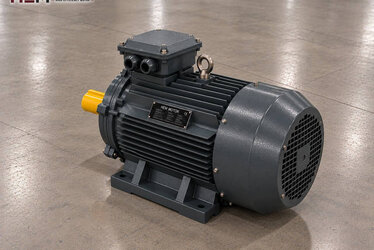
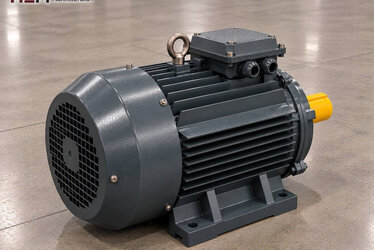
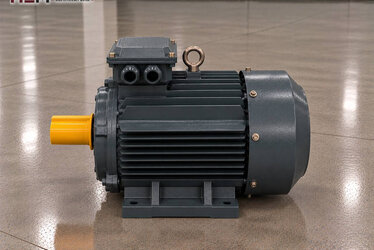
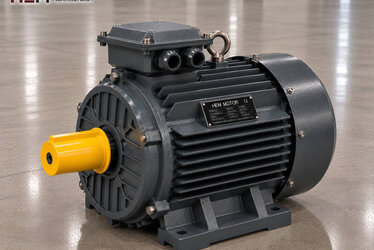
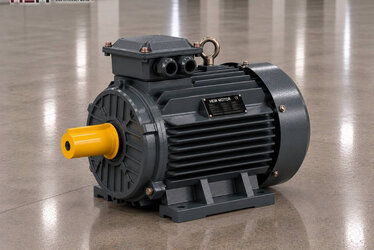
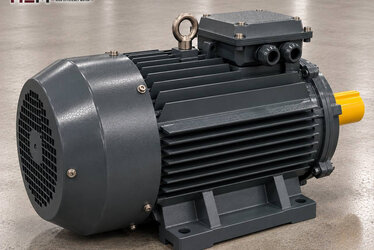
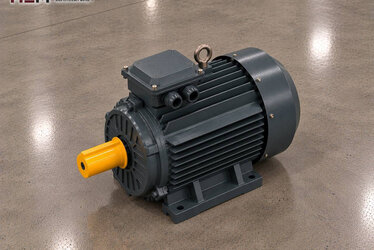
| Main motor, small cone crusher | Turning the pinion shaft by belt | Choke feeding, power measurement | 90 kW 1000 rpm 315M-6 |
| Main motor, mid-size crusher | Belt or coupling drive | Direction of rotation, alignment | 132 kW 1000 rpm 315L2-6 |
| Main motor, higher-speed design | Belt drive | Pulley ratio, starting method | 160 kW 1500 rpm 315L1-4 |
| Lubrication pump motor | Eccentric and bearing lubrication | Interlock with main motor | 2.2 kW 1500 rpm 100L1-4 |
The models in the table are examples; the actual selection is made according to the crusher's load, required speed, mounting and operating conditions, using the crusher manufacturer's data. For comparison: the 315M-6 model delivers 869.9 Nm rated torque at 988 rpm and the 315L2-6 model 1,276 Nm at 988 rpm.
When requesting a motor
Write to us with the crusher make and model, the power (kW) and speed (rpm) for the main motor and each auxiliary motor, supply voltage, mounting type, transmission (belt or coupling), direction of rotation, starting method and quantity. Sending nameplate photos of your current motors is the quickest way.
You can see models and prices in our electric motor shop and larger ratings among the cast iron frame models. WhatsApp and phone details are on the contact page.
Frequently Asked Questions
Why does the cone crusher motor current keep fluctuating?
The most common reason is irregular feed; as the chamber fills and empties, the load rises and falls. Arranging the feed to keep the chamber full steadies the current and also makes the liners wear evenly.
Why won't the main motor start unless the lubrication motor is running?
The interlock in the controls protects the eccentric bushing and bearings from running dry. The main motor is not released until oil pressure and flow are established; this interlock must not be bypassed.
Can a full crusher be started after a power failure?
It is not recommended; while trying to turn a packed chamber the motor draws current close to locked-rotor current. The gap should first be opened with the hydraulic system and the chamber emptied, then the start made.
Can a 4-pole motor be used on a cone crusher instead of a 6-pole one?
Technically yes, but the motor pulley must be made smaller to keep the eccentric at the same speed; this changes belt speed, wrap angle and the torque that can be transmitted. The motor should not be changed without doing the calculation together with the crusher manufacturer.