English
 Français
 Türkçe
 Español
 Русский

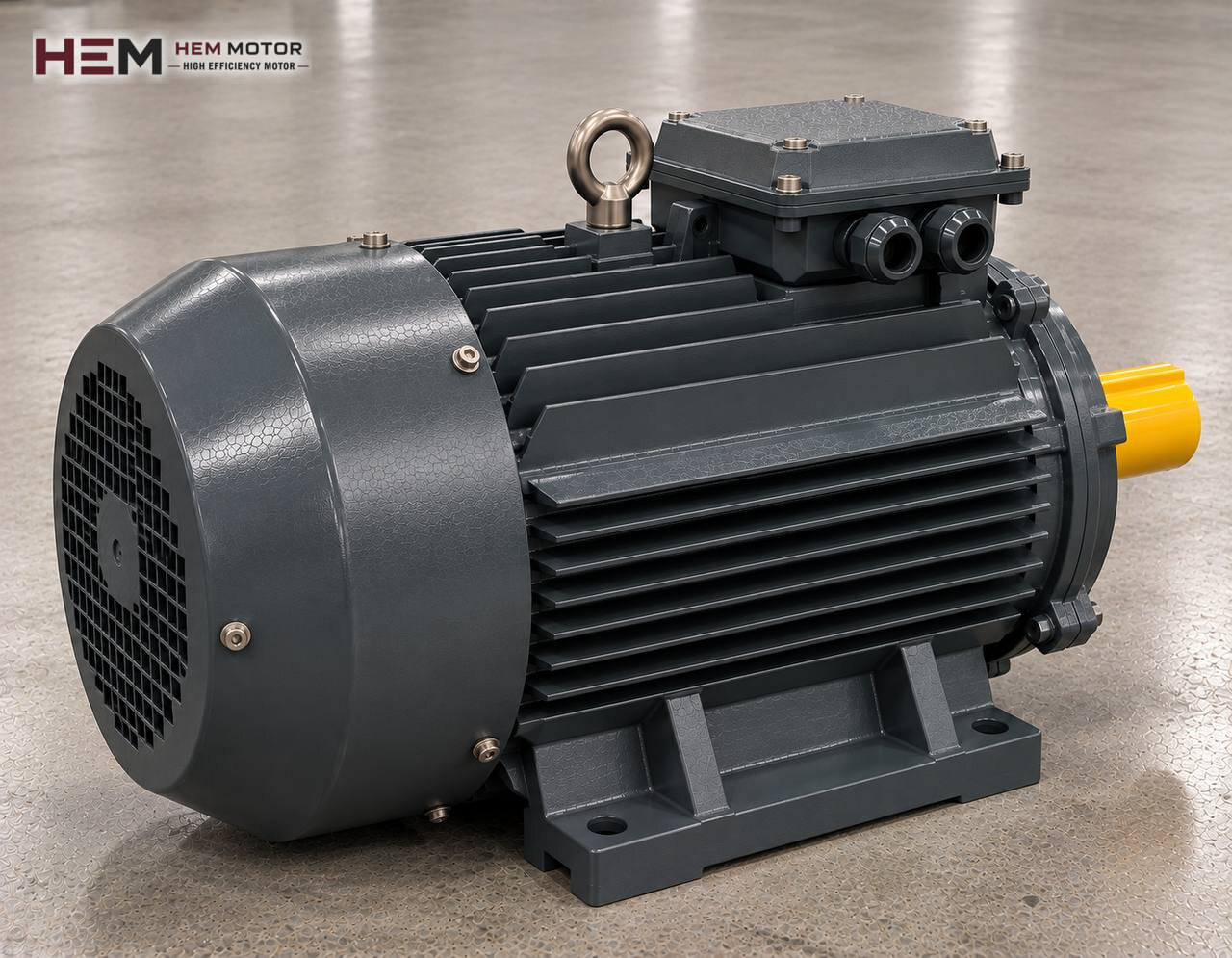
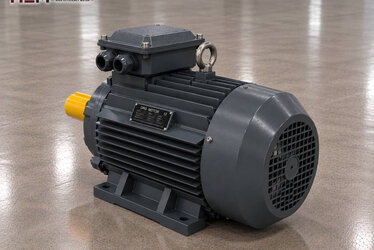
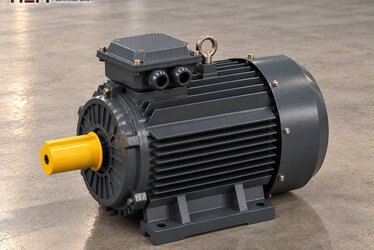
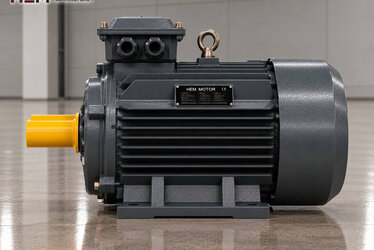
A hammer crusher is a machine in which hammers hung by pins on discs mounted along a shaft strike the rock at high speed, and the broken pieces leave by filtering through the grate bars under the rotor. Because it gives a fine product in a single pass on medium-hard and soft material such as limestone, marl, gypsum, coal and dry clay, it is common both in aggregate quarries and in cement and lime plants. This page covers the electric motor that turns the machine's rotor; the general framework for the whole plant is on the electric motors for crushers and stone crushing plants page.

How does the rotor crush, and what does the motor carry?
As the rotor turns, the hammers swing outwards under centrifugal action and transfer part of their energy at the moment they hit the rock. The rock breaks by impact, by being thrown against the breaker plate in the housing, or by rubbing between hammer and grate. All this energy comes from the rotational energy of the rotor; the motor constantly restores the speed the hammers lose.
The load seen by the motor therefore has two components. The first is the continuous crushing power: it rises with feed rate and material hardness. The second is the short shocks when a large lump enters or the grate clogs. The heavy rotor absorbs most of these shocks with its own inertia and protects the motor from them; that is why motor current on a hammer crusher looks smoother than on a jaw crusher.
Long start-up: accelerating a heavy rotor
For the motor, the hardest moment on a hammer crusher is not crushing but starting. The rotor, made of discs, hammers and pulley, has a large moment of inertia; while accelerating this mass from zero to rated speed the motor draws high current for a long time. Heat builds up in the winding during this period. If the motor is stopped and restarted often, successive starts heat the winding more than normal running.
In practice the following is recommended: the rotor is always started empty, and the feed is opened only after the motor reaches full speed. Ask the crusher maker for the start-up time and rotor inertia, and pass this information to us when selecting the motor. With star-delta starting, the reduced torque may not accelerate a heavy rotor sufficiently; in such cases a soft starter or frequency inverter is considered. A control arrangement limiting the number of successive starts and a PTC thermistor embedded in the winding are practical ways to protect the winding during long starts; the thermistor is an order option.
Speed, pulley and coupling selection
The peripheral speed of the hammer tip is the main variable determining product fineness: as speed rises the product gets finer, but hammer and grate wear also increase. The crusher maker sets the rotor speed; the motor speed is matched to it by the pulley ratio or by direct connection.
Belt and pulley transmission
In the most common arrangement a 4- or 6-pole motor turns the rotor pulley through V-belts. The pulley ratio allows the rotor speed to be adjusted; in addition, when an uncrushable piece of iron enters the crusher, brief belt slip absorbs part of the mechanical shock. The price is a constant radial load on the motor's drive-end bearing. The pulley should be fitted close to the shaft shoulder, belt tension kept at the belt maker's value, and new belts re-tensioned after the first hours of running.
Direct coupling
If the rotor speed is close to the motor's rated speed, the motor can be connected directly with a flexible coupling; in this arrangement no belt load acts on the bearing, but shocks also reach the shaft directly. Some plants insert a fluid coupling so that the motor picks up the load gradually at start-up. In a coupled arrangement the motor and crusher should sit on a common base and alignment should be done with a dial gauge.
Reversing rotor, wear and vibration
Many hammer crushers are run with the direction of rotation reversed to use both faces of the hammers. The direction of a standard three-phase motor is reversed by swapping two supply leads; if this is done with a direction selector in the control, the motor must not be started in reverse before it has stopped completely. In a belt arrangement the pulley and belts must also suit both directions.
As the hammers wear, or if one breaks off, the rotor balance is lost. Vibration from an unbalanced rotor passes to the motor through the belts and base, shortens bearing life and loosens foot bolts. Replacing hammers in opposite pairs, checking vibration after replacement and periodically tightening the motor base bolts also protect the motor.
Motor environment with dusty and damp material
Because the hammer crusher gives a fine product, it spreads plenty of dust around it. If dust builds up between the motor's cooling fins, heat dissipation drops; combined with long starts, this link between dust and winding temperature makes the motor heat up faster than expected. Cleaning the fan cover and fins should be written into the maintenance plan, and the motor should, if possible, be placed on the side away from the crusher's dust outlet.
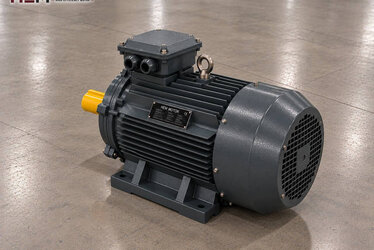
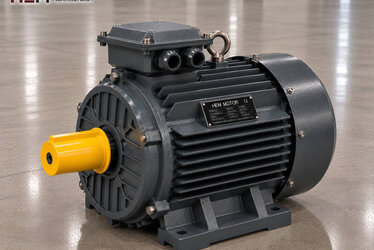
HEM three-phase motors come with an IP55 enclosure and class F insulation. With damp material such as clay and marl, the grate can clog; rotor load then increases and motor current rises. Current monitoring or an overload relay warns of clogging before the motor heats up. In plants that stand idle for long periods in winter, an anti-condensation heater can be requested. A standard motor is not suitable for environments with very high dust density or combustible dust; this condition must be stated in the order.
Sample motor selection
| Crusher arrangement | Transmission | Point of attention | Sample HEM motor |
|---|---|---|---|
| Small single-rotor hammer crusher | V-belt, 4-pole | Start-up time, belt tension | 22 kW 1,500 rpm 180L-4 |
| Medium limestone crusher | V-belt, 4-pole | Reversing operation, dust | 45 kW 1,500 rpm 225M-4 |
| Low rotor speed crusher | V-belt, 6-pole | High shaft torque, pulley diameter | 37 kW 1,000 rpm 250M-6 |
| Large single-rotor crusher | Belt or coupling | Soft start, SF 1.15 margin | 75 kW 1,500 rpm 280S-4 |
These motors are given only as examples; the right motor is chosen by looking at the crusher's rotor inertia and load, the required speed, the connection type and the site conditions. For instance, the 225M-4 delivers 289.4 Nm rated torque at 1,485 rpm and the 250M-6 delivers 358.7 Nm at 985 rpm; the 75 kW 280S-4 has a service factor of 1.15.
What information is needed for a motor request?
Write to us with the crusher make and type, the required power (kW) and speed (rpm), supply voltage, motor mounting (foot-mounted B3 in most belt arrangements), transmission, starting method, whether it runs in both directions, and quantity. A nameplate photo of the motor to be replaced answers most questions on its own. Foot and flange options vary with frame size; shaft and flange dimensions are checked together at the order stage.
You can review suitable models and prices in our electric motor shop and, for larger powers, look at the cast iron frame motors. If you plan to run on a drive, the inverter-compatible motors page explains cooling at low speed and cable filters. Our WhatsApp and phone details are on the contact page.
Frequently Asked Questions
Why does the hammer crusher motor draw high current for a long time at start-up?
The heavy rotor has a large moment of inertia, and the motor draws current close to starting current until it brings this mass from zero to rated speed. Starting the rotor empty and choosing a suitable starting method does not shorten this time much, but it relieves the winding and the supply.
Can a 3,000 rpm motor be used on a hammer crusher?
A 2-pole motor can be seen on small crushers with high rotor speed, but most machines use a 4- or 6-pole motor with belt drive. The rotor speed and pulley ratio determine which speed is suitable; the decision is made from the crusher maker's data.
Does reversing the rotor direction damage the motor?
The motor can run in either direction; direction is reversed by swapping two phase leads. Damage occurs when reverse is applied while the motor is still turning, not when it is stopped. The control should wait for a full stop before changing direction.
What should be done if motor vibration increases after the hammers are replaced?
First check that the hammers were fitted in opposite pairs and with equal weight. Then review belt tension, pulley run-out and the motor foot bolts. If vibration persists, the rotor balance should be dealt with on the crusher side.