English
 Français
 Türkçe
 Español
 Русский

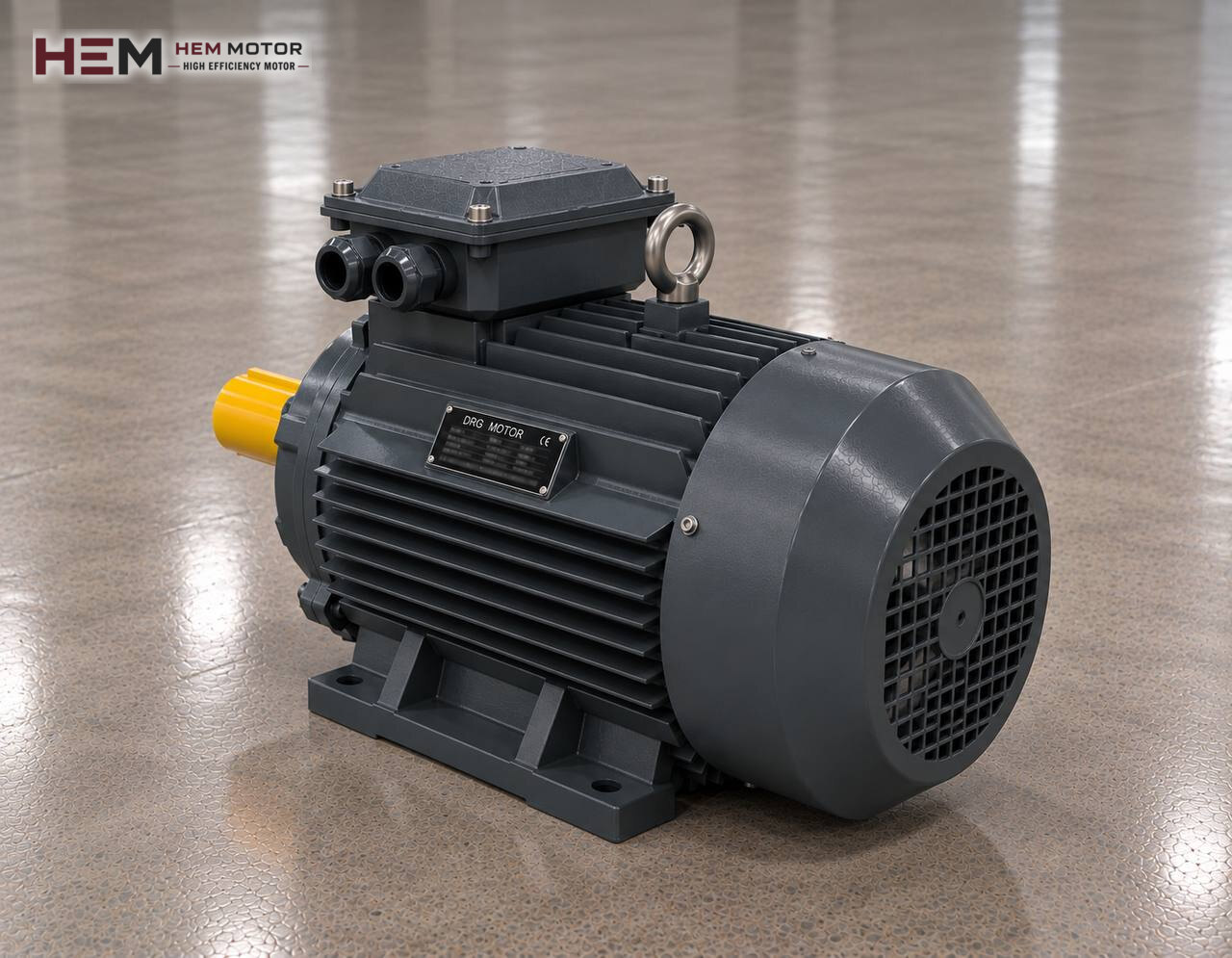
The jaw crusher is the machine that first breaks the largest blocks coming from the quarry: rock is squeezed between a fixed jaw plate and a moving jaw that swings towards it, and leaves reduced in size through the crushing chamber, which narrows downwards. Because it can also handle hard, abrasive rock such as granite, basalt and quartzite, it is the most common primary-stage machine. This page covers the electric motor that turns the crusher's eccentric shaft; for the whole line, see the stone crushing plant electric motors page.

Eccentric shaft, toggle plate and two flywheels
In a single-toggle jaw crusher the moving jaw hangs directly on the eccentric shaft. As the shaft turns, the top of the jaw traces an elliptical path, while the bottom swings back and forth against the toggle plate behind it. On every turn the jaw closes on the rock once and opens once; crushing happens only during the closing half.
There is a large flywheel at each end of the shaft. One of them is also the pulley around which the motor's belts run. The flywheels store the energy supplied by the motor during the opening half and release it to the rock during the crushing half. The motor therefore does not have to meet the crushing stroke, which comes once per turn, on its own; but the load still rises and falls once per revolution.
How does the motor load change?
The harder and larger the feed, and the narrower the closed side setting (CSS), the more energy each squeeze consumes. When the setting is tightened, capacity falls but motor current rises; measuring current under load after changing the setting is therefore a good habit.
Irregular feed makes the load irregular too. When two or three blocks drop into the chamber at once, flywheel speed falls noticeably and the motor briefly goes above rated current to regain it. When uncrushable tramp iron (a bucket tooth, a drill bit) enters the chamber, the toggle plate breaks or a hydraulic relief acts to protect the machine; this is the machine's safety system, not the motor's. On the motor side, the task is to set overcurrent protection correctly to the nameplate value.
Flywheel starting and restarting with a full chamber
What makes starting a jaw crusher hard is the inertia of the two heavy flywheels and the eccentric shaft. In an empty crusher the motor brings this mass up to rated speed within a few seconds. In a machine that stopped with the chamber full of rock, however, the jaw may be jammed and the first movement demands very high torque. Many crusher manufacturers therefore require the machine to be started only when empty and a full chamber to be cleared first.
The starting method is determined by the crusher manufacturer's starting condition and the transformer capacity on site. Star-delta reduces starting torque; for an empty crusher this is often enough. If a more controlled start is wanted, a soft starter or frequency inverter is used. Because our models from 4 kW up carry a 400/690 V label, they run in delta on a 400 V supply and are suitable for star-delta starting. A PTC thermistor to monitor winding heating during successive starts is an order option.
Belt drive and motor base
On most jaw crushers the motor turns the flywheel pulley through multiple V-belts. Since the eccentric shaft speed is low, the pulley ratio is large; 6-pole motors are therefore often preferred, as they give higher shaft torque for the same power and need a smaller ratio. Some plants use a 4-pole motor with a smaller motor pulley; the decision rests with the crusher manufacturer's pulley calculation.
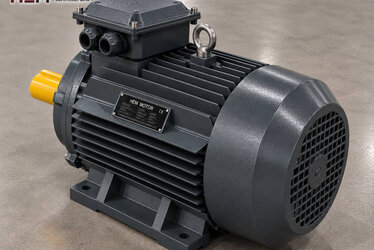
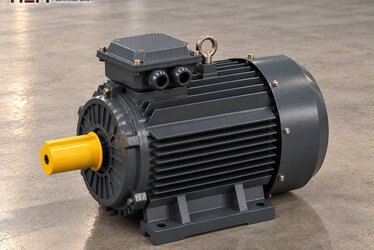
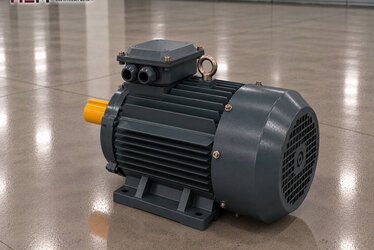
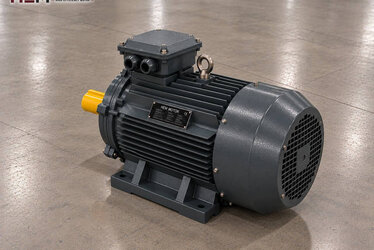
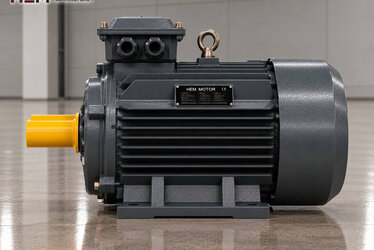
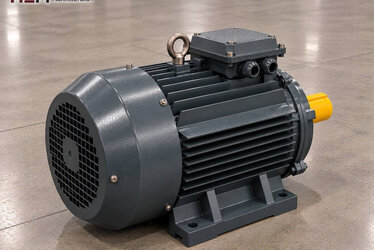
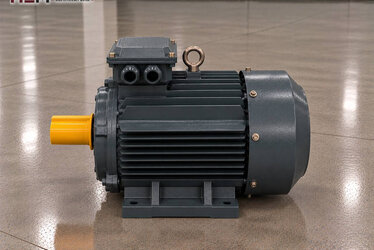
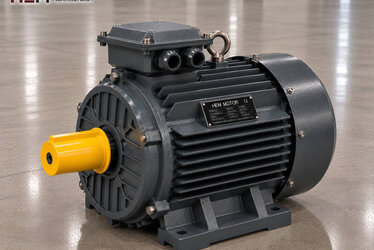
The motor usually stands on a separate slide base and the belt is tensioned by moving the motor. On small and mobile machines the motor may sit on a hinged platform attached to the crusher frame; crusher vibration then passes directly into the motor. In both layouts belts should be kept at equal tension and replaced as a set, and motor foot bolts checked periodically. Depending on frame size, our motors come mainly in foot-mounted B3, and also B5, B14, B34, B35 and vertical V1/V3/V5/V6/V15; shaft and pulley dimensions are confirmed with the order.
Conditions at the primary stage
The jaw crusher sits right under the hopper fed by truck or dozer; dust raised during tipping soon covers the motor fins. Cleaning the fan cover and frame should be a separate item in the crusher maintenance plan. Our motors have an IP55-protected frame and class F winding insulation. On open sites a simple shelter against sun and direct rain, and an anti-condensation heater during long winter stops, extend service life. Water sprays used for dust suppression should not be aimed at the motor.
Machines with hydraulic setting adjustment may have a small hydraulic unit, and those with lubricated bearing housings an oil pump. Their motors should be listed as separate items; details on the hydraulic pump motors page.
Sample motors
| Jaw crusher class | Nature of the load | Key selection point | Sample HEM model |
|---|---|---|---|
| Small or mobile crusher | Vibration from the frame | Platform mounting, bolt checks | 30 kW 1,000 rpm 225M-6 |
| Medium stationary primary crusher | Torque fluctuating each revolution | Pulley ratio, number of belts | 45 kW 1,000 rpm 280S-6 |
| Large primary crusher | Heavy flywheel, long start | Starting method, transformer capacity | 90 kW 1,000 rpm 315M-6 |
| Very large hard-rock crusher | High continuous load | SF 1.15 margin, current monitoring | 132 kW 1,000 rpm 315L2-6 |
The models are examples only; final selection takes into account crusher load, required speed, mounting and operating conditions. To give an idea: the 280S-6 delivers 436.3 Nm at 985 rpm and the 315M-6 869.9 Nm at 988 rpm rated torque; models of 75 kW and above have a service factor of 1.15.
Information to send for a quote
What helps us most when preparing a quote: machine details such as crusher brand, model and feed opening; required power (kW) and speed (rpm); site voltage; mounting arrangement; pulley diameter and belt type; starting method and how many motors are needed. A nameplate photo of the motor on site gives most of this list in one shot.
High-power options are listed in the cast iron frame family; prices of all models are shown in our shop. For WhatsApp or phone, go to our contact page.
Frequently Asked Questions
The jaw crusher stopped with a full chamber; can I restart the motor?
It is not recommended. The torque needed to move a jammed jaw is very high; the motor draws starting current for a long time and the belts slip. The chamber should be cleared first, then the crusher started empty.
I tightened the closed side setting and motor current rose; is that normal?
Yes. For a finer product the rock is squeezed more and the energy per stroke increases. If current approaches the nameplate value, reduce the feed rate or revert the setting.
Is the motor damaged when the toggle plate breaks?
The toggle plate breaks to protect the machine; the motor usually sees only a short load impulse. Even so, belts, pulley runout and motor foot bolts should be checked afterwards.
Why does the motor fail more often on a mobile jaw crusher?
The motor is carried close to the crusher frame, so it receives vibration directly, plus frequent relocation and outdoor conditions. Bolt checks, sound cable entries and bearing maintenance should be done more often.