English
 Français
 Türkçe
 Español
 Русский

When washed sand leaves the sand washer or hydrocyclone, it still carries most of its water; if it is dumped on the stockpile like that, water drains from the pile for days and the sand reaches a saleable moisture level only late. The dewatering screen is the machine that removes this water within a few minutes: a slightly upward-inclined box carrying fine-aperture polyurethane panels compacts and moves the sand forward with strong linear vibration, while the water runs down through the panels. This page covers the drive side that vibrates the box; the stone crushing plants page summarises which machines turn with which motor in the rest of the plant.

How does it differ from a sizing screen?
A conventional stone screen separates material by size; a dewatering screen does not grade the sand, it separates it from water. That is why it also works differently. The box slopes upward towards the discharge, so a bed of sand builds up on the deck and this bed acts as a filter in its own right. The vibration presses the sand grains together and squeezes out the water between them. Linear motion and high acceleration are needed, because the wet, heavy bed has to be walked uphill.
When the screen runs empty or with a thin layer, this filter bed does not form and fine sand escapes through the panels with the water. For this reason, continuity of feed affects the performance of a dewatering screen more than motor power does.
What produces the vibration?
On most dewatering screens, two counter-rotating vibration motors (vibromotors) are fitted to the sides of the box. These motors, carrying adjustable unbalanced weights on their housing, are a special product group and are not included in the HEM Motor 2026 catalogue. On such a screen a standard three-phase motor cannot replace the vibration motor.
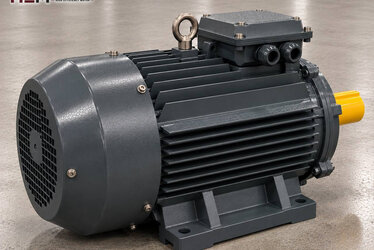
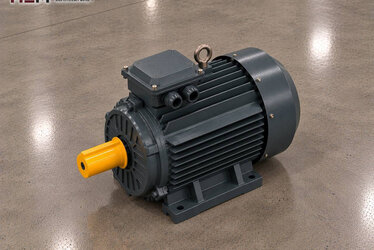
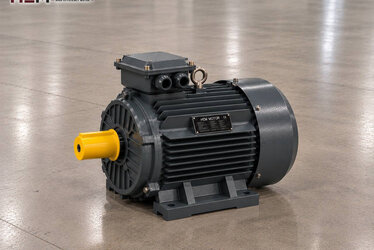
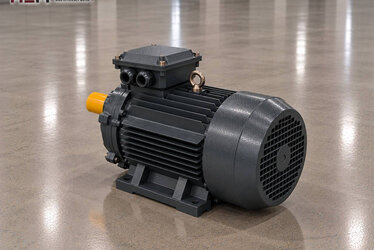
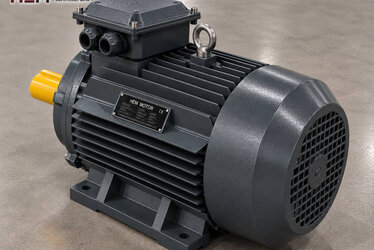
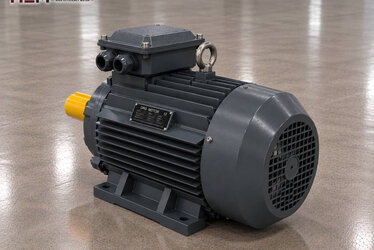
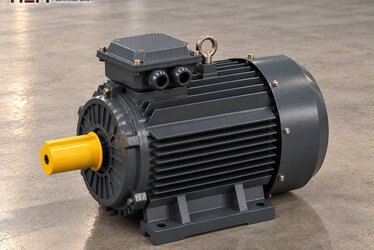
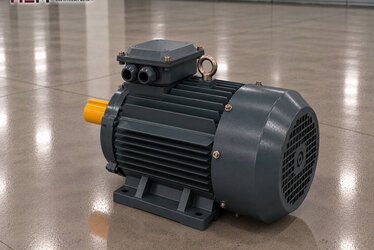
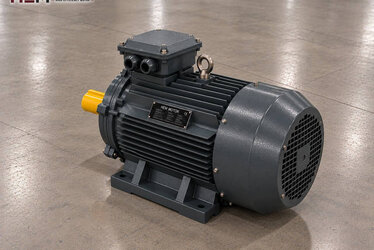
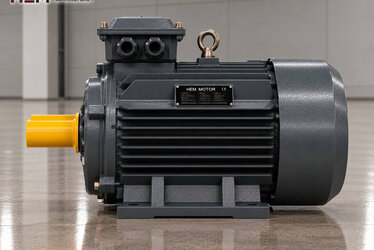
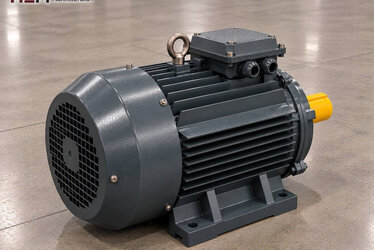
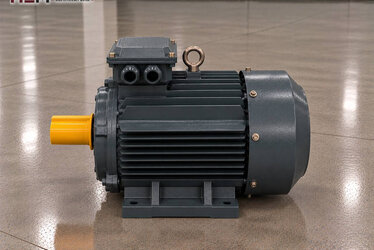
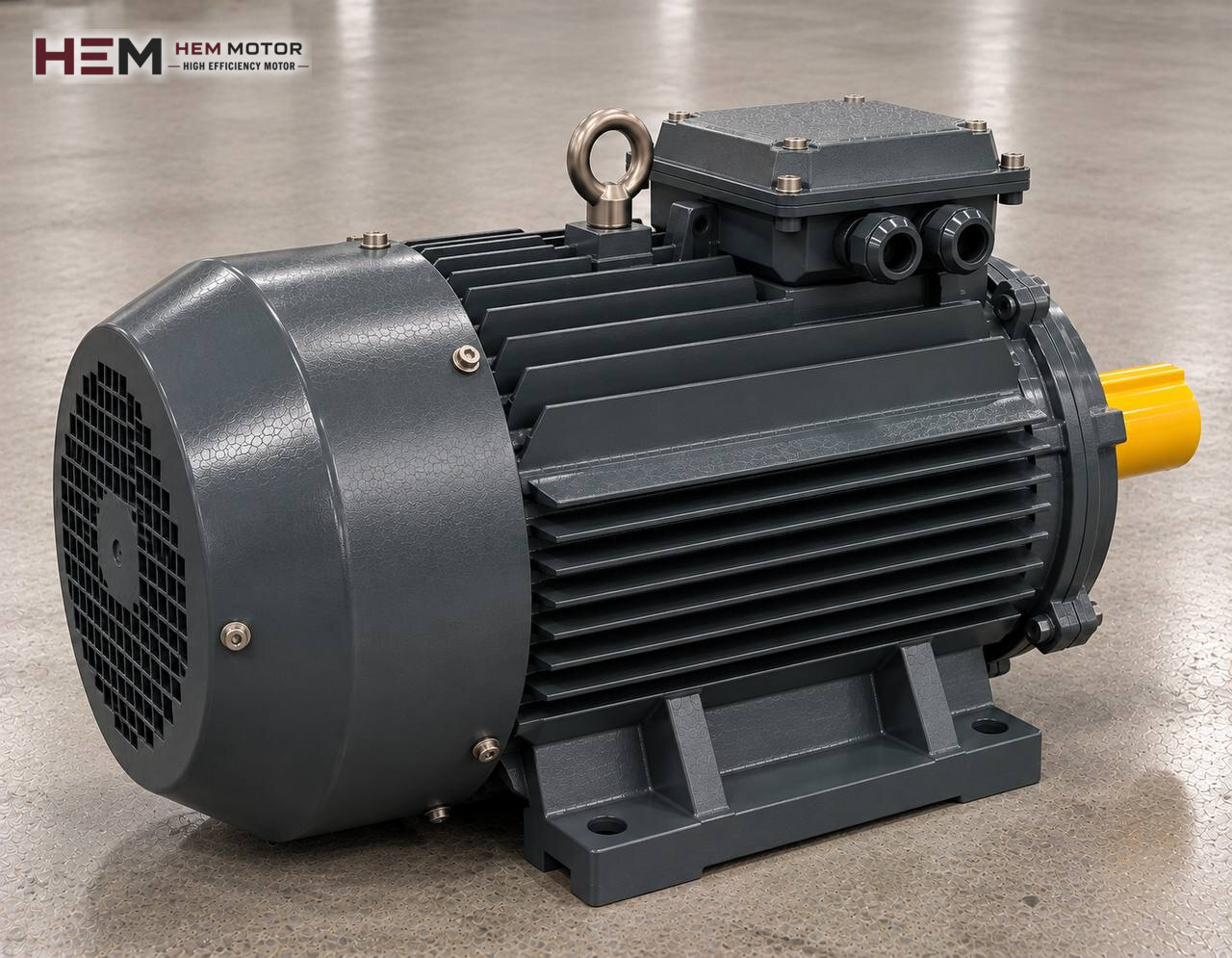
On some large and heavy-duty screens, however, the vibration comes from an exciter box attached to the box. Two shafts synchronised by gears inside it are turned by a standard three-phase motor via a cardan shaft or V-belts. This arrangement is where the motors offered by HEM fit on this machine. In addition, throughout the sand washing line, standard motors are used on drives such as the hydrocyclone pump, slurry pump and sand screw that feed the dewatering screen.
Motor load in the exciter arrangement
On an exciter-driven dewatering screen the motor keeps the heavy unbalanced weights at constant speed and covers friction in the exciter bearings. Because the sand bed is wet and dense, the total moving mass is greater than on a dry screen of the same size. The load is continuous and fairly even; the current drops when the feed stops and rises slightly when the sand bed thickens.
At start and stop the spring system passes through its resonance zone. On dewatering screens the box usually rests on rubber or coil springs; at stop, the slowing screen swings widely for a while in this zone. If the screen was stopped full of sand, the heavy bed slows acceleration on the next start; so when stopping, the feed should be cut first and the screen left to empty for a few minutes. The starting method (direct, star-delta, soft starter or inverter) is chosen according to the machine manufacturer's recommendation.
Cardan shaft, belts and mounting
Cardan shafts are common on exciter-driven screens, because the motor can be placed at a dry point away from the box. The cardan angle must stay within the limit given by the manufacturer and the joints must be greased regularly. In a belt arrangement, the belt run is kept long enough to absorb the linear stroke of the box. Exciter speed is set by motor speed and pulley ratio; when replacing the motor, keep the number of poles the same. Vibration frequency on dewatering screens is usually higher than on sizing screens; that is why 1,500 rpm class motors and ratios close to 1:1 are common.
The motor is mostly foot-mounted (B3) on a slide-rail base. HEM also supplies B5, B14, B34, B35 and vertical positions depending on frame size; base and shaft dimensions are cross-checked when ordering.
Wet environment and protection
The dewatering screen is one of the wettest points in the plant: water running from the panels, splashing mud and constant water mist. Placing the motor away from this zone, on a high, dry base beside the box, is the best protection. The IP55 enclosure is protected against splashing water, but it is not designed for pressurised water jet cleaning, submersion or being buried in mud; do not point a hose directly at the motor when cleaning the plant. If necessary, a sheet-metal shield is fitted over the motor.
Washing plants may stand idle for long periods in winter and off-season; an anti-condensation heater is an order option to prevent condensation in the winding during these periods. Operators who want to monitor winding temperature can also request a PTC sensor. Where the screen is driven by an inverter, the motor's own fan may be insufficient at low speed, in which case a separately supplied cooling fan is added; if the panel is far away, an output filter is considered. For details see the inverter-compatible motors page.
Example motors and selection table
Four-pole motors stand out on exciter-driven dewatering screens. On a medium-sized screen, the 7.5 kW 132M-4 delivers 49.1 Nm at 1,460 rpm. On wider boxes, 71.7 Nm is obtained with the 11 kW frame 160M-4 and 97.8 Nm with the 15 kW frame 160L-4. On geared auxiliary drives such as the sand screw feeding the screen, smaller frames like the 5.5 kW 132S-4 are used.
| Arrangement | What produces the vibration or work | Point to clarify | Example HEM model |
|---|---|---|---|
| Dewatering screen with vibromotors | Two vibration motors fixed to the box | Vibromotors are not in the 2026 catalogue | Not applicable |
| Medium screen with exciter | Exciter driven by cardan shaft | Cardan angle, number of poles | 132M-4, 7.5 kW |
| Wide screen with exciter | Exciter driven by belt or cardan | Starting method, anti-condensation heater | 160M-4, 11 kW |
| Heavy-duty screen on inverter | Speed-controlled exciter | External fan, PTC, cable length | 160L-4, 15 kW |
| Sand screw feeding the screen | Geared screw | Gearbox flange and shaft size | 132S-4, 5.5 kW |
These examples are not a final selection; the decision is made according to the screen and exciter data, required speed, mounting layout and operating conditions.
What we need for a motor request
Along with the screen make, panel area and vibration source (vibromotor or exciter), send us: the power (kW) and speed (rpm) of the existing motor, the plant voltage, mounting type, the type of connection to the exciter (cardan or belt) and the quantity required. If you are also replacing pump or sand screw motors on the same line, add them to the list. Photographing the old motor's nameplate as shown on the send the motor nameplate page is enough.
Frame and power options with current prices are on our buy page. To send your request by WhatsApp or phone, go to the contact page; motors ready in the warehouse are dispatched from within Türkiye.
Frequently Asked Questions
The vibration motor on my dewatering screen burnt out; can I fit a standard motor instead?
No. A vibration motor shakes the box directly with the unbalanced weights on its housing; a standard motor does not have this design. The same type of vibration motor is needed as a replacement. This product group is not included in the HEM Motor 2026 catalogue.
A lot of sand escapes under the screen; is the motor too weak?
Most often the problem is not the motor but irregular feed or worn panels. When no sand bed forms, fine sand escapes with the water. Check the feed and panels first.
Why does the motor shake when an exciter-driven screen stops?
As the motion slows, the box passes through the zone that matches the natural frequency of its springs and swings widely for a short time. This vibration also reaches the motor base; foot bolts and base connections should be checked periodically.
The washing plant is closed all winter; what should I do for the motors?
Keeping the motors dry is important. If an anti-condensation heater is fitted it should be energised during standstill; if not, measure winding insulation at the start of the season and check the motor with a short no-load run.