Replacing the Electric Motor of a Grain Drying Fan

Replacing the Electric Motor of a Grain Drying Fan

In grain drying plants, the fan is the main piece of equipment that drives heated air through the mass of product and carries moisture out. During harvest it runs for days without interruption; once the season ends, it stands idle for months. These two extremes determine the points to watch when replacing a drying fan motor: the speed the fan impeller requires, the distance between the hot air and the motor, and the moisture and dust that build up during standstill. In this article we explain step by step which information you need to gather when replacing the motor of a drying fan, using the cast iron models HEM Motor has on sale.
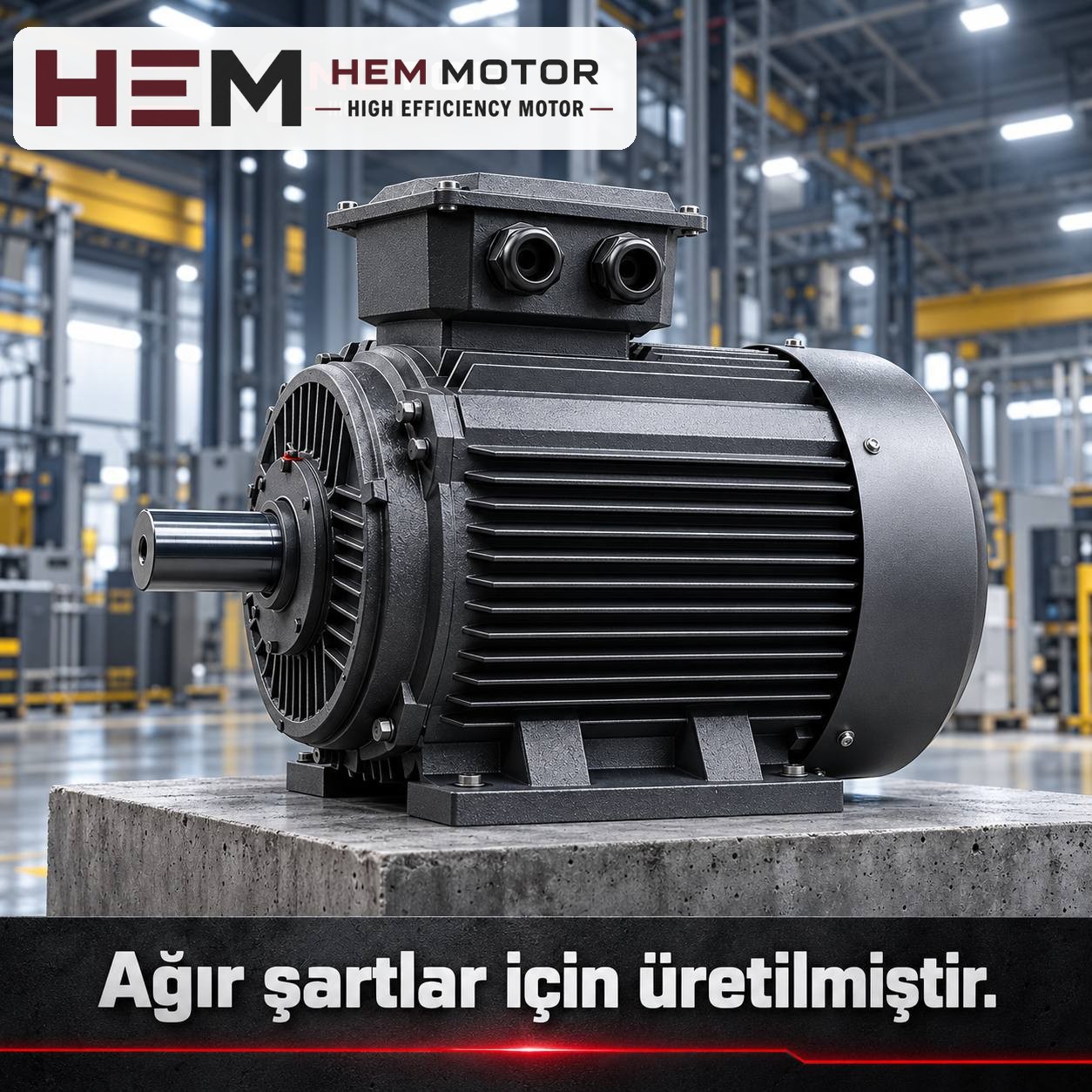
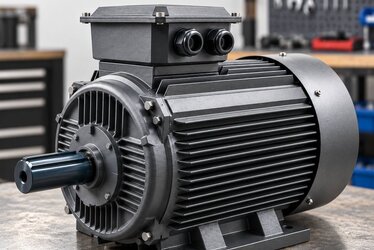
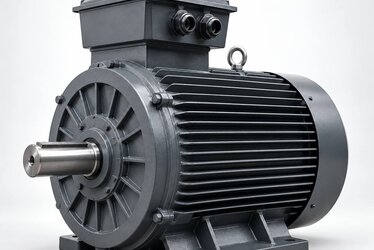
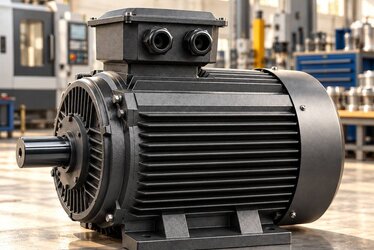
Three-phase electric motor in a heavy industrial environment
In drying plants, the motor is exposed to dust and seasonal changes in humidity (representative image).

What determines the motor load in a drying fan?

A fan load behaves differently from machines that require constant torque, such as compressors or conveyors. The power drawn by a fan rises very quickly with impeller speed: it is roughly proportional to the cube of the speed. If the speed increases by ten percent, the power the fan demands grows by about one third. That is why, when replacing a fan motor, the most critical piece of information is the speed the impeller was designed for.

In practice this has two consequences:

  • Do not change the number of poles. Fitting a 3,000 rpm motor to an impeller that runs with a 1,500 rpm motor overloads both the motor and the impeller unless the pulley ratio is changed. Conversely, fitting a 1,000 rpm motor noticeably reduces the airflow and lengthens the drying time.
  • Take small differences in rated speed into account. The nameplate speeds of two motors with the same number of poles may differ by a few rpm. This difference is usually within tolerance, but if the motor is already running at its limit, it shows up in the current drawn.

The resistance of the product mass also affects the load. The pressure the fan faces when the silo or dryer is full differs from the pressure it faces when empty. Measuring the motor current both when full and when partly filled is the most reliable way to understand the motor's real load.

The position of the motor relative to the hot air

In dryers, the fan may be located before or after the burner or heat exchanger. This layout is decisive in selecting the motor.

  • If the fan is on the cold air side: The fan draws in outside air and pushes it to the heater. The motor stays at normal ambient temperature; this is the most suitable situation for a standard three-phase motor.
  • If the fan is on the hot air side: The fan draws in heated air. In this case the motor must be positioned outside the hot air stream, with sufficient distance and air circulation between the impeller shaft and the motor. Placing the frame of a standard motor directly in the hot air duct is not correct.
  • If the motor is inside a closed cabinet: If the cabinet is poorly ventilated, the motor cannot dissipate the heat it produces. Make sure space is left in front of the fan cover.

If the ambient temperature where the motor will run exceeds normal limits, state this clearly in the order; this information can change the motor selection.

Seasonal operation: moisture, condensation and dust

The most insidious problem in drying plants is that the motor stands unused for months. Day-night temperature differences can cause condensation inside the motor; moisture that accumulates in the winding can lead to an insulation failure at the first start of the season.

Pre-season checklist

  • Have the winding insulation resistance measured with a suitable instrument; if it is low, dry the motor before running it.
  • Check the bearing noise by turning the shaft by hand; review the lubrication condition after a long standstill.
  • Clean the build-up of straw, bran and dust on the fan cover and frame fins.
  • Confirm that the terminal box gasket is in place and that the cable entries are tight.

The models HEM Motor has on sale are IP55: they are protected against dust ingress and against water jets from any direction. However, in an outdoor installation exposed directly to rain, snow and sun, building a protective canopy over the motor extends its service life. It is also good practice to have the cable entry facing downward to prevent rainwater from running towards the terminal box.


Prices and technical data are on the product pages; choose a model and order online.

Example cast iron models for drying fans

The models below are examples of powers and speeds often seen in small and medium-sized dryers. The power your fan needs depends on the impeller size, the required airflow and the system pressure; the models listed are examples, not recommendations.

  • 132S1-2 cast iron: 5.5 kW (7.5 HP), 2-pole, rated 2,930 rpm, IEC 132S, 400/690 V (Δ/Y), rated current 10.1 A. A speed seen in small direct-coupled dryer fans.
  • 160M2-2 cast iron: 15 kW (20 HP), 2-pole, rated 2,945 rpm, IEC 160M, 400/690 V (Δ/Y), rated current 26.5 A.
  • 180L-4 cast iron: 22 kW (30 HP), 4-pole, rated 1,470 rpm, IEC 180L, 400/690 V (Δ/Y), rated current 39.7 A. The speed class used for large-diameter, slower-turning impellers.

All models have class F insulation and run on a 50 Hz network. Further information prepared for fan and agricultural applications is on the agricultural machinery electric motors and fan and extractor motors pages.

Starting and speed control

Large fan impellers have high inertia; it can take the motor several seconds to bring the impeller up to full speed. During this time the motor draws a high current. With direct-on-line starting, the thermal protection setting must be chosen to tolerate this long run-up. Star-delta starting is common in drying plants to reduce the starting current; motors rated 400/690 V are connected in delta when running on a 400 V network and are therefore suitable for star-delta starting.

Some plants use a frequency inverter to adjust the airflow. Our three-phase series are suitable for speed control with a frequency inverter; for long periods at low speed with full torque an external fan may be required, and if the cable between drive and motor is long, a dv/dt or sine filter is considered; these conditions are stated in the order. For details, see the question on use with an inverter.

Hypothetical example: the motor of a belt-driven drying fan

This example is an illustration and does not reflect a real application. Suppose that in the belt-driven fan of a maize dryer, the winding of a motor whose nameplate reads 22 kW and 1,470 rpm has burned out at the start of the season.

  • Speed and poles: The nameplate indicates a 4-pole motor. If the 180L-4 model with the same number of poles is chosen, the fan speed does not change and the pulleys can be used as they are.
  • Frame: If the old motor's frame code is 180L, the base and tensioning arrangement will very likely fit; if it differs, the foot spacing is compared using the technical drawings.
  • Cause of failure: A new motor should not be fitted before the cause of the burned winding has been investigated. If there is a cause such as condensation, phase loss or excessive belt tension, the new motor will face the same problem.
  • Commissioning: At the first start, the direction of rotation and the current with a full silo are measured; if the current is above the rated value, the fan setting and system resistance are reviewed.

What to send with your order

  • A photo of the old motor's nameplate: power, rated speed, voltage, frame code
  • How the fan is connected: impeller directly on the shaft, or belt-driven
  • Mounting arrangement (foot-mounted, flange, vertical) and the motor's position relative to the hot air stream
  • Installation location: indoors, under a canopy, outdoors
  • Supply voltage, starting method and drive information, if any

Review suitable models for your drying fan and current prices on the buy electric motors page. To ask about the right model using your motor's nameplate details, you can use the nameplate submission page or reach us via the contact page.

HEM Motor Models Related to This Article

The cards show example models related to the topic. A suitable motor is not chosen by power alone: compare speed, voltage, mounting, shaft and connection dimensions on the product page; if unsure, send a photo of the existing motor’s nameplate on WhatsApp.

5.5 kW 3000 rpm Cast Iron Frame Electric Motor 132S1-2

132S1-2

5.5 kW · 3000 rpm

  • Cast iron frame · IEC 132S
  • 2930 rpm · IP55
  • Mounting: B3 foot; flange (B5/B14/B35) depending on frame — confirmed with the order

US$336.56 (€300.36)

View product
15 kW 3000 rpm Cast Iron Frame Electric Motor 160M2-2

160M2-2

15 kW · 3000 rpm

  • Cast iron frame · IEC 160M
  • 2945 rpm · IP55
  • Mounting: B3 foot; flange (B5/B14/B35) depending on frame — confirmed with the order

US$566.59 (€505.64)

View product
22 kW 1500 rpm Cast Iron Frame Electric Motor 180L-4

180L-4

22 kW · 1500 rpm

  • Cast iron frame · IEC 180L
  • 1470 rpm · IP55
  • Mounting: B3 foot; flange (B5/B14/B35) depending on frame — confirmed with the order

US$913.59 (€815.32)

View product

Similar Articles