160 kW Three-Phase Asynchronous Electric Motor: Choosing Between 315L and 355M Frames

160 kW Three-Phase Asynchronous Electric Motor: Choosing Between 315L and 355M Frames

For a 160 kW three-phase asynchronous electric motor, the frame choice depends on speed: in the HEM Motor 2026 catalog, the 2-pole and 4-pole 160 kW models use a 315L frame, while the 6-pole model uses a 355M frame. This difference determines whether the base can stay as it is when a 160 kW (220 HP) motor replaces an old one. Below we explain why the frame differs, the steps for comparing with the existing base, and the general logic of bearing and lubrication maintenance on motors of this size.

160 kW models: which speed, which frame?

The values are taken from HEM Motor product records. All three models have a cast iron frame, IP55 protection and class F insulation, and their winding is 400/690 V (Δ/Y) for 50 Hz.

ModelPoles / synchronous speedRated speedIEC frameRated torqueRated current (400 V)
315L1-22 poles / 3,000 rpm2,980 rpm315L512.8 Nm265 A
315L1-44 poles / 1,500 rpm1,488 rpm315L1,027 Nm271 A
355M1-66 poles / 1,000 rpm990 rpm355M1,543 Nm281 A

The first part of the model code gives the IEC frame: in "315L1-4", 315 is the frame number, L is the frame length letter, 1 is the power step within the same frame, and 4 is the number of poles. In the same family, the 185 and 200 kW 4-pole models are also in the 315L frame, and the 200 kW 6-pole 355M2-6 is in the 355M frame; so the frame chosen at 160 kW also serves as a reference if a power increase is considered later.

Why does the 6-pole version move up to a 355 frame?

The quantity that really determines the size of an asynchronous motor is not power but torque. To deliver the same 160 kW at 990 rpm, the motor must produce 1,543 Nm at the shaft; this is about three times the torque of the 2-pole model. Higher torque means a larger-diameter, longer rotor-stator package. When this package no longer fits inside the 315L frame, the next frame number is used.

As the frame grows, the cooling surface and bearing load change too. Because the 6-pole motor turns slowly, its fan moves less air; the large surface of the bigger frame helps make up for this. In the end, the right frame for 160 kW follows automatically from the machine's speed; what matters to the user is how this frame will sit on the base on site.
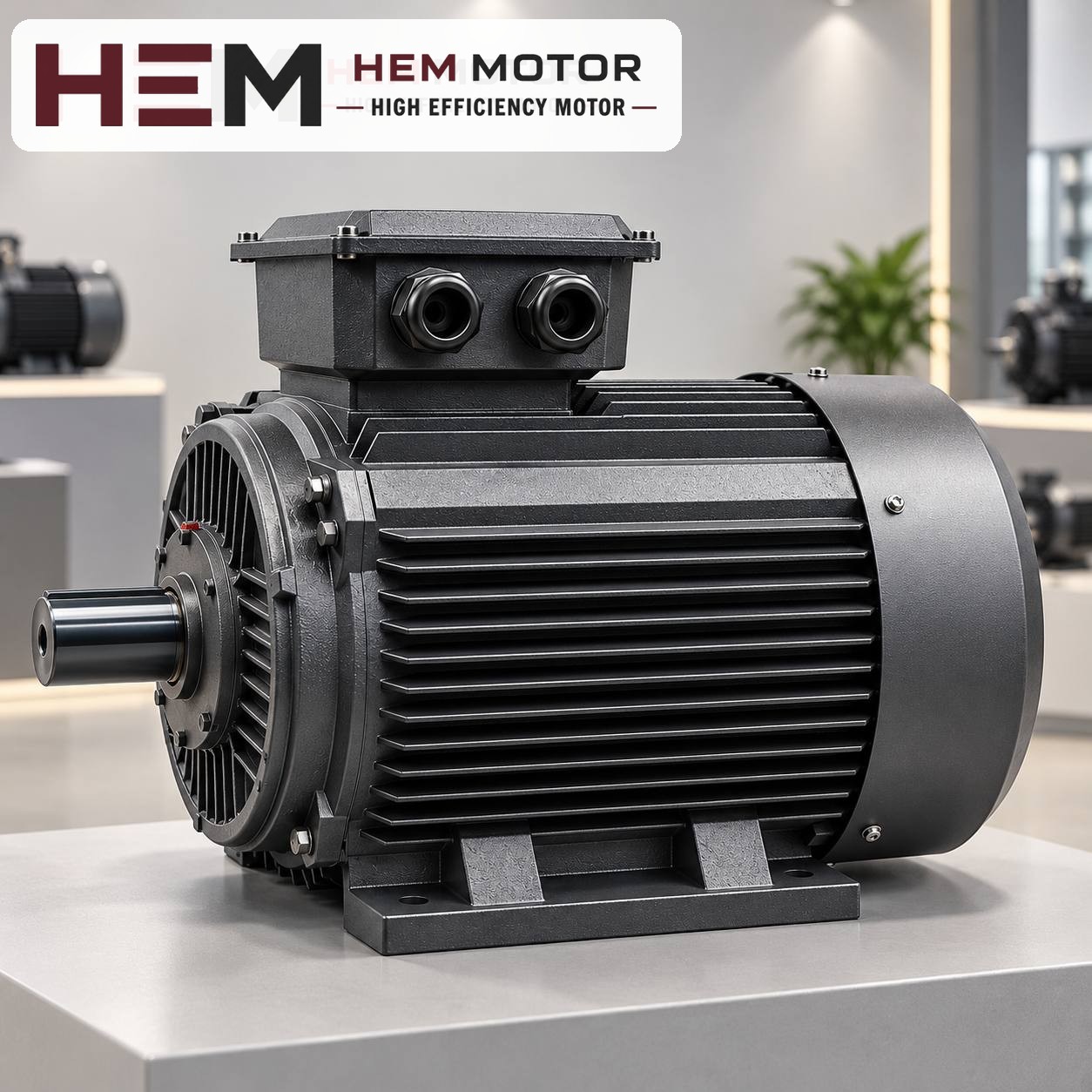
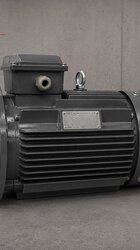
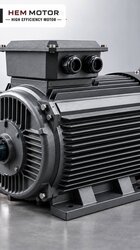
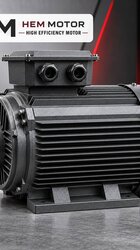
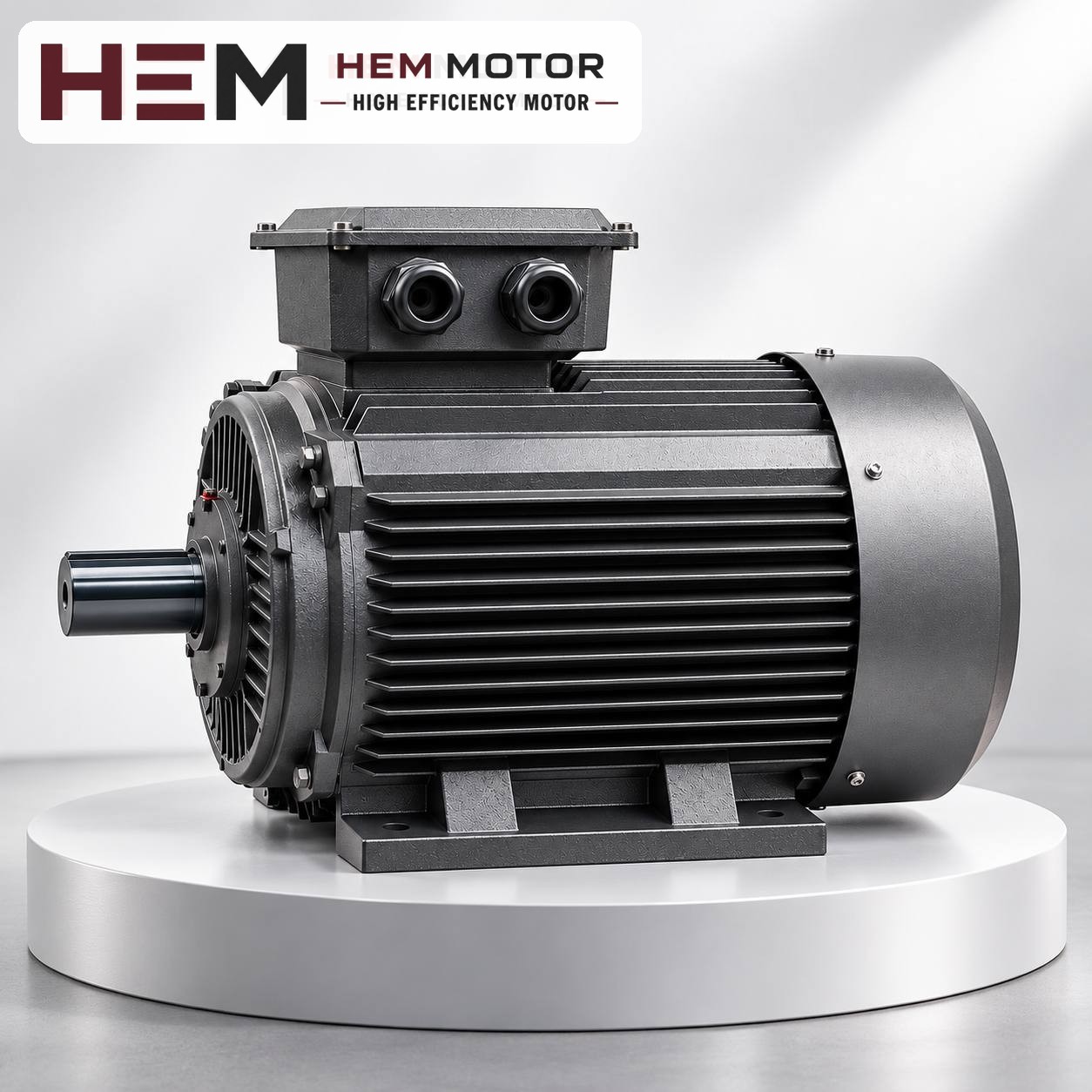
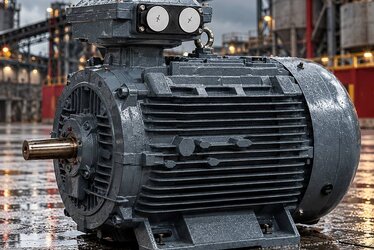
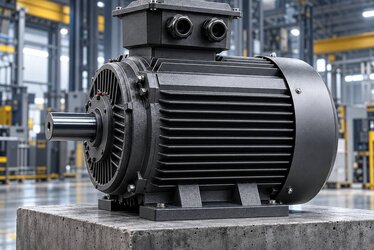
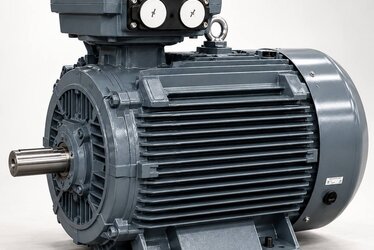
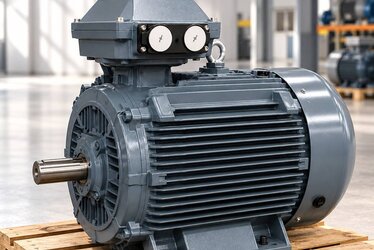
Cast iron frame three-phase electric motor standing on a base
When replacing a large-frame motor, fit on the base is checked before ordering (representative image).

Comparing with the old motor's frame: shaft height

The IEC frame number indicates the height from the motor's foot base to the shaft axis in millimetres. Therefore, when a 355-frame motor replaces a 315-frame motor, the shaft axis rises by the difference between the frame numbers. Since the shaft of the driven machine is fixed, this difference directly upsets coupling alignment; the motor will not fit in place unless the base is lowered or rebuilt.

Care is needed even if the frame number stays the same but the letter changes. The letters S, M and L affect the frame length and therefore the longitudinal distance between the foot holes. For example, the 132 kW 4-pole model is in a 315M frame, while the 160 kW 4-pole model is in a 315L frame; the shaft height is the same, but the rear foot holes may fall at a different point. In that case it may be necessary to drill new holes in the base or use an adapter plate.

Will the base need changing? Step-by-step check

Carrying out this check before ordering avoids waiting after the motor arrives on site. We do not give dimension values as numbers in this article; the correct values for each frame and mounting type are in the 2D drawings on the technical drawings page. The order can be as follows:

  • Read the nameplate: Note the frame code (e.g. 315M, 315L, 355M) and mounting type (such as B3, B35) on the old motor's nameplate. If the nameplate is illegible, you can estimate the frame number by measuring the shaft height.
  • Measure the shaft height: Take the distance from the surface the feet sit on to the shaft centre. This value should come out close to the frame number.
  • Measure the foot holes: Record the longitudinal and transverse distances between holes, and the distance from the shaft shoulder to the nearest hole axis.
  • Check the shaft end: See whether the shaft diameter, shaft length and keyway match the coupling hub.
  • Compare with the drawing: Put the frame drawing of the chosen model side by side with the old dimensions. If the difference is only longitudinal, the holes need shifting; if it is in height, base work is needed.
  • Check the terminal box orientation: If the cable entry faces a wall or the machine, specify the box position in the order.

For the general frame–power correspondence, you can also look at our IEC frame – power table article. To compare frame and speed options, review suitable HEM Motor models and current prices.
Prices and technical data are on the product pages; choose a model and order online.

Bearings and lubrication: what to watch at this size

In the 160 kW class, the bearings carry both the weight of the rotor and the load coming from the coupling or pulley. On motors of this power, bearings are generally designed to be relubricated during operation; if there is a grease nipple, the lubrication interval and the amount of grease to be applied each time are stated on the motor nameplate or in the catalog. Apply these values from the model's own data, not by guesswork; the 2026 technical catalog is the reference source.

  • The interval changes with speed: On high-speed motors such as the 2-pole 315L1-2, grease ages faster; lubrication is needed more often than on the 4-pole model in the same frame.
  • Too much grease is harmful too: If the bearing housing is completely filled, internal friction rises and the bearing heats up. If there is a grease drain plug, open it during lubrication and let the old grease escape.
  • Do not mix grease types: Greases with different soap bases may be incompatible with each other; find out which grease is used in the motor and continue with the same one.
  • Monitor heat and noise: A short temperature rise after lubrication is normal; a steadily rising temperature or a metallic noise calls for a bearing check.
  • Belt and coupling load: With belt drives, excessive tension wears the front bearing. With coupling drives, misalignment is the most common cause of bearing failure after a base change.

If the motor will wait on site for a while after delivery, protecting the bearings is a separate matter; our storage and standby article covers this. If operation with a drive is planned, this should also be stated in the order.

Hypothetical example: the base in a 6-pole replacement

In a hypothetical grinding line, suppose a 132 kW 6-pole motor with a 315L frame is to be upgraded to 160 kW due to a capacity increase. Since the new motor is the 355M1-6, the shaft axis rises and the existing base is no longer adequate. The maintenance team first measures the old motor's shaft height and foot holes, then compares them with the technical drawing of the 355 frame. As a result, either the base plate is lowered or a new steel base is fabricated; coupling alignment is redone with a dial indicator after installation. This example shows that a frame change can create workshop work in addition to the cost of the motor.

If a 4-pole fan motor in the same plant were replaced, the picture would be different: moving from 315M to the 315L1-4, the shaft height stays the same, and the work is usually limited to adapting the rear foot holes.

Conclusion: clarify the frame information in the order

At 160 kW, the 2-pole and 4-pole models are in the 315L frame and the 6-pole model in the 355M frame; base compatibility starts with this difference. If the old motor's nameplate photo, frame code, shaft height measurement, mounting type, voltage, speed and application are ready before ordering, the suitable model is determined quickly. For other ratings in the cast iron series, see the cast iron frame electric motor series page, and you can see all models in our online store. Send a photo of your current motor's nameplate, its speed and mounting information via the nameplate submission page or get in touch; request a quote for a suitable model.

Frequently Asked Questions

What frame does a 160 kW motor have?

In the HEM Motor catalog, the 2-pole (315L1-2) and 4-pole (315L1-4) 160 kW models are in the 315L frame, while the 6-pole model (355M1-6) is in the 355M frame.

Will a 355-frame motor fit on the same base as a 315-frame motor?

Usually not; because the frame number indicates shaft height, the shaft axis rises and coupling alignment is lost. The base needs to be adapted or replaced.

How many kW is a 220 HP motor?

In our product records, the 160 kW models are given as equivalent to 220 HP. When reading the HP value on an old nameplate, compare the speed and frame as well.

How often are bearings lubricated on large motors?

The interval and grease quantity vary by model and speed; the value given on the motor nameplate or in the catalog applies. High-speed motors generally need more frequent lubrication.

HEM Motor Models Related to This Article

The cards show example models related to the topic. A suitable motor is not chosen by power alone: compare speed, voltage, mounting, shaft and connection dimensions on the product page; if unsure, send a photo of the existing motor’s nameplate on WhatsApp.

160 kW 1500 rpm Cast Iron Frame Electric Motor 315L1-4

315L1-4

160 kW · 1500 rpm

  • Cast iron frame · IEC 315L
  • 1488 rpm · IP55
  • Mounting: B3 foot; flange (B5/B14/B35) depending on frame — confirmed with the order

US$6,096.13 (€5,440.38)

View product
160 kW 3000 rpm Cast Iron Frame Electric Motor 315L1-2

315L1-2

160 kW · 3000 rpm

  • Cast iron frame · IEC 315L
  • 2980 rpm · IP55
  • Mounting: B3 foot; flange (B5/B14/B35) depending on frame — confirmed with the order

US$5,214.57 (€4,653.65)

View product
160 kW 1000 rpm Cast Iron Frame Electric Motor 355M1-6

355M1-6

160 kW · 1000 rpm

  • Cast iron frame · IEC 355M
  • 990 rpm · IP55
  • Mounting: B3 foot; flange (B5/B14/B35) depending on frame — confirmed with the order

US$6,245.81 (€5,573.96)

View product

Similar Articles