English
 Français
 Türkçe
 Español
 Русский

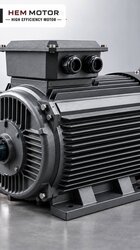
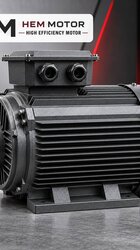
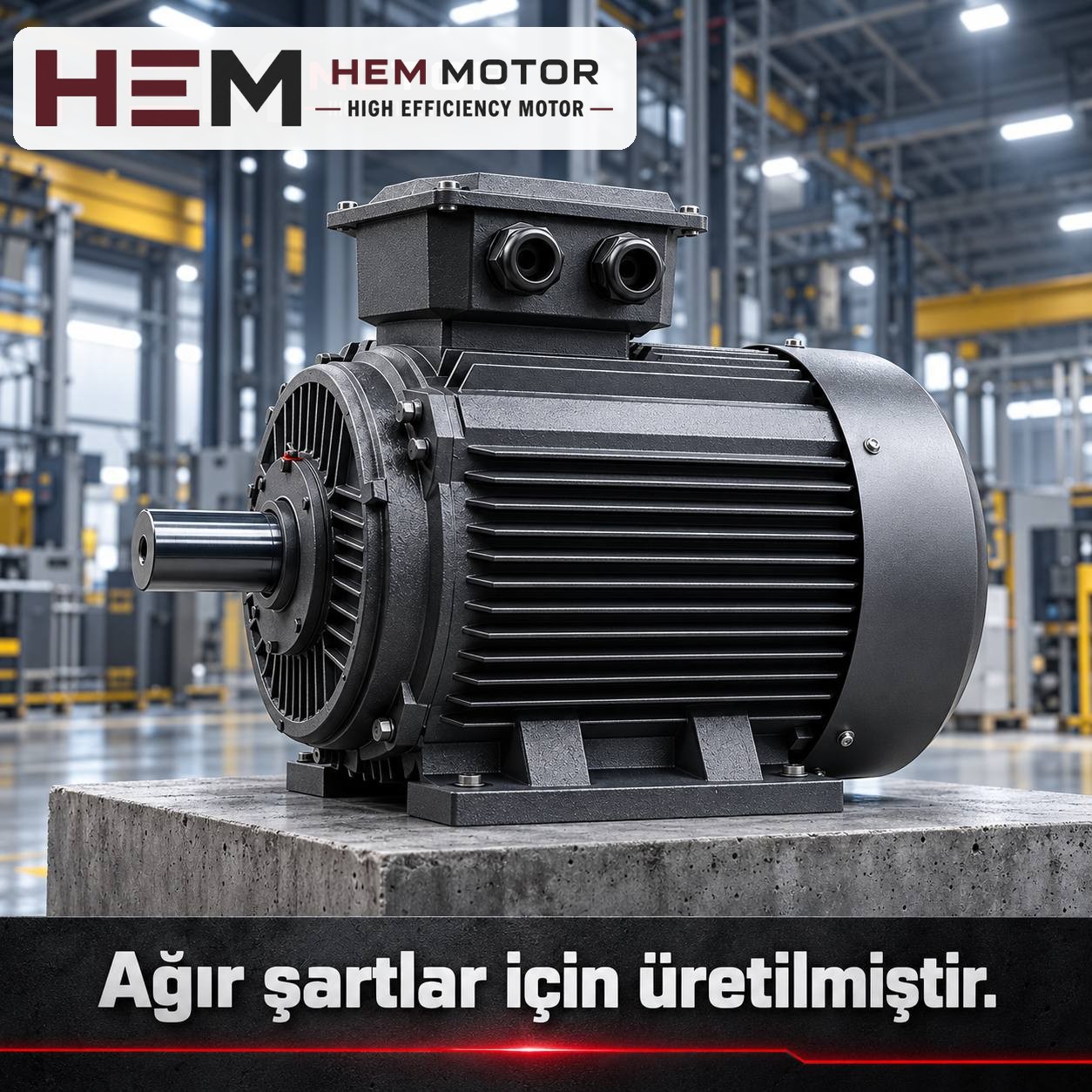

When choosing a 90 kW three-phase asynchronous electric motor, the first decision is the speed; frame, current, torque and even the base preparation follow from that decision. In HEM Motor's 90 kW range, the 3000 and 1500 rpm models are in the IEC 280M frame, while the 1000 rpm model is in the next frame size up, 315M. All three models have a 400/690 V (Δ/Y) winding; this winding is directly suitable for star-delta starting on a 400 V supply. In this article we look at these differences specific to 90 kW, the starting options and the information that must be prepared for the panel and cable calculation.

Three speeds, two frames: comparing the 90 kW models
At the same power, the lower the speed, the higher the torque the motor must produce at the shaft. As torque grows, the rotor and stator core also grow; this is why the 6-pole 90 kW motor moves to a larger frame than its 2- and 4-pole counterparts. The values below are taken from HEM Motor product records (125 HP equivalent, rated current at 400 V):
| Model | Poles / synchronous speed | Rated speed | IEC frame | Rated current (400 V) | Rated torque |
|---|---|---|---|---|---|
| 280M-2 | 2 / 3,000 rpm | 2,975 rpm | 280M | 152 A | 288.9 Nm |
| 280M-4 | 4 / 1,500 rpm | 1,486 rpm | 280M | 155 A | 578.4 Nm |
| 315M-6 | 6 / 1,000 rpm | 988 rpm | 315M | 161 A | 869.9 Nm |
Two practical conclusions follow from the table. First, the torque of the 1000 rpm model is about three times that of the 3000 rpm model; this difference is taken into account when sizing the coupling, the gearbox input and the base bolts. Second, the currents are close to each other; on the panel side the difference between the three models is small, the real difference is on the mechanical side. All three models have a cast iron frame, IP55 protection and class F insulation; they are wound for a 50 Hz supply.
What does the frame difference by speed mean on site?
The IEC frame number gives the height of the shaft centre line above the base of the feet in millimetres. Moving from the 280M frame to the 315M frame raises the shaft centre line and changes the foot mounting dimensions and the shaft diameter. Therefore, putting a 6-pole 90 kW motor on the same base in place of an old 4-pole 90 kW motor is not directly possible; the base, coupling alignment and drive ratio have to be reconsidered.
If a change of speed is being considered, first clarify the shaft speed the machine requires. For example, in a geared drive, moving from 1500 rpm to 1000 rpm also changes the gearbox output speed. To compare frame dimensions and foot holes with the base, use the frame-based 2D technical drawings; take dimension figures from the drawing instead of guessing.
What to check when replacing the existing motor
- The frame code (such as 280M, 315M) and the rated speed on the old motor's nameplate.
- Mounting arrangement: at this power, foot mounting (B3) is mostly used; flange use is confirmed separately with the order.
- Coupling type or pulley connection; in a belt drive, the side load the shaft will carry.
- Which side the terminal box is on and the direction of the cable entry.
400/690 V winding and starting options
The nameplate of all three models reads 400/690 V (Δ/Y). This means the motor runs at full voltage in delta connection on a 400 V supply, and in star connection on a 690 V supply. Being wound for delta operating voltage on a 400 V supply makes the motor suitable for star-delta starting. At 90 kW, direct-on-line starting puts too much strain on the supply in most plants, so the choice of method is important.
- Star-delta: At start the motor is connected in star; the starting current drawn from the supply and the starting torque drop to about one third compared with direct-on-line starting. It is a common solution for loads that start unloaded or lightly loaded, such as fans, centrifugal pumps and compressors. If the load requires high torque at start, the motor may not accelerate enough in the star position; the current surge at changeover is also taken into account.
- Soft starter: It limits the current by raising the voltage steplessly; since torque falls with the square of the voltage, the setting is made carefully for loaded starts. In pumps, its feature of reducing water hammer at stop is also used.
- Frequency inverter: It keeps the starting current at the lowest level and is the only solution if speed adjustment is needed. Our three-phase ranges are suitable for speed control with a frequency inverter; for prolonged full-torque operation at low speed an external fan may be required, and if the cable between drive and motor is long a dv/dt or sine filter is considered; these conditions are stated with the order.
What decides the method is the torque the machine requires at start and how far the supply (transformer rating and other loads) can carry the starting current. Once these two points are clear, review the suitable HEM Motor models and current prices.
Information to prepare for cable and panel
The cable cross-section and switchgear for a 90 kW motor are calculated by the project or panel engineer; they cannot be read from the motor nameplate alone. For the calculation to be done correctly, the following information should be given to the engineer together:
- Rated current: 152 A (280M-2), 155 A (280M-4) or 161 A (315M-6) at 400 V.
- Starting method: with star-delta, two separate cable groups go to the motor and the contactors are selected according to the phase current; in a drive system, the drive output cable and filter requirement are evaluated separately.
- Length of the cable route, installation method (duct, tray, underground) and ambient temperature.
- Permissible voltage drop from the panel to the motor and the short-circuit power of the supply.
- Protection arrangement: the setting range of the thermal or electronic motor protection relay, and if needed a request for winding temperature sensors.
You can find general information on how the protection relay is set according to rated current in our motor protection article.