English
 Français
 Türkçe
 Español
 Русский

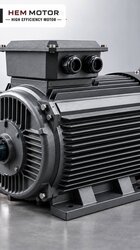

On a thickness planer, what determines main motor power is the volume of chips removed in a pass: the amount of wood removed per minute, obtained by multiplying board width, depth of cut and feed speed. When any one of these three values doubles, the load on the cutter block roughly doubles too. The right power is therefore chosen knowing how much chip will be removed at the machine's full width, in hardwood and at the fastest feed setting. Cutter block speed and the belt arrangement are kept exactly as on the old motor.
Two separate drives on a thickness planer
The most important difference between a thickness planer and a surface planer is the feed. On a surface planer the operator pushes the wood by hand; on a thickness planer the board is passed under the cutter block at constant speed by serrated and smooth feed rollers. The machine therefore usually has two separate drives:
- Main motor: Turns the cutter block by belt. This is the drive that removes the chips and consumes most of the power.
- Feed drive: Turns the rollers via a chain or gearbox. On small machines it is taken mechanically from the main motor; on large machines it is a separate small geared motor, a stepped gearbox or a motor adjusted by a drive.
This distinction affects motor selection in two ways. First, feed speed directly determines the load on the main motor; when the feed setting is raised, the main motor removes more chip. Second, if the feed is driven by a separate motor, many machines have a protection that stops the feed when the main motor is overloaded (feed cut-off on overcurrent); when replacing the main motor, the setting of this protection must also be updated to the new motor's rated current.
Factors that increase chip load
Chip volume is a simple product: width × depth of cut × feed speed. But the same chip volume does not require the same power in every wood. The factors that change the main motor's load are:
- Width: Working at the machine's full width is the heaviest case. When narrow pieces are fed side by side, the total width again approaches full width.
- Depth of cut: As the depth taken in one pass increases, both chip volume and the load at the knife's entry into the wood increase.
- Feed speed: A faster setting raises output but raises motor load in the same proportion.
- Wood species and moisture: Hardwoods such as oak and beech need markedly more power than softwoods. Knotty and resinous timber also makes the load fluctuate.
- Knife condition: A dull knife removes the same chip with more friction; current rises and the surface burns.
Estimating the power requirement from an existing machine
If you have a working machine, the most reliable data is its current. Measure the main motor's current with a clamp meter while running your heaviest job (hardwood, full width, usual depth and feed) and compare it with the rated current on the nameplate. If the current is comfortably below the rated value, the motor is adequate. If higher capacity is wanted, the new load can be roughly estimated by the ratio of chip volumes: increasing the feed speed by fifty per cent increases the cutting part of the load by about fifty per cent as well. This is a preliminary estimate; the machine's cutter block, bearings and belt capacity must also be able to carry the new load.
Cutter block speed and the belt arrangement are kept
On a thickness planer the cutter block turns at high speed for surface quality, and this speed is the product of motor speed and pulley ratio. The machine manufacturer chose the motor pole count and the pulley diameters together; some machines use a 2-pole motor and a small ratio, others a 4-pole motor and a larger ratio. The rule on replacement is simple: the speed class on the old motor's nameplate is kept and the pulleys stay in place.
The pole count is not changed even when the motor is enlarged to increase power. The next power size usually means the next frame size; shaft diameter and shaft height may change, the motor pulley is adapted to the new shaft and the belt line is realigned. The number or section of belts should also be checked so that the belts can carry the increased power. Dimensions by frame size are in the 2026 technical and product catalogue. You can review suitable HEM Motor models and current prices on the buy electric motors page.
Start-up, starting method and protection
On thickness planers, main motor power is greater than on workshop surface planers and the cutter block is heavy. That is why star-delta starting or a soft starter is often seen instead of direct-on-line starting. Because motor torque drops in the star position, start-up takes longer; if the machine starts unloaded, this is generally not a problem. As a rule, the board is not fed before the cutter block reaches full speed.
Motors with a 400/690 V (Δ/Y) nameplate are connected in delta on a 400 V network and are suitable for star-delta starting; motors with a 230/400 V (Δ/Y) nameplate run in star on a 400 V network and therefore cannot be started this way. This difference is easily overlooked, especially when a larger motor replaces an older motor of 3 kW or less. The thermal relay is set to the new motor's rated current so that it carries the start.
The cutter block coasting after being switched off is a safety matter; on machines with a brake, the brake is part of the machine design and a brake motor is not replaced with a standard motor.