A 75 kW motor starting with no load reaches its speed in a few seconds; when the same motor tries to set a full crusher, a water-filled pump line or a loaded conveyor in motion, the picture changes. The start takes longer, the current stays high for a long time, the protection may trip, or the motor may never reach its speed. Most of these problems arise not from the motor's power but from information missing from the order. In this article we use HEM Motor's 75 kW models as examples to explain which information should be collected for starting under load and how it affects the decision.
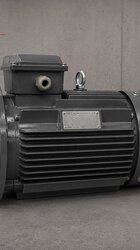
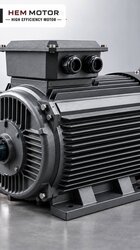
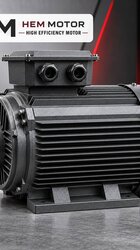
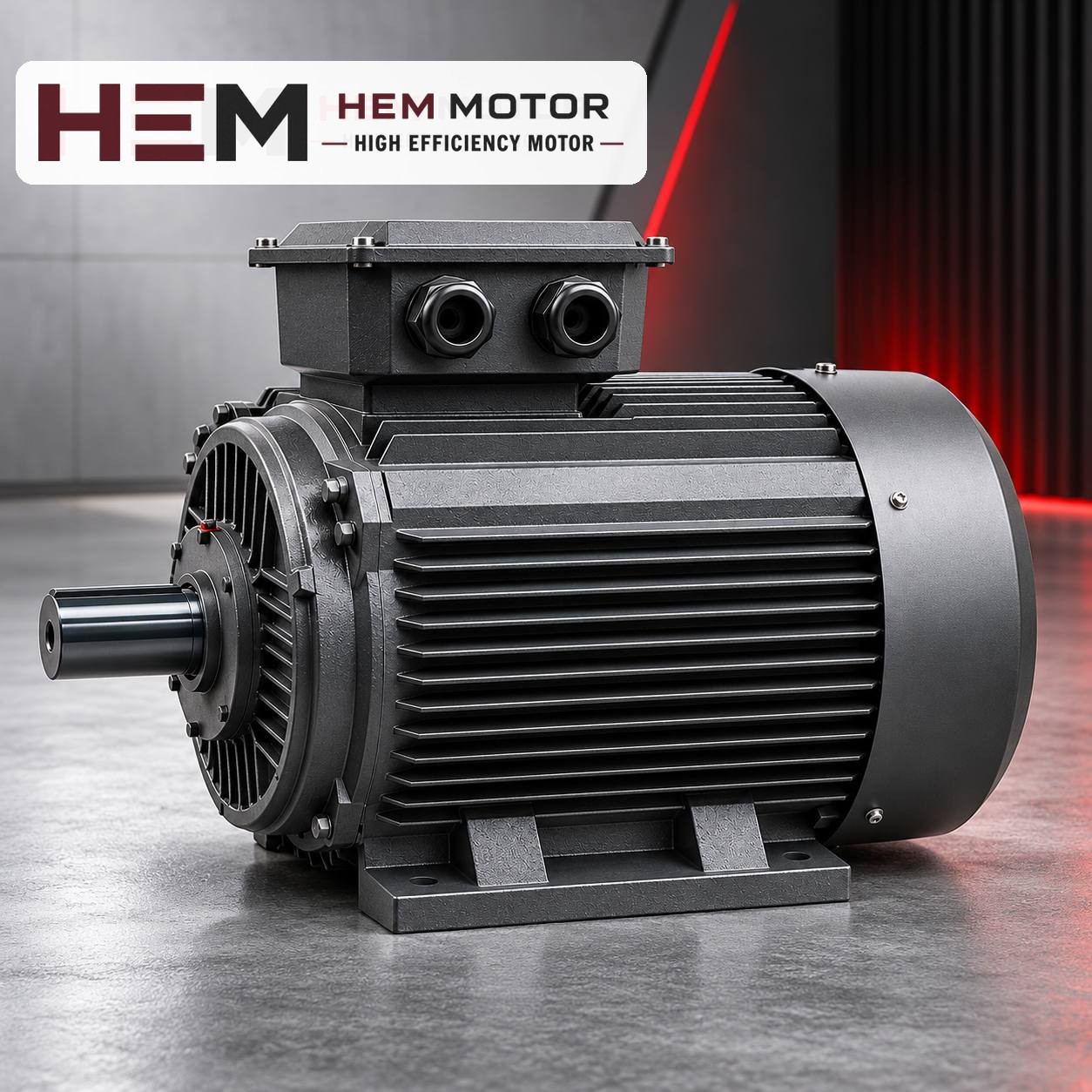
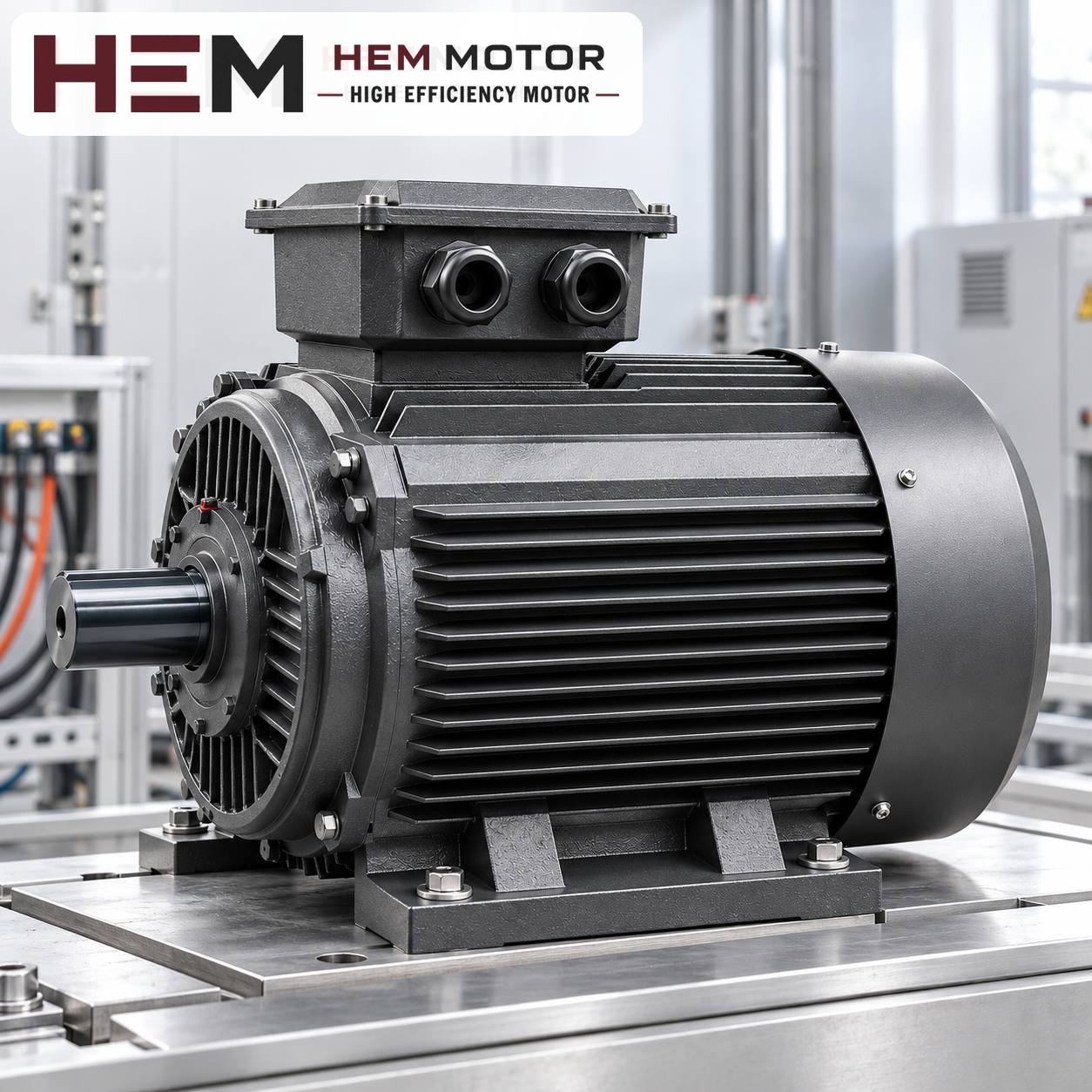
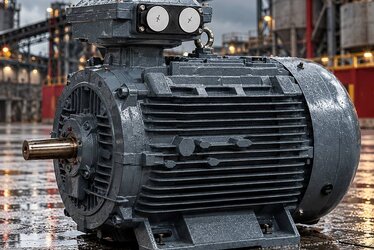
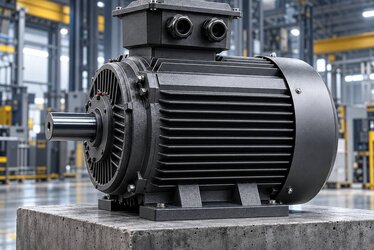
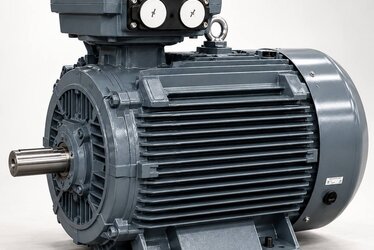
When starting under load, what decides the outcome is the comparison of motor torque and machine resisting torque throughout the start (representative image).
Key values of the 75 kW models
At HEM Motor, 75 kW is offered with a cast iron frame at three speeds. All models are IP55, insulation class F, supplied at 400/690 V (Δ/Y), 50 Hz, and have a service factor (SF) of 1.15.
The rated torque in the table is the torque the motor delivers continuously at rated load. The torque at the moment of starting, the starting current and the torque curve that changes with speed cannot be read from this table; these values are in the model's row in the 2026 technical and product catalogue and should be taken from there for the calculation.
The real question when starting under load: the torque margin
As the motor accelerates from standstill to its speed, two torques meet at every instant: the torque the motor produces at that speed and the torque the machine opposes at that speed. The difference between them is the torque that produces acceleration. If the difference is large, the start is short; if it is small, the start takes longer; if the difference falls to zero at any speed, the motor stalls there and cannot reach its speed.
The resisting torque of machines behaves very differently from one machine to another. Without knowing this, the question "is 75 kW enough?" cannot be answered correctly.
Low at start, rising with speed: Centrifugal fans and pumps belong to this group. Resistance is low at the beginning of the start; however, if the fan impeller is large and heavy, the start may still take long because of inertia.
Roughly constant torque, independent of speed: Loaded conveyors, screw conveyors, reciprocating compressors and crushers belong to this group. Even at the moment of starting there is resistance close to the rated load.
Torque that peaks at start: A crusher left full of material, a mixer with settled contents or a seized bearing can create resistance above rated at the very first instant. This depends on how the machine is operated and must always be stated.
Information to collect before ordering
For starting under load, power and speed alone are not enough. When the following information comes together, the motor and the starting method can be matched correctly.
Machine side
Machine type and starting condition: Does the machine start emptied or loaded? Does the crusher stand full, is material left on the belt?
Resisting torque at start: A value given by the machine manufacturer or a measurement made with the old motor. If unknown, state the machine type and whether it starts loaded.
Inertia: The moment of inertia of rotating masses such as a flywheel, large fan impeller or heavy drum, and the transmission ratio relative to the motor. High inertia lengthens the start and heats the motor.
Transmission: Coupling, belt and pulley or gearbox; its ratio and the speed on the motor side.
Supply and starting side
Starting method: Direct-on-line, star-delta, soft starter or frequency inverter. Which one is in the existing panel and whether it can be changed.
Transformer and line: The rating of the supplying transformer, the cable cross-section and length. If the voltage drops during the start, motor torque also falls noticeably.
Starting frequency: How many starts per hour or per day and how much time passes between two starts. Consecutive starts under load heat the winding.
Environment and operation
Operating time: Continuous or intermittent operation; how long the motor stays at full load.
Environment: Ambient temperature, dust, altitude and whether the motor can draw cooling air.
Old motor's nameplate: If replacing, its power, speed, current and frame size, and any record of starting problems.
Prices and technical data are on the product pages; choose a model and order online.
How does the starting method affect starting torque?
The most common mistake with starting under load is to consider the starting method separately from motor selection. The same motor behaves completely differently with different methods.
Direct-on-line starting: The motor uses the whole torque curve in the catalogue during the start, but draws a high current from the supply. If the transformer and line can handle this current, it is the strongest option for a loaded start.
Star-delta: A motor rated 400/690 V (Δ/Y) is started in star on a 400 V network. Because the winding voltage is reduced during this stage, both current and torque fall to about one third of their direct-on-line values. It works well for loads that are light at start, such as fans; with a loaded crusher or conveyor the motor may not accelerate enough in the star stage, and a large current surge occurs at the changeover to delta.
Soft starter: It limits current by raising the voltage gradually; since torque falls with the square of the voltage, its setting must be made carefully for heavy-load starts. It is common on pumps and fans with light starts.
Frequency inverter: Because it can deliver near-rated torque at low frequency with limited current, it is the most controlled method for heavy starts. Our three-phase series are suitable for speed control with a frequency inverter; for long periods at low speed with full torque an external fan may be needed, and if the cable between drive and motor is long, a dv/dt or sine filter is considered. Details are in the question on use with an inverter; state these conditions with your order.
What SF 1.15 means and what it does not
All HEM Motor models of 75 kW and above have a service factor of 1.15. This means the motor is designed with a reserve of about 15% above its nameplate power. This reserve is a safety margin against measurement uncertainty, fluctuations in ambient conditions and short-term load increases.
The service factor is not the solution to a starting problem. How much torque the motor produces at start is determined by the torque curve in the catalogue and the chosen starting method; the SF does not change that. Likewise, choosing a motor smaller than needed on the grounds that "the reserve is there anyway" is not correct: a motor that uses its reserve continuously runs hotter and has no margin left for an unexpected load increase. Select the motor for the real load and treat the SF as additional safety.
Example scenario: a belt conveyor that starts loaded
The following sequence is hypothetical and does not describe a real customer application. Suppose that at an aggregate plant a long belt conveyor is stopped with material on it at the end of the shift and starts loaded in the morning. The drive is from a 1,500 rpm motor via a gearbox, and the existing panel has a star-delta starter.
The conveyor is a constant-torque load and starts loaded. Since in the star stage motor torque falls to about one third of the direct-on-line value, whether the belt can accelerate in star must be assessed together with the gearbox ratio and the belt load.
If the assessment shows that star-delta will not be enough, the options are direct-on-line starting, if the transformer allows, or a frequency inverter. This decision is as important as the motor's power.
Since there is only one start per day, starting frequency is not a problem; however, after a fault, the motor should be allowed to cool between repeated attempts.
If the same plant drives a low-speed, high-inertia drum, the 315S-6 (985 rpm, 727.2 Nm rated torque) comes into question, and for a directly coupled high-speed fan or pump the 280S-2 (2,975 rpm). In every case, the decision is made knowing the machine's starting torque and inertia.
Send us the information and we will assess the start together
When selecting a 75 kW motor for starting under load, send us the following:
Power, speed and the driven machine; whether it starts loaded or empty
Starting torque and inertia if known, transmission type and ratio
Existing or planned starting method, transformer rating and cable length
Starting frequency, operating time and ambient conditions
Mounting arrangement, voltage and, if replacing, a photo of the old motor's nameplate
Review suitable models and current prices on the buy electric motors page. If you are looking for a model to replace your existing motor, send us the motor nameplate; once you describe the starting conditions we will identify the model together. For other questions you can reach us via our contact page.
HEM Motor Models Related to This Article
The cards show example models related to the topic. A suitable motor is not chosen by power alone: compare speed, voltage, mounting, shaft and connection dimensions on the product page; if unsure, send a photo of the existing motor’s nameplate on WhatsApp.
When choosing a replacement for a three-phase motor whose nameplate shows HP (horsepower), the right approach is to convert the HP value to kW and fit it to a standard kW rating: 1... More Details
For a 160 kW three-phase asynchronous electric motor, the frame choice depends on speed: in the HEM Motor 2026 catalog, the 2-pole and 4-pole 160 kW models use a 315L frame, while ... More Details
With a 132 kW three-phase asynchronous electric motor, the real work begins after the motor has been chosen: if the cable, switchgear and transformer capacity feeding a load that d... More Details
When choosing a 90 kW three-phase asynchronous electric motor, the first decision is the speed; frame, current, torque and even the base preparation follow from that decision. In H... More Details
On a thickness planer, what determines main motor power is the volume of chips removed in a pass: the amount of wood removed per minute, obtained by multiplying board width, depth ... More Details
On a low-speed conveyor, the choice between a 4-pole and a 6-pole motor does not change the torque that pulls the belt at the gearbox output; for the same power and the same drum s... More Details
We use necessary and optional cookies to improve your experience, enhance content and analyse traffic. Under the GDPR, optional (analytics/marketing) cookies are only used with your explicit consent. Please choose your preference below.
Cookie Policy
 English
 Français
 Türkçe
 Español
 Русский