English
 Türkçe

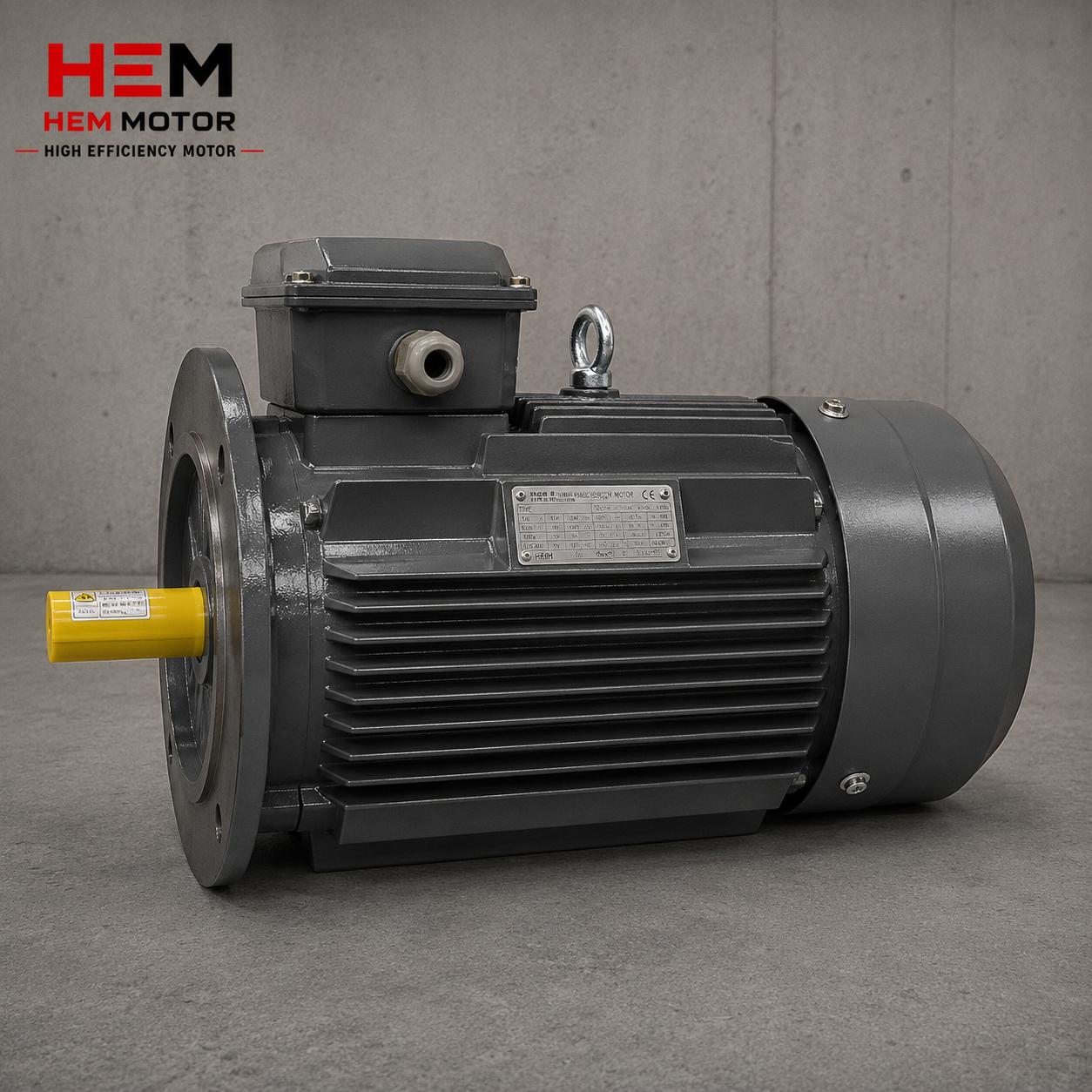

One of the most frequently requested powers in industry is the 3 kW electric motor. It appears across a wide application range, from pumps to conveyors, from compressors to fans. However, most buyers, when they say "I want a 3 kW motor," have in fact made only half the decision; because it is possible to order the same 3 kW power at different speeds, with different torque characteristics and in different frame sizes. This is exactly where 3 kW electric motor selection comes down to correctly understanding the options hidden within a single power value.
In this article we address the relationship between pole count, speed and torque while holding the 3 kW power constant, which pole count is right for which application, standard frame and shaft dimensions, efficiency requirements and the reality of stock and supply. The aim is to make the most correct purchase even within a single power rating.
Same Power, Different Poles: The Meaning of 2/4/6 Poles
The speed of an asynchronous motor is determined by the pole count. On a 50 Hz grid, 2 poles correspond to approximately 3000 rpm, 4 poles to 1500 rpm and 6 poles to 1000 rpm synchronous speed (the actual speed is slightly lower due to slip). This is why you can order the same 3 kW power as 2, 4 or 6 poles.
The critical point here is this: power stays constant, but torque rises as speed falls. Power is proportional to the product of torque and speed; therefore, if you halve the speed at the same power, the torque roughly doubles. Accordingly:
- 2-pole 3 kW: Highest speed (~2900 rpm), lowest torque. For applications requiring high speed.
- 4-pole 3 kW: Medium speed (~1450 rpm), medium torque. The most common and balanced choice.
- 6-pole 3 kW: Lowest speed (~960 rpm), highest torque. Produces roughly three times the torque of a 2-pole.
So a 6-pole 3 kW motor offers roughly three times more torque than a 2-pole 3 kW motor. This is decisive for applications that must turn slowly but powerfully. To grasp the speed-torque relationship in depth, the pole count, speed and torque relationship can be reviewed.
Speed Is Chosen by Application
The way to choose the right pole count is to understand the character of the load the motor will drive. Each application has an ideal speed range, and the motor should be selected according to this range.
2-Pole: High-Speed Applications
Centrifugal pumps and high-pressure fans, by their hydraulic character, operate efficiently at high speed. In these applications a 2-pole motor is preferred, because the airflow and pressure the pump and fan demand are only achieved at high speed. Because their speed is high, they can be smaller and lighter at the same power, but their noise and bearing loads are higher.
4-Pole: General Drive and the Balanced Choice
For conveyors, compressors, gearbox inputs and general machine drives, the 4-pole motor is the most common choice. The speed around 1500 rpm is an ideal starting point for most mechanical transmission systems; it offers a balanced character in terms of efficiency, torque and noise. That is why, when a "standard" 3 kW motor is mentioned, the 4-pole version usually comes to mind.
6-Pole: Low Speed, High Torque
Some applications demand a slow but powerful rotation: hard-starting mixers, some crane and lifting systems, low-speed fans. In these cases a 6-pole motor provides the high torque directly and often reduces the need for a gearbox. Thanks to its low speed it is quieter, but it is larger and heavier at the same power.
Standard Frame and Shaft Dimensions
Mechanical compatibility is critical in 3 kW motor selection. A standard 4-pole 3 kW motor is built in an IEC 100L frame with a shaft diameter of 28 mm. This standardization allows the motor to be fitted smoothly to an existing system or gearbox. When the pole count changes, the frame size can change too; for example, when you choose the same 3 kW power as 6 poles, the motor may be in a larger frame to handle the higher torque.
The main points to consider in mechanical selection are:
- Frame type (IEC frame): A standard size such as 100L provides ease of spare parts and matching.
- Shaft diameter: Standard 28 mm; the coupling or pulley should be selected accordingly.
- Mounting type: Foot (B3), flange (B5) or foot-flange (B35) mounting is selected by application.
- Terminal box orientation and cable entry: Should suit the cabling layout in the field.
Determining the frame and mounting type correctly prevents surprises during installation of the motor. For mounting options, the IEC frame and mounting types resource is a useful guide.
Efficiency Requirement: IE3 and IE4
Today efficiency is no longer a preference but, in most cases, a legal requirement. For motors connected directly to the grid (DOL) and above 0.75 kW, the IE3 efficiency class is mandatory. Since 3 kW is well above this threshold, motors of this power are supplied as IE3 or IE4.
This requirement is actually in the buyer's favor. A 3 kW motor runs for most of the day in many applications; a high-efficiency motor delivers energy savings well above the purchase price over its life. The choice between IE3 and IE4 depends on running hours: in a motor running very long hours, the extra efficiency of IE4 pays for itself faster.
Electrical Characteristics and Connection of a 3 kW Motor
Alongside the mechanical selection, the electrical characteristics are also decisive for a correct purchase in a 3 kW motor. A standard 3 kW asynchronous motor usually runs on a 400 V three-phase supply and has a six-terminal box so its windings can be connected in both star (Y) and delta (Δ). This makes it possible for the motor to suit different grid voltages and different starting methods.
The choice of starting method matters in a medium-power motor such as 3 kW. 3 kW is generally a power suitable for direct-on-line (DOL) starting; the starting current is within acceptable limits for most grids. However, when the starting current must be limited or a soft start is desired, a star-delta starter or a soft starter can be used. In applications requiring variable speed, a variable frequency drive both provides a soft start and adjusts the speed to demand.
The points to watch for a correct connection are:
- Supply voltage: The voltage range on the nameplate must match the grid; the star/delta choice should be made accordingly.
- Thermal protection: A motor protection circuit breaker or thermal relay suited to the motor's rated current should be used.
- Phase sequence: If the direction of rotation is critical, the phase sequence should be checked and two phases swapped if needed.
- Grounding: For safety, the motor housing must always be grounded.
Correct Sizing: Is 3 kW Enough or Too Much?
The basic question to ask before choosing the 3 kW power is whether this power is truly suited to the application. Oversizing (choosing a larger-than-needed motor) is a common mistake; a motor running continuously at half load is inefficient in terms of both initial cost and power factor. Conversely, a small motor running at its limit burns out early from continuous overload.
For correct sizing, the load's real power requirement, the starting character (hard start or easy start) and the duty cycle (continuous or intermittent) must be evaluated together. Loads such as pumps and fans have a power curve that varies strongly with speed; that is why in these applications both power and speed must be chosen together. Constant-torque loads such as conveyors and compressors show a more predictable power requirement.
3 kW is a "sweet spot" where this calculation frequently lands on 3 kW in industry; it is a frequent choice for medium-scale pumps, fans, conveyors and general machine drives. Still, the final decision should be determined by the application's real load profile. On choosing the right power, the motor power sizing guide is a useful resource.
Stock and Supply: Why Is 4-Pole Faster?
A fact often overlooked when buying a 3 kW motor is stock availability. Since the most demanded version in industry is the 4-pole 3 kW IE3 motor, this version is usually quickly available from stock. Because the 2-pole and 6-pole versions serve more specialized applications, they may be in more limited stock and supplied to order.
This matters in project planning: while it is possible to reach a standard 4-pole motor quickly in an urgent need, the supply lead time comes to the fore for orders requiring special poles or special mounting. That is why, before finalizing your requirement, it is wise to evaluate both the technical need and the stock and supply lead time together.
Sharing your application's speed, frame, mounting and efficiency requirements and obtaining stock status and a quote for the right 3 kW motor is the fastest and soundest way to buy. Requesting an application-specific quote against current electric motor prices is the right start.
Frequently Asked Questions
Why can the same 3 kW motor come at different speeds?
Because the speed is determined by the motor's pole count. You can order the same 3 kW power as 2-pole (~3000 rpm), 4-pole (~1500 rpm) or 6-pole (~1000 rpm). The power stays constant, but torque rises as speed falls. Which speed is right depends on the application the motor will drive.
What is the shaft diameter on a 3 kW motor?
A standard 4-pole 3 kW motor is built in an IEC 100L frame with a shaft diameter of 28 mm. The coupling, pulley or gearbox connection is selected to this dimension. Since the frame size can change when the pole count changes, it is important to confirm the chosen version's frame and shaft dimensions before finalizing the mechanical connection.
Is IE3 mandatory for a 3 kW motor?
Yes. For motors connected directly to the grid (DOL) and above 0.75 kW, the IE3 efficiency class is mandatory; since 3 kW is above this threshold, it is supplied as IE3 or the more efficient IE4. This is also in the buyer's favor in terms of energy saving in continuously running applications.