English
 Türkçe


Summary (TL;DR)
- Rated slip is the percentage difference between an asynchronous motor's synchronous speed and its full-load speed; it is the basis of torque production.
- Synchronous speed is fixed by pole count and frequency (1500 rpm at 4 poles); the ~1450 rpm on the label is the full-load speed.
- Slip rises with load: as the motor is loaded the speed drops slightly, and slip grows to produce more torque.
- A low-slip motor is efficient and speed-stable; a high-slip motor suits shock loads and soft starting.
- For correct power-speed selection, base your figures on the full-load speed on the label, not the synchronous speed; HEM Motor supplies the right pole/speed from stock.
Why does the label of an asynchronous motor read "1450 rpm" rather than "1500 rpm"? Behind this seemingly trivial difference lies the whole operating principle of the asynchronous motor: rated slip. Slip is the physical phenomenon that lets the motor produce torque, and it affects everything from correct power-speed selection, to efficiency calculation, to speed stability under load and motor heating. At the purchasing stage most businesses look only at power (kW) and roughly at speed; yet the magnitude of slip is a critical parameter that determines how the motor behaves under load. This article covers rated slip, the difference between synchronous speed and full-load speed, the slip percentage calculation, the application areas of high/low-slip motors and the slip-torque-efficiency relationship, in a way that helps the buyer choose the right motor.
Difference Between Synchronous Speed and Full-Load Speed
In an asynchronous motor a rotating magnetic field forms in the stator. The rotation speed of this field is called the synchronous speed and it depends on only two things: the supply frequency and the pole count of the motor. The synchronous speed formula is: n_s = 120 × f / p (f frequency, p pole count). On the 50 Hz grid in Turkiye the synchronous speeds are clear and fixed by the pole count.
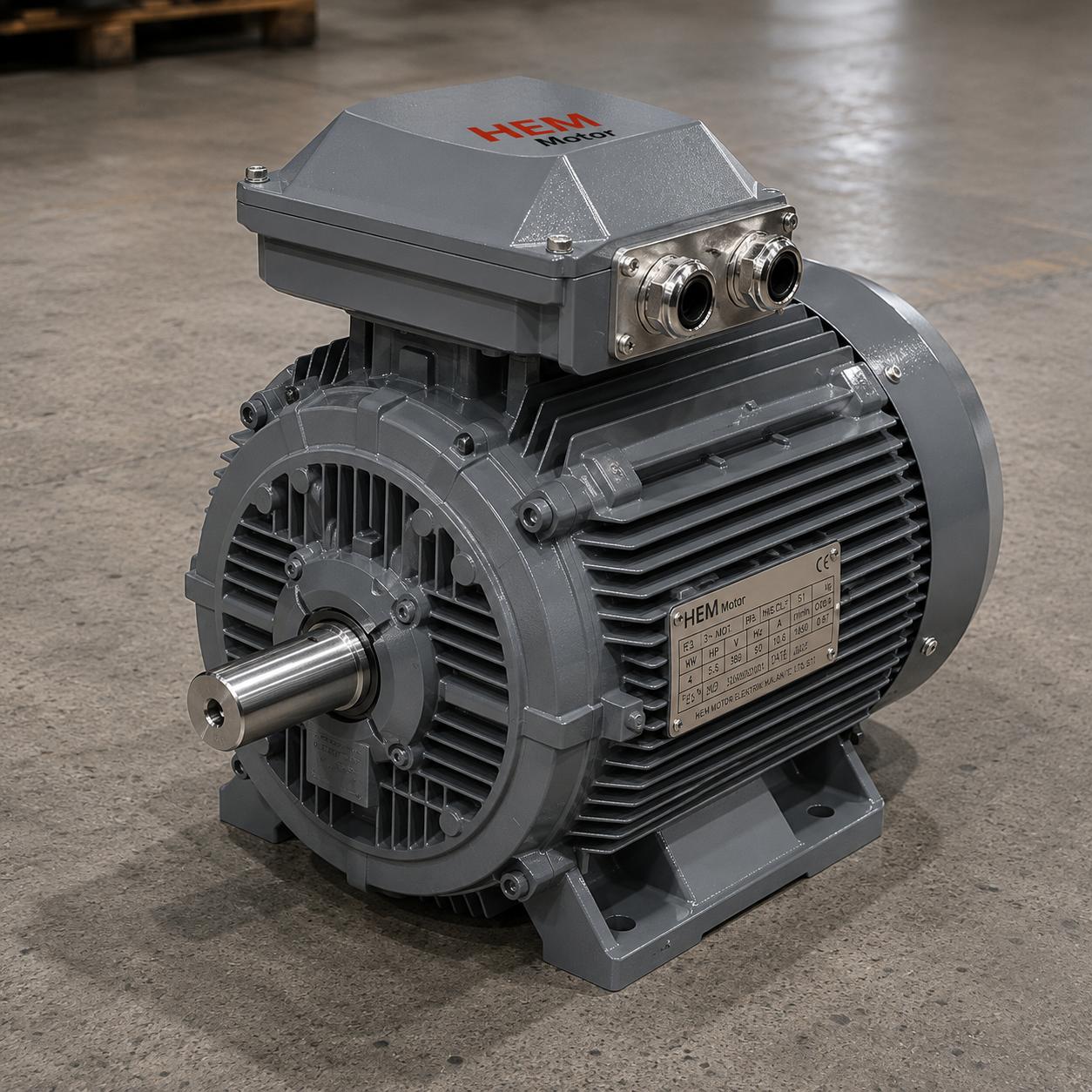
The rotor "chases" this magnetic field but can never quite catch it. If the rotor reached synchronous speed there would be no conductor cutting the magnetic field, no current would be induced in the rotor, and no torque could be produced. So the rotor always turns slightly below synchronous speed; the difference is called slip. The actual speed at which the motor runs at rated load is the full-load speed, and this is the value printed on the label (e.g. ~1450-1470 rpm on a 4-pole motor).
| Pole Count | Synchronous Speed (50 Hz) | Typical Full-Load Speed | Approx. Rated Slip |
|---|---|---|---|
| 2 poles | 3000 rpm | ~2900-2950 rpm | 1.7-3.3% |
| 4 poles | 1500 rpm | ~1450-1470 rpm | 2-3.3% |
| 6 poles | 1000 rpm | ~960-980 rpm | 2-4% |
| 8 poles | 750 rpm | ~720-735 rpm | 2-4% |
How Is the Slip Percentage Calculated?
The slip percentage is the ratio of the difference between synchronous speed and full-load speed to the synchronous speed: s (%) = (n_s − n) / n_s × 100. For example, on a 4-pole motor with a synchronous speed of 1500 rpm and a label speed of 1455 rpm, slip = (1500 − 1455) / 1500 × 100 = 3%. In standard industrial asynchronous motors slip is generally between 2% and 5%. As power increases slip usually decreases; in small motors slip can be higher.
An important property of slip is that it changes with load. When the motor runs unloaded the slip is almost zero (the speed is very close to synchronous); as load increases the motor slows slightly to produce more torque, so slip grows. At rated load slip reaches the rated slip on the label. Therefore the statement "speed drops as load increases" actually means "slip rises as load increases".
The Slip-Torque Relationship
The torque produced in an asynchronous motor depends directly on slip. In the operating region (near rated slip) there is an almost linear relationship between torque and slip: as slip rises, torque rises. When the motor meets a load its speed drops slightly, slip increases, and the motor produces the torque to meet that load. This makes the asynchronous motor a self-balancing system; as the load changes the motor adjusts its slip and settles at a new equilibrium point.
- No load: slip ~0, torque ~0, speed very close to synchronous.
- Rated load: slip = rated slip, torque = rated torque, speed = full-load speed.
- Overload: slip increases further; torque keeps rising up to the breakdown (pull-out) torque, beyond which the motor stalls and stops.
The breakdown torque is the maximum torque the motor can produce and is usually 2-3.5 times the rated torque. If the load exceeds this value the motor stalls. In correct motor selection, the starting and continuous torque demand of the application must stay within the motor's rated and breakdown torque.
High-Slip and Low-Slip Motors
The magnitude of slip defines the character of the motor and is chosen by application.
- Low-slip motor (1-3%): the speed stays almost constant even as the load changes. Efficiency is high because rotor losses are proportional to slip; less slip means less rotor loss. Ideal for constant-speed, continuously running applications such as pumps, fans and compressors. IE3/IE4 efficient motors are generally low-slip.
- High-slip motor (5% and above): the speed drops noticeably when load increases. This is an advantage in shock and variable loads (presses, crushers, cranes, some conveyors); the motor "softens" the shock and absorbs sudden load peaks via flywheel effect. However, because rotor losses are higher, efficiency falls and heating rises.
If speed stability matters in an application a low-slip motor is chosen; if shock-load absorption matters a high-slip motor is chosen. Most general industrial applications give the best result with standard low-to-medium-slip motors in the IE3/IE4 efficiency class.
The Relationship Between Efficiency and Slip
The rotor copper losses of an asynchronous motor are directly proportional to slip: rotor loss ≈ slip × air-gap power. This explains why low-slip motors are more efficient. As the efficiency class rises (IE2 → IE3 → IE4), manufacturers reduce slip somewhat through better rotor design and lower losses; that is, a more efficient motor also gives a slightly more stable speed under load. The full-load speed declared on the label is the result of this design.
Correct Power-Speed Selection
A common mistake in motor selection is to treat the synchronous speed (e.g. 1500 rpm) as the real operating speed. Always base your calculations on the full-load speed on the label. This difference matters especially in gearbox output speed, pulley-belt ratio or pump/fan flow calculations; if you calculate using the synchronous speed the real output will come out a few percent low.
- Determine the real operating speed the application requires and choose the pole count that gives the closest full-load speed.
- Compare the torque demand (starting + continuous) with the motor's rated and breakdown torque.
- For constant loads running continuously, prefer a low-slip (high-efficiency IE3/IE4) motor.
- For shock/variable loads, consider that slip provides load absorption.
- Evaluate power (kW) together with speed; the same kW gives different torque at different poles/speeds.
At HEM Motor we offer motors in 2, 4, 6 and 8-pole options, in the 0.55 kW – 355 kW range, in IE3 and IE4 efficiency classes, with the correct power-speed combination from stock. Based on the torque and speed needs of your application we determine the most suitable pole count and efficiency class together.
How Slip Relates to Frequency and Voltage
Rated slip relates not only to load but also to the frequency and voltage feeding the motor. Because synchronous speed is directly proportional to frequency, when you drive the motor at different frequencies with a frequency inverter (VFD) the synchronous speed changes too; however the absolute slip (the speed difference in rpm) at rated load tends to stay roughly constant. So in inverter drive the percentage slip appears to grow at low frequencies, and because the motor's cooling weakens, heating becomes more critical. If continuous operation below 50 Hz is planned, the motor's torque and cooling behaviour in this region must be considered, and a forced-cooling fan option evaluated if needed.
From the voltage side, if the supply voltage drops below the rated value the motor draws more current to carry the same load and slip increases somewhat; this raises heating. A quality asynchronous motor operating within voltage tolerance (typically ±10%) runs stably by keeping its slip within these limits. Correct winding design and adequate copper cross-section keep slip and heating under control during voltage fluctuations; with low-quality windings slip and losses grow quickly.
- If frequency drops: synchronous speed falls, percentage slip rises, cooling weakens; a forced fan may be needed at continuous low speed.
- If voltage drops: current and slip rise, heating increases; a quality motor within tolerance stays stable.
- Frequency/voltage correct: slip is at the label value and the motor runs at its most efficient and most stable point.
Same Power, Different Speed: How Does Torque Change?
The most frequently overlooked point in the purchasing decision is that the same kW power produces very different torque at different pole counts. Power is proportional to the product of torque and speed (P ≈ torque × speed). So if you choose a motor of the same kW at a lower speed (more poles), the motor produces higher torque but turns more slowly. For example, a 6-pole motor (~960 rpm) of the same power gives noticeably higher rated torque than its 4-pole (~1450 rpm) equivalent.
This relationship determines the selection logic in geared applications and direct-drive systems: where high torque and low speed are needed a multi-pole motor or a geared solution is chosen, and where high speed is needed a low-pole motor is preferred. Slip is part of this choice too; in multi-pole motors the percentage slip is usually a little higher, which affects speed stability under load and the efficiency calculation. The correct choice requires evaluating the power-speed-torque triad together with the real demand of the application.
Frequently Asked Questions
The label says 1450 rpm but the synchronous speed is 1500; is this an error?
No, this is completely normal and a requirement of how the asynchronous motor works. 1500 rpm is the synchronous speed (the speed of the magnetic field); 1450 rpm is the full-load speed at which the motor runs at rated load. The ~3% difference between them is the rated slip and is necessary for the motor to produce torque.
Why does the motor speed drop when the load increases?
When load increases the motor must produce more torque; in an asynchronous motor torque rises only if slip rises. An increase in slip means the speed moves a little further from synchronous, that is, it drops. This small speed drop (usually a few percent) is the natural result of the motor balancing the load.
Is a low-slip motor always better?
In constant-speed, continuously running applications (pump, fan, compressor) a low-slip motor is more efficient and more stable, so it is preferred. But in shock loads such as presses and crushers, a high-slip motor can benefit the system by absorbing sudden load peaks. The choice depends on the load character of the application.
The Right Slip, the Right Motor
Rated slip is the hidden but decisive parameter of the asynchronous motor; read correctly, it tells you in advance the real speed, torque and efficiency of the motor under load. Basing figures on the full-load speed on the label rather than the synchronous speed is the first step of correct power-speed selection. For a motor with the pole count, speed and efficiency class suited to your application, HEM Motor provides fast supply from stock with manufacturer assurance. Contact our technical team to determine the most suitable motor for your project and request a quote.
Related guides: torque (Nm) from kW and speed, IE3 motor stock guide: power and speed combinations, effect of the 50/60 Hz difference on speed and power, rated and starting torque at DOL and output speed and torque selection in a geared motor.