On a low-speed conveyor, the choice between a 4-pole and a 6-pole motor does not change the torque that pulls the belt at the gearbox output; for the same power and the same drum speed, output torque is almost the same in both cases. What changes is the gearbox ratio, the motor frame, the rated current and compatibility with the existing drive. On most new conveyors a 4-pole motor with a gearbox selected for it gives a more compact solution; a 6-pole motor makes sense when the existing gearbox must be kept or the ratio reduced.
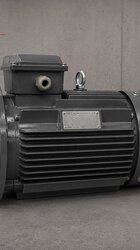
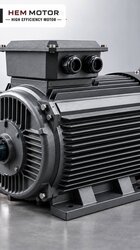
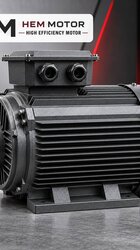
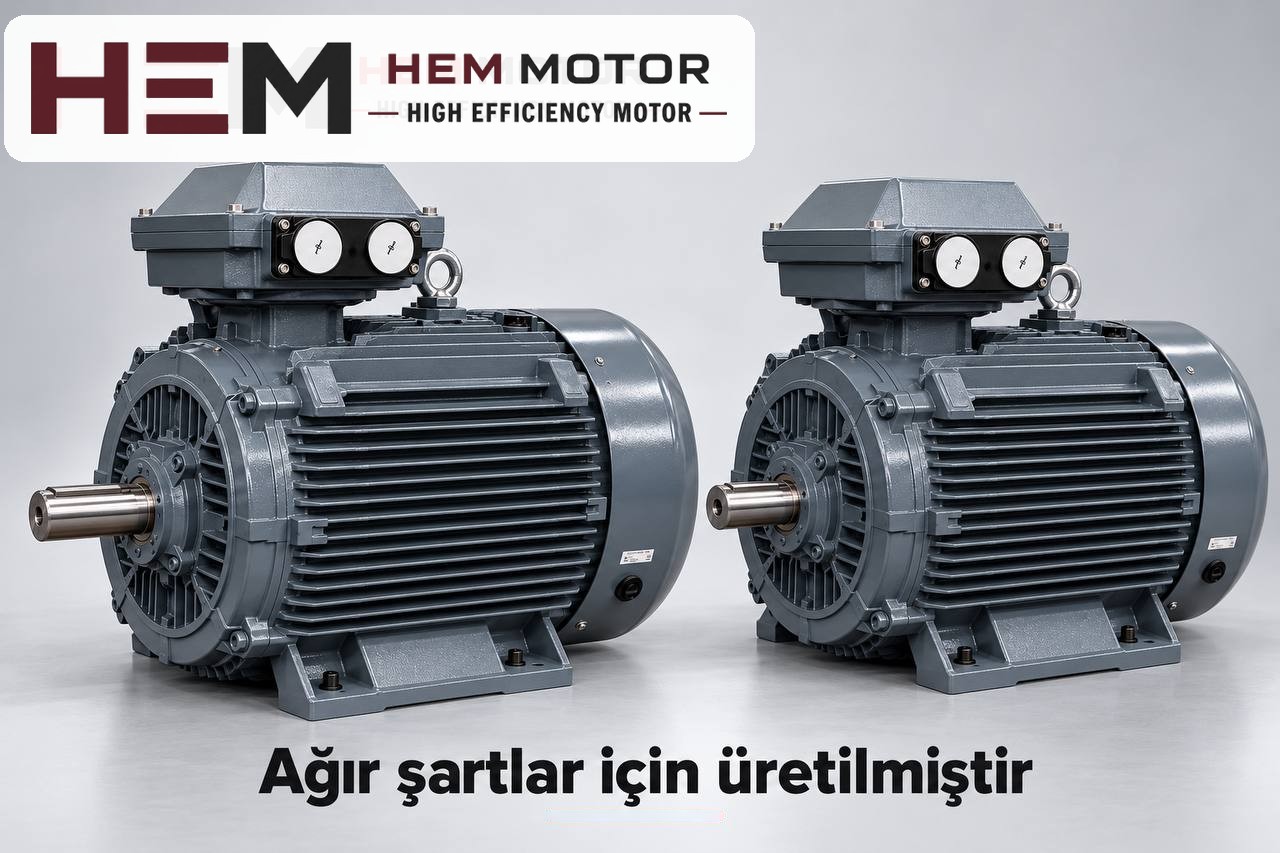
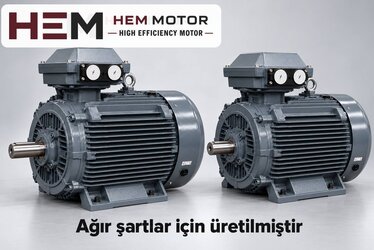
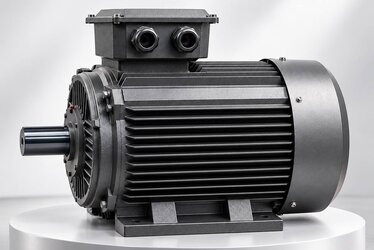
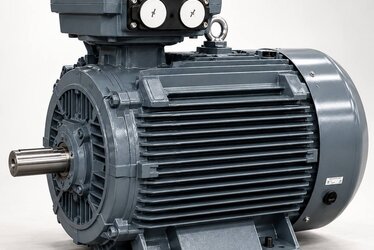
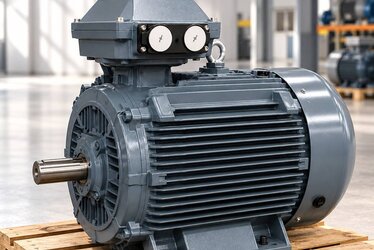
At the same power, 4-pole and 6-pole motors may have different frames and speeds (representative image).
The torque that pulls the belt comes from the gearbox output, not the motor
On a conveyor, the torque on the drum shaft depends on the power transmitted and the drum speed. If the drum speed is fixed for the same belt speed and the motor power is the same, the torque at the gearbox output also stays the same; the small difference comes only from gearbox efficiency. The rated torque on the shaft of a 6-pole motor is higher, but because this motor works with a lower-ratio gearbox, it does not turn into an advantage at the output.
The comparison below is a hypothetical example. Suppose a belt with a drum speed of about 48 rpm needs 4 kW. With a 4-pole motor at 1,450 rpm the required ratio is about 30, and with a 6-pole motor at 968 rpm about 20. In both cases the theoretical torque at the gearbox output stays at around 800 Nm, which corresponds to 4,000 W at 48 rpm.
Value (4 kW, HEM Motor catalogue data)
112M-4 (4 poles)
132M1-6 (6 poles)
Rated speed
1,450 rpm
968 rpm
Rated torque (motor shaft)
26.3 Nm
39.5 Nm
IEC frame
112M
132M
Rated current (400 V)
7.95 A
8.99 A
Ratio required for a 48 rpm drum (hypothetical)
≈ 30
≈ 20
The table also shows that at the same power the 6-pole motor is one frame size larger and draws slightly more rated current. This must be taken into account when selecting fuses, thermal relays and cables.
What changes on the gearbox side?
The main effect of the choice is on the gearbox. The consequences of the two approaches can be listed as follows:
Ratio: With a 6-pole motor the same drum speed is reached with a smaller ratio. At very low drum speeds this can mean one gearbox stage fewer or a shorter gearbox.
Gearbox size: Gearbox size is determined mainly by output torque. Since output torque is the same in both cases, the gearbox housing often stays similar; the input side changes according to the motor flange.
Input flange: At 4 kW the 4-pole motor is in a 112M frame and the 6-pole motor in a 132M frame. Since the gearbox input is made for an IEC flange, if the number of motor poles changes, the input flange and shaft bushing change too.
Efficiency of worm gearboxes: In this type of gearbox, efficiency generally falls as the ratio increases. Working with a smaller ratio may reduce losses somewhat; the exact value is read from the gearbox manufacturer's table.
If the motor is being replaced on an existing conveyor
On a working conveyor the rule is simple: do not change the number of poles. The gearbox was selected for the old motor's speed. If a 6-pole motor is fitted instead of a 4-pole one, the belt slows by about one third; if the reverse is done, the belt speeds up and both capacity and material flow change. On top of that, flange and shaft dimensions may not match.
If the rated speed on the old motor's nameplate is around 1,400–1,460 rpm it is a 4-pole motor; if around 930–980 rpm, a 6-pole motor.
If the number of poles stays the same, small differences between the rated speeds of different manufacturers do not noticeably change belt speed.
The frame code of the old motor should be compared with that of the new one. A different frame at the same power means a different flange and shaft; you can compare the dimensions in the frame dimensions table and the 2D technical drawings.
Prices and technical data are on the product pages; choose a model and order online.
On a conveyor designed from scratch, the following questions guide the decision between the two options:
How low is the drum speed? At very low speeds the ratio required with a 4-pole motor rises; if it cannot be reached in one stage, a 6-pole motor can save a stage.
Are there space and weight limits? At the same power, a 4-pole motor is generally one frame size smaller; mounting in tight spaces becomes easier.
What is the spare stock at the plant? If the plant has many 4-pole motors in the same frame, staying with the same number of poles makes spare parts and equivalents easier to find.
Electrical side: At the same power, the 6-pole model's rated current is slightly higher; on long cable runs this is reflected in the voltage drop calculation.
Price: A larger frame at the same power also affects motor cost. Compare current prices on the product pages of both models.
If belt speed needs to be adjusted during operation, a frequency inverter can be considered regardless of the pole choice. Our three-phase series are suitable for speed control with a frequency inverter; for long periods of full-torque operation at low speed an external fan may be required, and if the cable between drive and motor is long a dv/dt or sine filter is considered; these conditions are stated with the order. Rather than running the motor at a very low frequency for long periods with a drive, choosing a gearbox with a suitable ratio is generally safer in terms of cooling.
Example models for low-speed conveyors
Example cast iron frame pairs for comparing 4-pole and 6-pole motors at the same power:
100L1-4: 2.2 kW, 4 poles, 1,450 rpm, IEC 100L, 230/400 V, rated torque 14.5 Nm, rated current 4.52 A.
112M-6: 2.2 kW, 6 poles, 955 rpm, IEC 112M, 230/400 V, rated torque 22 Nm, rated current 5.09 A.
112M-4: 4 kW, 4 poles, 1,450 rpm, IEC 112M, 400/690 V, rated torque 26.3 Nm, rated current 7.95 A.
132M1-6: 4 kW, 6 poles, 968 rpm, IEC 132M, 400/690 V, rated torque 39.5 Nm, rated current 8.99 A.
Review suitable HEM Motor models and current prices on the buy electric motors page. General information on geared drives is on the electric motors for gearboxes page. For motors to be connected to a gearbox by flange, the mounting arrangement is offered according to the frame and the flange size is confirmed with the order.
Conclusion and what is needed for a quotation
On a low-speed conveyor, choosing 4 or 6 poles does not change the belt pull; it changes the gearbox ratio, the motor frame, the current and compatibility with the existing drive. On an existing conveyor, keep the number of poles; in a new design, decide according to drum speed, space, spare stock and gearbox stages. For a quotation we need the power, the required drum speed or belt speed, the gearbox type and ratio, the mounting arrangement, the voltage and the current motor nameplate.
You can see suitable models and current prices in our online sales section. Send the nameplate photo, speed and mounting details of your current motor through the send nameplate page and request a quotation for the suitable model. To consult us on the selection, reach us via our contact page.
Frequently Asked Questions
Does a 6-pole motor pull the conveyor more strongly?
Not at the same power and the same drum speed. The torque on the motor shaft is higher, but because the gearbox ratio is smaller, output torque stays almost the same.
What happens if I fit a 6-pole motor instead of a 4-pole motor on a conveyor?
If the gearbox is not changed, the belt slows by about one third. In addition, at the same power a 6-pole motor is often one frame size larger, and the flange and shaft may not match.
Why does a 6-pole motor draw more current at the same power?
As the number of poles increases, the motor's electrical characteristics change for the same power; in catalogue data, too, the 6-pole model's rated current is slightly higher at the same power. Protection and cables are selected accordingly.
For low speed: a frequency inverter or a 6-pole motor?
If a constant low speed is needed, a gearbox with a suitable ratio and the right number of poles is enough. If the speed must vary, a drive is added; for long periods of full-torque operation at low frequency an external fan may be required.
HEM Motor Models Related to This Article
The cards show example models related to the topic. A suitable motor is not chosen by power alone: compare speed, voltage, mounting, shaft and connection dimensions on the product page; if unsure, send a photo of the existing motor’s nameplate on WhatsApp.
When choosing a replacement for a three-phase motor whose nameplate shows HP (horsepower), the right approach is to convert the HP value to kW and fit it to a standard kW rating: 1... More Details
For a 160 kW three-phase asynchronous electric motor, the frame choice depends on speed: in the HEM Motor 2026 catalog, the 2-pole and 4-pole 160 kW models use a 315L frame, while ... More Details
With a 132 kW three-phase asynchronous electric motor, the real work begins after the motor has been chosen: if the cable, switchgear and transformer capacity feeding a load that d... More Details
When choosing a 90 kW three-phase asynchronous electric motor, the first decision is the speed; frame, current, torque and even the base preparation follow from that decision. In H... More Details
On a thickness planer, what determines main motor power is the volume of chips removed in a pass: the amount of wood removed per minute, obtained by multiplying board width, depth ... More Details
When buying a motor in the 110 kW class, choosing the speed is a decision about the driven system more than about the motor itself. At the same power, 1,000, 1,500 and 3,000 rpm mo... More Details
We use necessary and optional cookies to improve your experience, enhance content and analyse traffic. Under the GDPR, optional (analytics/marketing) cookies are only used with your explicit consent. Please choose your preference below.
Cookie Policy
 English
 Français
 Türkçe
 Español
 Русский