English
 Français
 Türkçe
 Español
 Русский



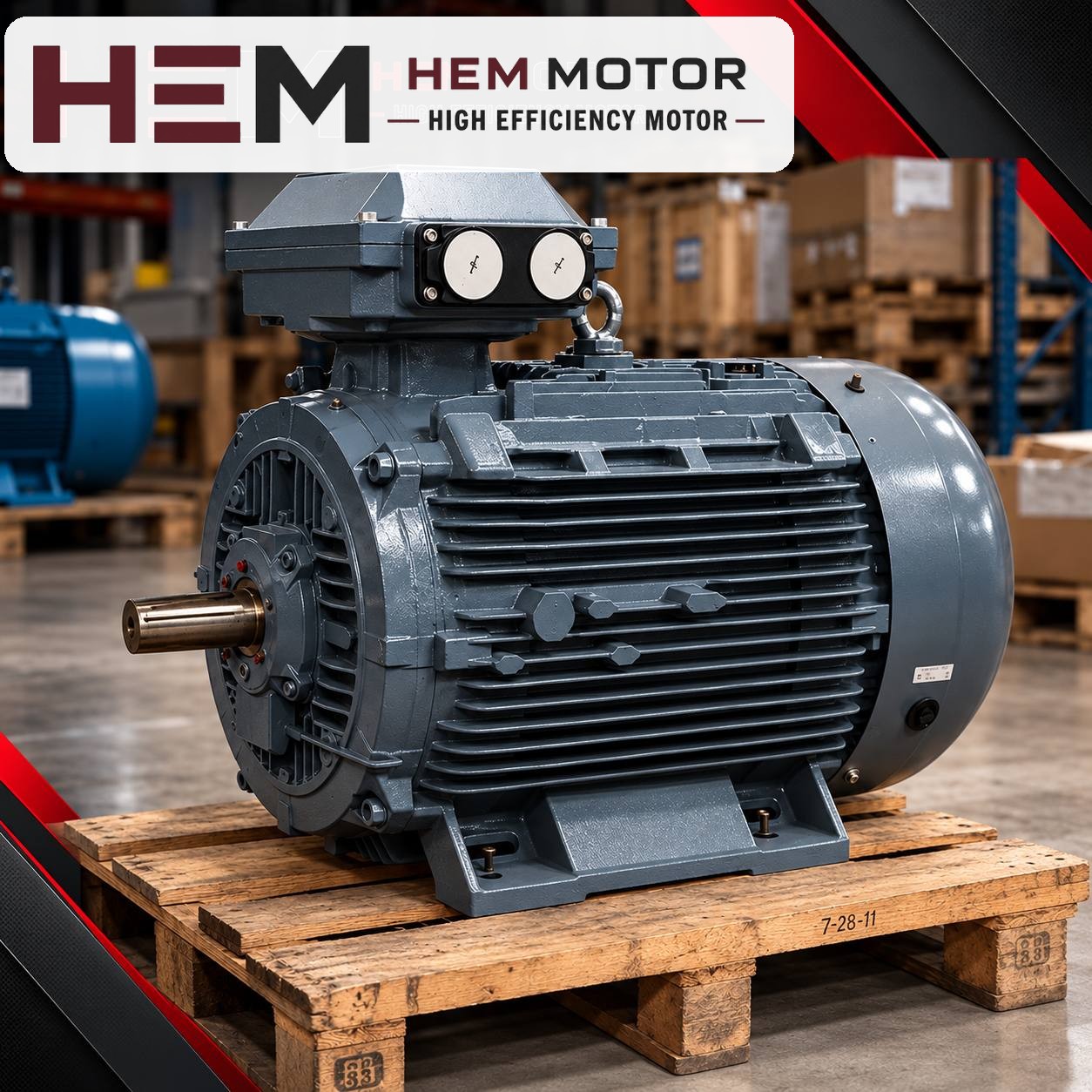

In a plansifter the sieve box does not rotate; it performs a circular oscillation in the horizontal plane, and this motion is produced by an eccentric counterweight turned by the motor. That is why the main criterion when selecting a plansifter motor is to accelerate a heavy, suspended mass safely and to keep the oscillation speed unchanged. When replacing the motor, the same synchronous speed, the same pulley ratio and the same mounting arrangement must be kept; power or speed is not changed "so that it sieves a little better".
What does the plansifter's sieving mechanism require from the motor?
A plansifter is a large box made of sieve frames stacked on top of each other. The box is suspended from the ceiling or a frame by flexible rods or cables. A counterweight sits on a vertical shaft in the middle of the box. The motor usually drives this shaft via belt and pulley; the centrifugal force of the weight moves the box along a circular path. On each sieve level the product spreads out with this oscillation, the fine fraction passes to the level below and the coarse fraction is separated through channels.
In this design three things determine the motor:
- Oscillation speed: The number of revolutions per minute of the sieve box, a design value set by the machine manufacturer. It comes from the motor speed multiplied by the pulley ratio.
- Counterweight and oscillation amplitude: Centrifugal force increases with the square of the speed. A small increase in speed disproportionately increases the force on the suspension rods and the frame.
- Inertia of the suspended mass: A loaded sieve box is heavy; at start-up the motor brings this mass from standstill to operating speed.
Speed: why does it have to be "the same"?
Increasing the oscillation speed of a plansifter does not by itself increase sieving capacity. The product's residence time on the sieve surface is shortened, sieve wires and frames are stressed more, and fatigue in the suspension rods accelerates. Lowering the speed, on the other hand, can cause product to accumulate on the sieve and spoil the separation. Changing the oscillation speed is a process decision and should not be made without the machine manufacturer's approval.
For this reason, the most important piece of information in a motor replacement is the synchronous speed of the old motor. Fitting a 1,000 rpm model in place of a motor rated at 1,500 rpm lowers the oscillation speed by about one third with the same pulley. A difference of a few rpm between the rated speed on the nameplate (for example 1,445 rpm) and the rated speed of the new motor is normal and has practically no effect on the oscillation. A different number of poles, however, does.
Check the pulley ratio
If the pulley has been changed or the old motor's nameplate is illegible, measure the pulley diameters, calculate the oscillation speed and compare it with the value in the machine's catalogue. Belt tension also matters: a loose belt slips at start-up and the oscillation speed drops under load.
Starting and stopping: passing quickly through resonance
The suspended sieve box coincides with its natural frequency at a certain low speed. When passing through this range during starting and stopping, the box swings more widely than usual; this is what is described on site as "the machine shakes when it starts". Staying in this range for a long time strains the suspension rods and the connections.
- Direct-on-line starting: The motor accelerates with full torque and passes quickly through the resonance range. If the supply allows, it is the simplest method at low power ratings.
- Star-delta starting: In star, the starting torque falls to about one third. With a heavy box, acceleration takes longer; a current and torque surge occurs at the changeover. The timer setting must suit the machine.
- Frequency inverter: Provides controlled starting and stopping with a ramp. The ramp must be set so that it does not linger in the resonance range. HEM Motor's three-phase series are suitable for speed control with an inverter; if the inverter-motor cable is long, a dv/dt or sine filter is considered, and these conditions are stated with the order.
When the motor is switched off, the box slows down under its own inertia. Some machines use a brake to shorten the stop; a brake motor is not considered the same as a standard motor and is a matter for a special order.
Motor mounting and ambient conditions
On plansifters the motor is mostly fixed to the machine frame and drives via a belt. In some designs the motor is vertical. Mounting arrangements (B3, B5, B14, B34, B35 and vertical V1/V3/V5/V6/V15) are offered according to the frame; the flange size is confirmed with the order. For vertical mounting, the side load created by the belt and the shaft direction must be stated in the order. For dimensions, see the 2026 technical and product catalogue.
Flour and semolina dust builds up on the motor fins and weakens cooling. IP55 protection guards against dust ingress, but the frame and fan cover must be cleaned regularly. If your plant has a zone classification for dust explosion risk, a special Ex-protected motor is required in that zone; such motors may fall outside the scope of the standard series in HEM Motor's 2026 catalogue. Always share the classification information with the order.