Electric Motor for a Cone Crusher: Drive Arrangement and Spare Unit Compatibility

Electric Motor for a Cone Crusher: Drive Arrangement and Spare Unit Compatibility

The electric motor of a cone crusher usually drives the crusher's countershaft (pinion shaft) by V-belt; the compatibility of a spare motor is therefore checked starting from this belt arrangement, the direction of rotation and the lubrication interlock. Power and speed are set according to the crusher manufacturer's data; when the spare motor has the same power, the same number of poles and the same frame as the old one, the pulley, slide rails and control panel remain unchanged. This article explains the drive arrangement of a cone crusher and the points to check when choosing a spare motor.
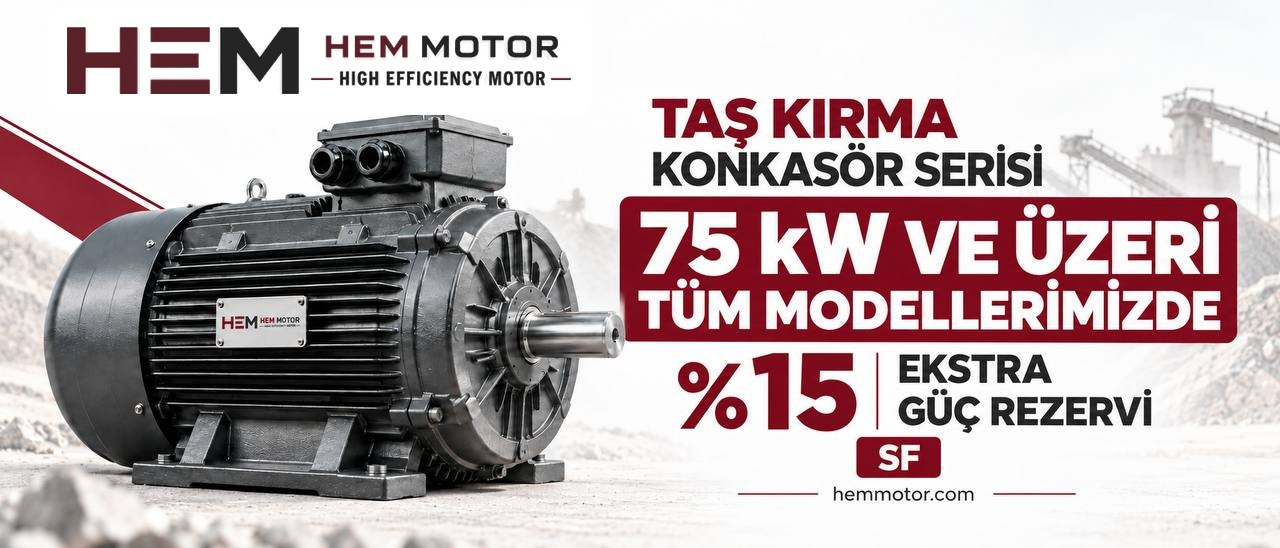
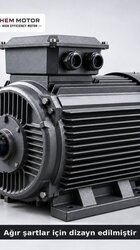
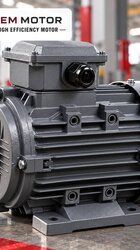
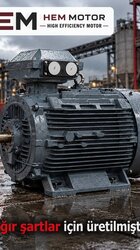
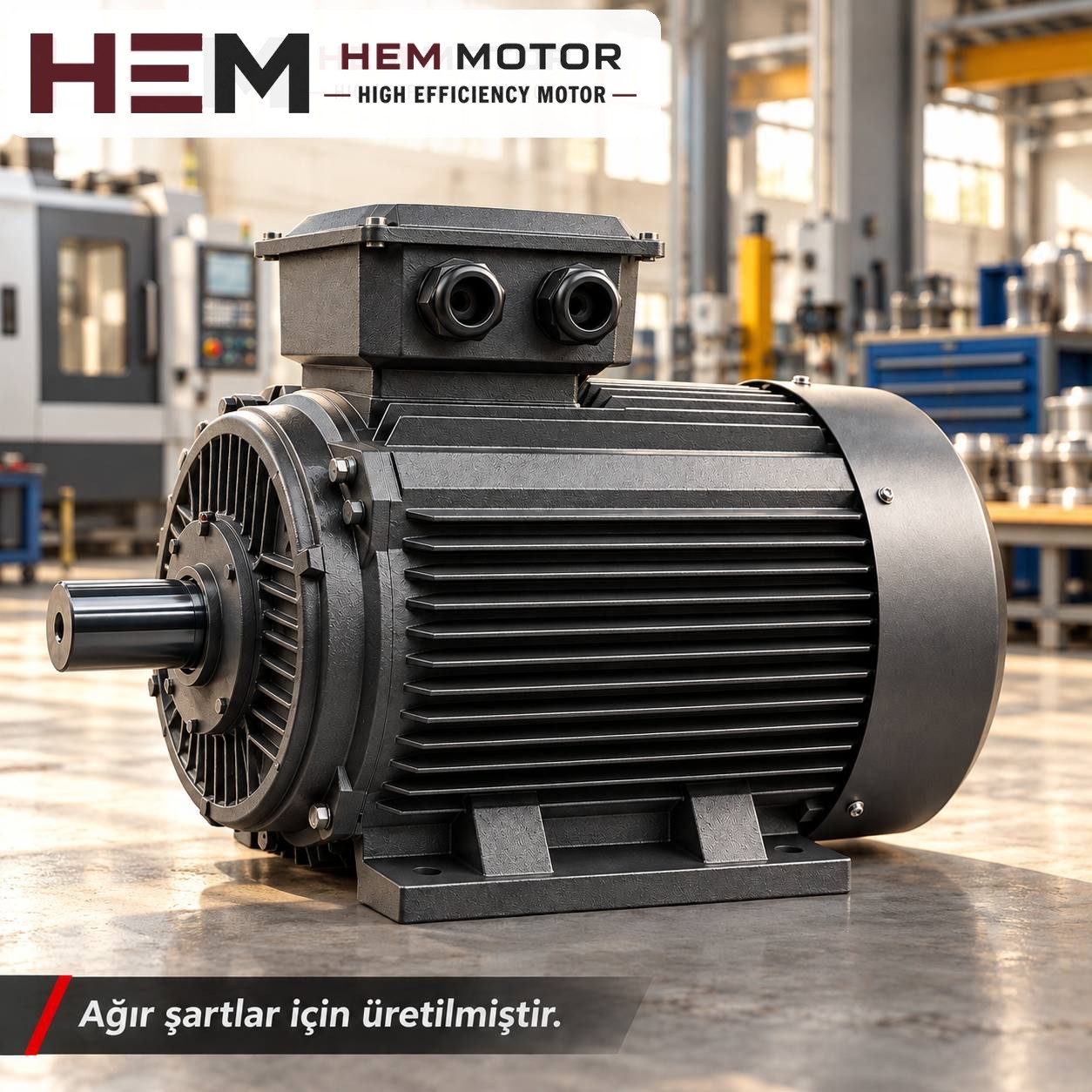
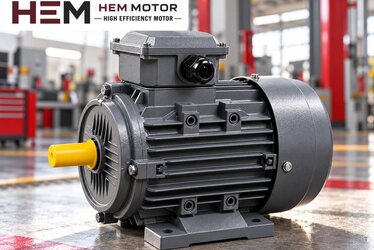
HEM Motor stone crushing and crusher series promotional image
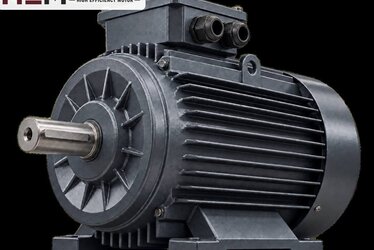
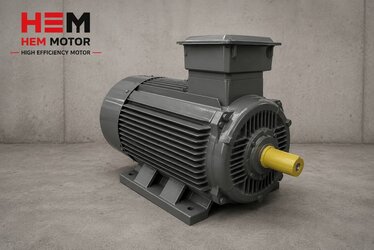
Models of 75 kW and above have a service factor of 1.15; this value is a safety margin (representative image).

How is power transmitted in a cone crusher?

In a cone crusher, crushing takes place between the mantle (inner cone), which gyrates with an eccentric motion, and the fixed outer liner (concave). The motor does not produce this eccentric motion directly; power is transmitted in this order:

  • Motor and motor pulley: The motor sits next to the crusher on slide rails or an adjustable base.
  • V-belt set: A multi-groove belt carries power to the crusher's countershaft pulley.
  • Countershaft and bevel gear: The countershaft turns the eccentric bushing through a bevel gear pair.
  • Eccentric and main shaft: The eccentric sets the mantle into gyration; the material is crushed by this motion.

In some plants the motor is also connected to the countershaft with a flexible coupling. However, the most common arrangement on site is belt-driven; the belt partly damps the shocks in the crusher before they reach the motor, and the crusher speed can be adjusted with the pulley ratio.

Crusher speed and pulley ratio

In a cone crusher, countershaft speed directly affects product size and capacity; that is why the crusher manufacturer specifies a given speed range. Countershaft speed comes from the motor speed and the ratio of the pulley diameters: countershaft speed = motor speed × motor pulley diameter ÷ crusher pulley diameter.

For this reason, the spare motor must have the same number of poles as the old one. Crushers most often use 4-pole (1,500 rpm class) motors; some plants prefer 6-pole motors. If the number of poles changes, the crusher speed also changes with the same pulleys; product size shifts and gears and bearings run outside their design speed. If a speed change is needed, it must be done with the crusher manufacturer's approval and by changing pulleys.

A hypothetical check

The values are only meant to show the method. With a 4-pole motor (rated 1,486 rpm), a 315 mm motor pulley and a 900 mm crusher pulley, the countershaft turns at about 1,486 × 315 ÷ 900 ≈ 520 rpm. If the spare motor's rated speed differs by a few rpm, the countershaft speed practically does not change. But if a 6-pole motor (about 985 rpm) is fitted to the same arrangement, the countershaft drops to about 345 rpm; this may fall outside the crusher's operating range.

Direction of rotation and lubrication interlock

On most cone crushers the direction of rotation of the countershaft is set by the manufacturer and shown by an arrow on the crusher body. Running in the wrong direction can lead to mechanical problems such as the nut that holds the mantle working loose. After the spare motor is connected, a short jog should be made without the belts fitted and the direction compared with the arrow. If the direction is wrong, two phases are swapped.

Cone crushers usually have a separate lubrication unit. The control panel does not allow the main motor to run until oil pressure and temperature are suitable. This interlock works together with the main motor's connection in the panel; when replacing the motor, the interlock circuit must not be touched, and during commissioning it must be confirmed that the lubrication unit starts first. The lubrication pump motor is a separate small motor; it is also assessed separately according to its nameplate.

Starting and load: starting with a full crusher

In normal operation a cone crusher starts empty and the feed is opened afterwards. However, after a power cut or an emergency stop, the crushing chamber may remain full of material. In that case the motor has to turn the full crusher and the heavy flywheel together; the start takes longer and the current stays high for a long time.

  • Star-delta: Common for empty starts; because starting torque drops, it may be insufficient for a full crusher.
  • Soft starter: Reduces starting shock and current; if a full start is required, its settings must be made accordingly.
  • Frequency inverter: Provides a controlled start and speed adjustment; some plants use it to set the crusher speed according to the product.

In plants where a full start is possible, not attempting a start without emptying the chamber is the safest operating practice. This article covers starting in general terms; the real question affecting motor selection is which method the old motor ran with. For star-delta starting on a 400 V supply, the motor nameplate must read 400/690 V (Δ/Y); the models of 4 kW and above on sale are offered with this rating.
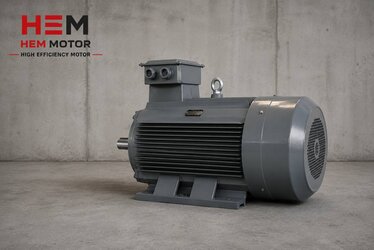
Prices and technical data are on the product pages; choose a model and order online.

Checklist for spare motor compatibility

The cone crusher is usually the most critical machine in the plant, and a long stoppage halts production. That is why the spare motor should be chosen in advance, with the old motor's data, not at the moment of failure. Points to check:

CheckWhat is done?
Power and number of polesA model with the same kW and speed as on the old motor's nameplate is chosen.
IEC frame codeThe same frame code makes it easier to match slide rail holes and shaft height.
Shaft end and pulleyThe pulley hub must fit the new shaft; the pulley must not overhang on the motor side.
Belt alignment and tensionThe pulleys must be in the same plane; tension is readjusted with the slide rails.
Voltage and startingThe nameplate voltage must suit the method in the panel.
Direction of rotationIt is compared with the arrow on the crusher body.
Protection settingThermal protection is set to the new motor's nameplate current.

In a belt drive, the closer the pulley is fitted to the end of the motor shaft, the lower the load on the motor bearing. A wide multi-groove pulley must not be fitted overhanging the shaft end. You can compare dimensions in the 2D technical drawings.

You can browse suitable HEM Motor models and current prices in the buy electric motors section.

Interpreting service factor 1.15 correctly

All HEM Motor models of 75 kW and above have a service factor of 1.15. This means the motor carries a safety margin against short-term loading of about 15% above its rated power. In crushers, this margin gives the operation some breathing room in situations such as hard material, a sudden increase in feed or a brief jam.

However, the service factor should not be used to select a smaller motor. If the crusher's continuous demand is 132 kW, choosing a 110 kW motor because "the SF will cover it" makes the motor run permanently within its reserve and shortens winding life. The right approach is to select the motor according to the crusher's rated demand and leave the reserve for unexpected loads. Other information specific to crushing plants is on the stone crushing plant electric motors page.

Example models for cone crushers

On cone crushers the motor power varies with the size and manufacturer of the crusher; the exact value is taken from the crusher nameplate or manual. The 4-pole cast iron models below are examples of powers found on crushers of this class. All are 400/690 V (Δ/Y), 50 Hz, IP55, class F insulation and SF 1.15:

  • 280M-4: 90 kW, 4 poles, rated 1,486 rpm, IEC 280M, 155 A (400 V), rated torque 578.4 Nm.
  • 315M-4: 132 kW, 4 poles, rated 1,488 rpm, IEC 315M, 224 A (400 V), rated torque 847.2 Nm.
  • 315L2-4: 200 kW, 4 poles, rated 1,490 rpm, IEC 315L, 334 A (400 V), rated torque 1,282 Nm.

When moving from a 280 frame to a 315 frame, the shaft height and foot spacing change; moving to a more powerful model means rebuilding the slide rail and pulley arrangement. The current price is on the product pages.

Conclusion and order information

When a spare motor for a cone crusher is chosen with the same power, the same number of poles and the same frame, the pulley, slide rails and panel remain as they are. The direction of rotation and the lubrication interlock must be checked during commissioning. For a quotation, send us:

  • A photo of the old motor's nameplate and the crusher make/model
  • Pulley diameters, belt type and a photo of the slide rails
  • Starting method (star-delta, soft starter, drive)
  • Likelihood of a full start and the operating environment (open site, dust, temperature)

You can see suitable models and current prices in our online sales section. Send the nameplate photo, speed and mounting details of your current motor through the nameplate submission page and request a quotation for the right model.

Frequently Asked Questions

Does fitting a more powerful motor to a cone crusher increase capacity?

Not directly. Capacity is set by the crusher's size, speed, setting and feed; a more powerful motor only adds a power reserve and does not change the crusher's mechanical limits.

Why does the direction of rotation of the spare motor matter?

On most cone crushers the direction of the countershaft is set by the manufacturer. The wrong direction can cause mechanical problems; the direction should be compared with the arrow on the body before fitting the belts.

Can I choose a motor one size smaller because SF is 1.15?

Not recommended. The service factor is a safety margin for unexpected loads; the motor should be selected according to the crusher's continuous demand.

Do I need to touch the lubrication unit when replacing the motor?

Usually not, but during commissioning it should be checked that the lubrication interlock in the panel works correctly together with the main motor.

HEM Motor Models Related to This Article

The cards show example models related to the topic. A suitable motor is not chosen by power alone: compare speed, voltage, mounting, shaft and connection dimensions on the product page; if unsure, send a photo of the existing motor’s nameplate on WhatsApp.

90 kW 1500 rpm Cast Iron Frame Electric Motor 280M-4

280M-4

90 kW · 1500 rpm

  • Cast iron frame · IEC 280M
  • 1486 rpm · IP55
  • Mounting: B3 foot; flange (B5/B14/B35) depending on frame — confirmed with the order

US$3,247.73 (€2,898.37)

View product
132 kW 1500 rpm Cast Iron Frame Electric Motor 315M-4

315M-4

132 kW · 1500 rpm

  • Cast iron frame · IEC 315M
  • 1488 rpm · IP55
  • Mounting: B3 foot; flange (B5/B14/B35) depending on frame — confirmed with the order

US$5,585.88 (€4,985.02)

View product
200 kW 1500 rpm Cast Iron Frame Electric Motor 315L2-4

315L2-4

200 kW · 1500 rpm

  • Cast iron frame · IEC 315L
  • 1490 rpm · IP55
  • Mounting: B3 foot; flange (B5/B14/B35) depending on frame — confirmed with the order

US$7,070.27 (€6,309.74)

View product

Similar Articles